
|
SECURITIES
AND EXCHANGE COMMISSION
|
Washington,
D.C. 20549
FORM
10-K
(Mark
One)
|
|
þ
|
ANNUAL REPORT PURSUANT TO
SECTION 13 OR 15 (d) OF THE SECURITIES EXCHANGE ACT OF
1934
|
For
the Fiscal Year Ended December 31, 2008
or
|
|
¨
|
TRANSITION
REPORT PURSUANT TO SECTION 13 OR 15 (d) OF THE SECURITIES EXCHANGE ACT OF
1934
|
For
the transition period
from to
Commission
File Number 1-8036
WEST
PHARMACEUTICAL SERVICES, INC.
(Exact
name of registrant as specified in its charter)
|
Pennsylvania
|
23-1210010
|
|
(State
or other jurisdiction of
incorporation
or organization)
|
(I.R.S.
Employer Identification Number)
|
|
101
Gordon Drive, PO Box 645,
Lionville,
PA
|
19341-0645
|
|
(Address
of principal executive offices)
|
(Zip
Code)
|
Registrant’s
telephone number, including area code: 610-594-2900
Securities
registered pursuant to Section 12(b) of the Act:
|
Title
of each class
|
Name
of each exchange on which registered
|
|
Common
Stock, par value $.25 per share
|
New
York Stock Exchange
|
Securities
registered pursuant to Section 12 (g) of the Act:
None
Indicate
by check mark if the registrant is a well-known seasoned issuer, as defined in
Rule 405 of the Securities Act.
Yes þ No o
Indicate
by check mark if the registrant is not required to file reports pursuant to
Section 13 or Section 15(d) of the Act.
Yes o No þ
Indicate
by check mark whether the registrant (1) has filed all reports required to be
filed by Section 13 or 15 (d) of the Securities Exchange Act of 1934 during the
preceding 12 months (or for such shorter period that the registrant was required
to file such reports), and (2) has been subject to such filing requirements for
the past 90 days. Yes þ No o
Indicate
by check mark if disclosure of delinquent filers pursuant to Item 405 of
Regulation S-K is not contained herein, and will not be contained, to the best
of registrant’s knowledge, in definitive proxy or information statements
incorporated by reference in Part III of this Form 10-K or any amendment to this
Form 10-K. o
Indicate
by check mark whether the registrant is a large accelerated filer, an
accelerated filer, a non-accelerated filer, or a smaller reporting
company. See the definitions of “large accelerated filer,”
“accelerated filer” and “smaller reporting company” in Rule 12b-2 of the
Exchange Act.
|
Large
accelerated filer
|
þ
|
Accelerated
filer
|
o
|
|
|
Non-accelerated
filer
|
o
|
(Do
not check if a smaller reporting company)
|
Smaller
reporting company
|
o
|
Indicate
by check mark whether the registrant is a shell company (as defined in rule
12b-2 of the Exchange Act). Yes o No þ
The
aggregate market value of the voting stock held by non-affiliates of the
registrant as of June 30, 2008 was approximately $1,403,459,343 based on the
closing price as reported on the New York Stock Exchange.
As of
January 31, 2009, there were 32,735,943 shares of the registrant’s common stock
outstanding.
DOCUMENTS
INCORPORATED BY REFERENCE
|
Document
|
Parts Into Which
Incorporated
|
|
Proxy
Statement for the Annual Meeting of Shareholders to be held May 5,
2009
|
Part
III
|
1
|
Page
|
|
|
PART I
|
|
|
3
|
|
|
3
3
3
4
6
6
7
7
7
7
7
8
8
8
9
|
|
|
9
|
|
|
13
|
|
|
14
|
|
|
15
|
|
|
15
|
|
|
15
|
|
|
PART
II
|
|
|
17
|
|
|
19
|
|
|
21
|
|
|
39
|
|
|
41
|
|
|
74
|
|
|
74
|
|
|
74
|
|
|
PART
III
|
|
|
75
|
|
|
75
|
|
|
75
|
|
|
76
|
|
|
76
|
|
|
PART
IV
|
|
|
77
|
PART I
West
Pharmaceutical Services, Inc. (which may be referred to as West, the Company, we, us or our) is a manufacturer of
components and systems for injectable drug delivery and plastic packaging and
delivery system components for the healthcare and consumer products
industries. Our products include stoppers and seals for vials and
components used in syringe, intravenous and blood collection
systems. Our customers include the world’s leading pharmaceutical,
biotechnology and medical device producers. The Company was
incorporated under the laws of the Commonwealth of Pennsylvania on July 27,
1923.
All
trademarks and registered trademarks used in this report are the property of
West Pharmaceutical Services, Inc., unless noted otherwise. Exubera® is a
registered trademark of Pfizer, Inc. Teflon® is a registered trademark of E.I.
DuPont de Nemours and Company. Crystal Zenith® is a registered trademark of
Daikyo Seiko, Ltd.
West
maintains a website at www.westpharma.com. Our
Annual Report on Form 10-K, Quarterly Reports on Form 10-Q, Current Reports on
Form 8-K and amendments to those reports filed or furnished pursuant to Section
13(a) or 15(d) of the Securities Exchange Act of 1934 are available on our
website under the Investors –
SEC Filings caption as soon as reasonably practical after we
electronically file the material with, or furnish it to, the Securities and
Exchange Commission (SEC). These filings are also available to the public over
the Internet at the SEC’s website at www.sec.gov. You may also
read and copy any document we file at the SEC’s Public Reference Room at 100 F.
Street, N.E., Washington, D.C. 20549. Please call the SEC at
1-800-SEC-0330 for further information on the Public Reference
Room.
Throughout
this Form 10-K, we “incorporate by reference” certain information from parts of
other documents filed with the SEC and from our Proxy Statement for the 2009
Annual Meeting of Shareholders (2009 Proxy Statement), which will be filed with
the SEC within 120 days following the end of our 2008 fiscal
year. Our 2009 Proxy Statement will be available on our website on or
about March 31, 2009, under the caption Investors — Proxy
Materials.
Information
about our corporate governance, including our Corporate Governance Principles
and Code of Business Conduct, as well as information about our Directors, Board
Committees, Committee Charters, and instructions on how to contact the Board, is
available on our website under the Investors — Corporate Governance
caption. Information relating to the West Pharmaceutical Services
Dividend Reinvestment Plan is also available on our website under the Investors — Dividend Reinvestment
Program caption. We will provide any of the foregoing
information without charge upon written request to John R. Gailey III, Vice
President, General Counsel and Secretary, West Pharmaceutical Services, Inc.,
101 Gordon Drive, Lionville, Pennsylvania 19341.
We have
two reportable segments: Pharmaceutical Systems and Tech
Group. Comparative segment revenues and related financial information
for 2008, 2007 and 2006 are presented in a table contained in Note 5 to our
consolidated financial statements, Segment Information, and are
discussed within Results of
Operations in the Management’s Discussion and Analysis
of Financial Condition and Results of Operations section of this 2008
Form 10-K. Intersegment sales are eliminated in consolidation.
Our
Pharmaceutical Systems segment designs, manufactures and sells a variety of
packaging components and systems used in parenteral drug delivery for the
pharmaceutical, biopharmaceutical and generic industries. The primary
components we manufacture are subject to regulatory oversight within our
customers’ manufacturing facilities. We have manufacturing facilities
in North and South America, Europe and Asia Pacific, with affiliated companies
in Mexico and Japan. See Item 2, Properties, for additional
information on our manufacturing sites.
Our
Pharmaceutical Systems segment consists of two operating segments — Americas and
Europe/Asia Pacific — which are aggregated for reporting purposes because they
have similar economic characteristics, as well as similar products,
manufacturing processes, customer objectives, distribution procedures and
regulatory requirements.
Our
Pharmaceutical Systems business is composed of the following product
lines:
Pharmaceutical
packaging
|
·
|
Elastomeric
stoppers and discs, which serve as primary closures for pharmaceutical
vials.
|
|
·
|
Secondary
closures for pharmaceutical vials called Flip-Off® aluminum seals,
consisting of an aluminum seal and removable plastic button, and in some
applications, just an aluminum
seal.
|
|
·
|
Elastomeric
plungers, needle shields and tip caps to fit most standard prefilled
syringes and combination seals for dental cartridges and pen delivery
systems.
|
|
·
|
Pharmaceutical
containers, closures and
dispensers.
|
|
·
|
Enhanced
component processing: VeriSure™, Westar® RS (ready-to-sterilize) and
Westar® RU (ready-to-use).
|
Disposable medical
components
|
·
|
Elastomeric
components for blood collection systems and flashback bulbs, injection
sites and sleeve stoppers for intravenous (IV) dispensing
systems.
|
|
·
|
Elastomer
and co-molded elastomer/plastic components for infusion and IV
systems.
|
|
·
|
Non-filled
syringe components.
|
|
·
|
Dropper
bulbs for applications such as eye, ear and nasal drops, diagnostic
products and dispensing systems.
|
Safety and
administration
|
·
|
Sterile
devices for the reconstitution, transfer and administration of drug
products, including patented products such as the Mixject™, Mix2Vial™ and
Vial Adapters.
|
Laboratory and other
services
|
·
|
Extractables
and leachables testing, package/container testing, method
development/validation, stability testing, process development and problem
resolution.
|
Products
and services recently brought to market are the Daikyo Crystal Zenith® luer lock
syringe, Envision™ and the West Ready Pack™ system. The Daikyo Crystal Zenith
syringe is the market’s first silicone-free, ready-to-use prefillable syringe
that offers pharmaceutical and biopharmaceutical companies a total system
solution that can mitigate the risks associated with glass syringes. West’s
Envision components (plungers and stoppers) are inspected by an automated vision
inspection system to ensure they meet enhanced quality specifications for
visible and subvisible particulate and contamination. The West Ready Pack system
is a one-source solution ideal for pharmaceutical research and development and
clinical work. Each system comes with West stoppers, Flip-Off seals and vials
conveniently packaged in small volumes. Because the components are delivered
ready-to-use, component preparation is eliminated from the customer’s
processing, saving them time and money.
Our
tamper-evident Flip-Off seals consist of a metal overseal and a molded plastic
cap that is removed in order to permit needle access to the drug-vial
contents. These are sold in a wide range of sizes and colors to meet
customers’ needs for product identification and differentiation. The seals can
be provided using proprietary printing and embossing technology for multiple
layers of protection, such as, point-of-use instructions, item-level information
such as vial contents, drug dosage and strength, and cautionary statements that
can serve as counterfeiting deterrence.
Elastomeric
components are offered in a variety of standard and customer-specific
configurations and formulations and are available with advanced barrier films
and coatings to enhance their performance. Our proprietary FluroTec®
coating is a film that is applied using a patented molding process to reduce the
risk of product loss by contamination, enhance seal integrity and protect the
shelf life of packaged drugs. We also apply a Teflon® coating to the surface of
stoppers and plungers to improve compatibility between the closure and the drug.
B2-Coating is a coating applied to the surface of stoppers and plungers using a
patented process that eliminates the need for conventional silicone application.
It helps manufacturers reduce product rejections due to trace levels of silicone
molecules found in non-coated packaged drug compounds. FluroTec and B2-Coating
technologies are licensed from Daikyo Seiko, Ltd.
Our
VeriSure components are an example of how laboratory services can be combined
with a product offering. These components allow pharmaceutical and
biopharmaceutical companies to navigate the complex task of extractables
identification and the related analysis for qualifying a drug product’s
container/closure system more efficiently. The customer will receive a
Certificate of Analysis with each shipment of components. Also, with a known
extractables profile, customers can begin the design of leachables studies on a
quicker basis, a process which our analytical laboratory services can
support.
In
addition, our post-manufacturing processes, Westar RS and Westar RU, are
documented and fully validated procedures for washing and siliconizing stoppers
and syringe components to remove biological materials and endotoxins. Westar RS
prepares components for introduction into the customer’s sterilizer and Westar
RU provides sterilized components. The Westar processes increase the overall
efficiency of injectable drug production by outsourcing component processing,
thereby eliminating steps otherwise required in each of our customers’
manufacturing processes, and assure compliance with the latest regulatory
requirements for component preparation.
Medimop
Medical Projects, Ltd. is a leader in the world market for transfer, mixing and
administration systems for injectable pharmaceuticals. Many injectable drug
products are produced as freeze-dried powders in order to preserve product
efficacy during shipment and storage. These products must be reconstituted,
typically by diluting the powder with sterile water or other diluent at the
point of use. All Medimop products marketed in the United States
(U.S.) are cleared by the U.S. Food and Drug Administration (FDA). In addition,
many Medimop products are protected by patents.
As an
adjunct to our Pharmaceutical Systems products, we offer contract analytical
laboratory services for testing and evaluating primary drug packaging components
and their compatibility with the contained drug formulation. West Analytical
Services provides us and our customers with in-depth knowledge and analysis of
the interaction and compatibility of drug products with elastomer, glass and
plastic packaging components. Our analytical laboratories also provide
specialized testing for complete drug delivery systems.
Our Tech
Group segment is a global custom injection molder with over 40 years of
experience, offering contract manufacturing solutions for the healthcare and
consumer industries. This segment has manufacturing operations in the U.S.,
Puerto Rico and Ireland. See Item 2, Properties, for additional
information on our manufacturing sites.
Our Tech
Group segment consists of two operating segments — Americas and Europe — which
are aggregated for reporting purposes because they have similar economic
characteristics, as well as similar products, manufacturing processes, customer
objectives, distribution procedures and regulatory requirements. The Tech
Group is committed to producing the highest quality injection molded components
and devices, which include unique components for surgical, ophthalmic,
diagnostic and drug delivery systems, such as contact lens storage kits, pill
dispensers and disposable blood collection systems, as well as various personal
care and consumer products. The Tech Group’s record of success includes
manufacturing and assembly of systems and devices used for nasal, oral,
pulmonary and injectable delivery of drugs used to treat diseases affecting the
lives of people around the world.
The Tech
Group segment also has expertise in product design and development, including
in-house mold design and construction, an engineering center for developmental
and prototype tooling, process design and validation and high-speed automated
assemblies. Technologies include multi-component molding, in-mold
labeling, ultrasonic welding and clean room molding and device
assembly.
Our
newest offering will be the ConfiDose® auto-injector system, a solution for
enhancing patient compliance and safety. The needle remains shielded at all
times and retracts automatically after the injection. The system eliminates
preparation steps and automates the injection of drugs, providing patients with
a sterile, single-use disposable system that can be readily used at home. The
Tech Group segment will be responsible for manufacturing and assembling
commercial quantities of this system.
In an
effort to align our plant capacity and workforce with the revised business
outlook, in December 2007, our Board of Directors approved a restructuring plan
for the Tech Group segment designed to reduce operating costs and increase the
manufacturing efficiency of the segment. We incurred a total of $6.4 million in
restructuring and related charges, as part of this plan, through December 31,
2008. We expect to incur additional amounts of no more than $1.0 million during
the first half of 2009 as these restructuring activities are concluded. For
additional details, see Note 3 to our consolidated financial statements, Restructuring and Other
Items.
We have
significant operations outside the U.S. They are managed through the
same business segments as our U.S. operations – Pharmaceutical Systems and Tech
Group. Sales outside of the U.S. account for approximately 54% of
consolidated net sales. For a geographic breakdown of sales, see the table in
Note 5 to the consolidated financial statements, Segment
Information.
Although
the general business processes are similar to the domestic business,
international operations are exposed to additional risks. These risks
include currency fluctuations relative to the U.S. dollar, multiple tax
jurisdictions and particularly in Latin and South America and Israel, political
and social issues that could destabilize local markets and affect the demand for
our products.
Depending
on the direction of change relative to the U.S. dollar, foreign currency values
can increase or decrease the reported dollar value of our net assets and results
of operations. See the discussion under the caption Summary of Significant Accounting
Policies - Foreign Currency Translation in Note 1 to our consolidated
financial statements. Also see Note 3, Restructuring and Other
Items. We attempt to minimize some of our exposure to these
exchange rate fluctuations through the use of forward exchange contracts and
foreign currency denominated debt. This activity is generally
discussed in Note 1 under the caption Summary of Significant Accounting
Policies – Financial Instruments and in Note 15, Financial Instruments, to our
consolidated financial statements in this 2008 Form 10-K.
We use
three basic raw materials in the manufacture of our products: elastomers,
aluminum and plastic. Elastomers include both natural and synthetic materials.
We have access to adequate supplies of these raw materials to meet our
production needs through agreements with suppliers.
We employ
a supply-chain management strategy in our reporting segments, which involves
purchasing from integrated suppliers that control their own sources of supply.
This strategy has reduced the number of our raw material suppliers. Due to
regulatory control over our production processes, and the cost and time involved
in qualifying suppliers, we rely on single-source suppliers for many critical
raw materials. This strategy increases the risk that our supply lines may be
interrupted in the event of a supplier production problem. These risks are
managed, where possible, by selecting suppliers with multiple manufacturing
sites, rigid quality control systems, surplus inventory levels and other methods
of maintaining supply in case of an interruption in production, and therefore
we foresee no significant availability problems in the near
future.
Patents
and other proprietary rights are important to our business. We own or
license numerous patents and have patent applications pending in the U.S. and in
other countries that relate to various aspects of our products. In
addition, key value-added and proprietary products and processes are licensed
from our Japanese affiliate, Daikyo Seiko Ltd. Our patents and other
proprietary rights have been useful in establishing our market share and in the
growth of our business, and are expected to continue to be of value in the
future, as we continue to develop proprietary products. Although
important in the aggregate, we do not consider our business to be materially
dependent on any individual patent.
We also
rely heavily on trade secrets, manufacturing know-how and continuing
technological innovations, as well as in-licensing opportunities, to maintain
and further develop our competitive position, particularly in the area of
formulation development and tooling design.
Although
our Pharmaceutical Systems business is not inherently seasonal, sales and
operating profit in the second half of the year are typically lower than the
first half primarily due to scheduled plant shutdowns in conjunction with our
customers’ production schedules and the year-end impact of holidays on
production. During the shutdown periods, maintenance procedures are performed
and vacations are taken by production employees.
We are
required to carry significant amounts of inventory to meet customer
requirements. Other agreements also require us to purchase inventory
in bulk orders, which increases inventory levels but decreases the risk of
supply interruption. Levels of inventory are also influenced by the
seasonal patterns addressed above. For a more detailed discussion of
working capital, please see the discussion in Management’s Discussion and Analysis
of Financial Condition and Results of Operations under the caption Financial Condition, Liquidity and
Capital Resources.
Our
Pharmaceutical Systems customers include practically every major branded
pharmaceutical, generic and biopharmaceutical company in the world.
Pharmaceutical Systems components and other products are sold to major
pharmaceutical, biotechnology and hospital supply/medical device companies,
which incorporate them into their products for distribution to the ultimate
end-user.
With
extensive experience in contract manufacturing, our Tech Group segment sells to
many of the world’s largest medical device and pharmaceutical companies and to
large customers in the personal care and food-and-beverage industries. Tech
Group components generally are incorporated into our customers’ manufacturing
lines for further processing or assembly. West’s products and services are
distributed primarily through our own sales force and distribution network, with
limited use of contract sales agents and regional distributors.
Our ten
largest customers accounted for approximately 35.8% of our consolidated net
sales in 2008, but not one of these customers individually accounted for more
than 10% of net sales.
At
December 31, 2008, our order backlog was $230.1 million, most of which is
expected to be filled during fiscal year 2009. The order backlog was $253.0
million at the end of 2007. The decrease is primarily due to foreign currency
translation. In addition, our success in reducing lead times and improving
on-time delivery performance has resulted in customer orders closer to the
delivery date which decreases backlog. Order backlog includes firm
orders placed by customers for manufacture over a period of time according to
their schedule or upon confirmation by the customer. We also have contractual
arrangements with a number of our customers, and products covered by these
contracts are included in our backlog only as orders are received.
We
compete with several companies across our Pharmaceutical Systems product
lines. However, we believe that we supply a major portion of the U.S.
market for pharmaceutical elastomer and metal packaging components and have a
significant share of the European market for these components. Because of the
special nature of our pharmaceutical packaging components and our long-standing
participation in the market, competition is based primarily on product design
and performance, although total cost is becoming increasingly important as
pharmaceutical companies continue with aggressive cost-control programs across
their entire operations.
We
differentiate ourselves from our competition as a "full-service, value-added"
global supplier that can provide pre-sale formula and engineering development,
analytical services, regulatory expertise and post-manufacturing technologies,
as well as after-sale technical support. Customers also appreciate the global
scope of West’s manufacturing capability and our ability to produce many
products at multiple sites.
Our Tech
Group business is in very competitive markets for both healthcare and consumer
products. The competition varies from smaller regional companies to
large global molders that command significant market shares. There are extreme
cost pressures and many of our customers look off-shore to reduce
cost. We differentiate ourselves by leveraging our global capability
and by employing new technologies such as high-speed automated assembly,
insert-molding, multi-shot molding and expertise with multiple-piece closure
systems. Because of the more demanding regulatory requirements in the medical
device component area, there are a smaller number of other competitors, mostly
large-scale companies. We compete for this market on the basis of our
reputation for quality and reliability in engineering and project management,
diverse contract manufacturing capabilities and knowledge of and experience in
complying with FDA requirements.
We
maintain our own research-scale production facilities and laboratories for
developing new products and offer contract engineering design and development
services to assist customers with new product development.
Our
quality control, regulatory and laboratory testing capabilities are used to
ensure compliance with applicable manufacturing and regulatory standards for
primary and secondary pharmaceutical packaging components. The
engineering departments are responsible for product and tooling design and
testing, and for the design and construction of processing equipment. The
primary responsibility of our innovation group is seeking new opportunities in
injectable packaging and delivery systems, most of which will be manufactured by
our Tech Group segment and marketed by our Pharmaceutical Systems segment.
Research and development spending will continue to increase as we pursue
innovative strategic platforms in prefillable syringe, injectable container,
advanced injection and safety and administration systems.
We spent
$17.2 million in 2008, $14.0 million in 2007 and $8.7 million in 2006 on
development and engineering for the Pharmaceutical Systems
segment. The Tech Group segment incurred research and development
expenses of $1.5 million, $2.1 million, and $2.4 million in the years 2008, 2007
and 2006, respectively.
Commercial
development of our new products and services for medical and pharmaceutical
applications commonly requires several years. New products that we
develop may require separate approval as medical devices, and products that are
intended to be used in packaging and delivery of pharmaceutical products will be
subject to both customer acceptance of our products and regulatory approval of
the customer’s products following our development period.
As of
December 31, 2008, we employed 6,300 people in our operations throughout the
world.
The
statements in this section describe major risks to our business and should be
considered carefully. In addition, these statements constitute our cautionary
statements under the Private Securities Litigation Reform Act of
1995.
Our
disclosure and analysis in this 2008 Form 10-K contains some forward-looking
statements that are based on management’s beliefs and assumptions. We also
provide forward-looking statements in other materials we release to the public
as well as oral forward-looking statements. Such statements give our current
expectations or forecasts of future events. They do not relate strictly to
historical or current facts. We have attempted, wherever possible, to identify
forward-looking statements by using words such as “estimate,” “expect,”
“intend,” “believe,” “plan,” “anticipate” and other words and terms of similar
meaning. In particular, these include statements relating to future actions,
business plans and prospects, new products, future performance or results of
current or anticipated products, sales efforts, expenses, interest rates,
foreign-exchange rates, economic effects, the outcome of contingencies, such as
legal proceedings, and financial results.
Many
of the factors that will determine our future results are beyond our ability to
control or predict. Achievement of future results is subject to known or unknown
risks or uncertainties, and therefore, actual results could differ materially
from past results and those expressed or implied in any forward-looking
statement. You should bear this in mind as you consider forward-looking
statements.
We
undertake no obligation to publicly update forward-looking statements, whether
as a result of new information, future events or otherwise. We also refer you to
further disclosures we make on related subjects in our Quarterly Reports on Form
10-Q and 8-K reports to the Securities and Exchange Commission.
Our
operating results may be adversely affected by unfavorable economic and market
conditions.
As widely
reported, financial markets in the U.S., Europe and Asia have been experiencing
extreme disruption in recent months, including volatility in security prices,
severely diminished liquidity and credit availability, rating downgrades of
certain investments and declining valuations of others. Our operating results in
one or more geographic regions may also be affected by uncertain or changing
economic conditions within that region. If global economic and market
conditions, or economic conditions in the U.S., Europe or Asia remain uncertain
or weaken further, we may experience material adverse impacts on our business,
financial condition and results of operations.
We
are exposed to credit risk on accounts receivable and certain prepayments made
in the normal course of business. This risk is heightened during periods when
economic conditions worsen.
A
substantial majority of our outstanding trade receivables are not covered by
collateral or credit insurance. In addition, we have made prepayments associated
with insurance premiums and other advances in the normal course of business.
While we have procedures to periodically monitor and limit exposure to credit
risk on trade receivables and other current assets, there can be no assurance
such procedures will effectively limit our credit risk and avoid losses, which
could have a material adverse effect on our financial condition and operating
results.
We
are exposed to fluctuations in the market values and the risk of loss of our
investment portfolio.
Our
available cash and cash equivalents are held in bank deposits, money market
funds and other short-term investments. We have funds in our operating accounts
that are with third-party financial institutions. These balances in the U.S. may
exceed the FDIC (Federal Deposit Insurance Corporation) insurance limits. While
we monitor the cash balances in our operating accounts, and adjust the balances
as appropriate, we could lose this cash or be unable to withdraw it in a timely
manner if the underlying financial institutions fail. Although we have not
recognized any material losses on our cash, cash equivalents and other cash
investments, future declines in their market values or other unexpected losses
could have a material adverse effect on our financial condition and operating
results.
Our
sales and profitability depend to a large extent on the sale of drug products
delivered by injection. If the products developed by our customers in the future
use another delivery system, our sales and profitability could
suffer.
Our
business depends to a substantial extent on customers' continued sales and
development of products that are delivered by injection. If our
customers fail to continue to sell, develop and deploy new injectable products
or we are unable to develop new products that assist in the delivery of drugs by
alternative methods, our sales and profitability may suffer.
If
we are unable to provide comparative value advantages, timely fulfillment of
customer orders, or resist pricing pressure, we will have to reduce our prices,
which may negatively impact our profit margins.
We
compete with several companies across our major product lines. Because of the
special nature of these products, competition is based primarily on product
design and performance, although total cost is becoming increasingly important
as pharmaceutical companies continue with aggressive cost control programs
across their entire operations. Competitors often compete on the basis of price.
We differentiate ourselves from our competition as a "full-service value-added"
supplier that is able to provide pre-sale compatibility studies and other
services and sophisticated post-sale technical support on a global basis.
However, we face continued pricing pressure from our customers and competitors.
If we are unable to resist or to offset the effects of continued pricing
pressure through our value-added services, improved operating efficiencies and
reduced expenditures, or if we have to reduce our prices, our sales and
profitability may suffer.
If we are
unable to expand our production capacity at our European and Asian facilities,
there may be a delay in fulfilling or we may be unable to fulfill customer
orders and this could potentially reduce our sales and our profitability may
suffer.
We
have significant indebtedness and debt service payments which could negatively
impact our liquidity.
We owe
substantial debts and have to commit significant cash flow to debt service
requirements. The level of our indebtedness, among other things,
could:
|
·
|
make
it difficult for us to obtain any necessary future financing for working
capital, capital expenditures, debt service requirements or other
purposes;
|
|
·
|
limit
our flexibility in planning for, or reacting to changes in, our business;
and
|
|
·
|
make
our financial results and share value more vulnerable in the event of a
downturn in our business.
|
Our
ability to meet our debt service obligations and to reduce our total
indebtedness depends on the results of our product development efforts, our
future operating performance, our ability to generate cash flow from the sale of
our products and on general economic, financial, competitive, legislative,
regulatory and other factors affecting our operations. Many of these factors are
beyond our control and our future operating performance could be adversely
affected by some or all of these factors.
If we
incur new indebtedness in the future, the related risks that we now face could
intensify. Whether we are able to make required payments on our outstanding
indebtedness and satisfy any other future debt obligations will depend on our
future operating performance and our ability to obtain additional debt or equity
financing.
We
are subject to regulation by governments around the world, and if these
regulations are not complied with, existing and future operations may be
curtailed, and we could be subject to liability.
The
design, development, manufacturing, marketing and labeling of certain of our
products and our customers’ products that incorporate our products are subject
to regulation by governmental authorities in the United States, Europe and other
countries, including the FDA and the European Medicines Agency. The regulatory
process can result in required modification or withdrawal of existing products
and a substantial delay in the introduction of new products. Also, it is
possible that regulatory approval may not be obtained for a new product. In
addition, our analytical laboratories perform certain contract services for drug
manufacturers and are subject to the FDA's current good manufacturing practices
regulations. We must also register as a contract laboratory with the FDA and are
subject to periodic inspections by the FDA. The Drug Enforcement Administration
has licensed our contract analytical laboratories to handle and store controlled
substances. Failure to comply with applicable regulatory requirements can result
in actions that could adversely affect our business and financial
performance.
Our
business may be adversely affected by changes in the regulation of drug products
and devices.
An effect
of the governmental regulation of our customers’ drug products, devices, and
manufacturing processes is that compliance with regulations makes it costly and
time consuming for customers to substitute or replace components and devices
produced by one supplier with those from another. In general terms,
regulation of our customers’ products that incorporate our components and
devices has increased over time. However, if the applicable
regulations were to be modified in a way that reduced the cost and time involved
for customers to substitute one supplier’s components or devices for those made
by another, it is likely that the competitive pressure on us would increase and
adversely affect our sales and profitability.
Our
business may be adversely affected by risks typically encountered in
international operations.
We
conduct business in most of the major pharmaceutical markets in the world. Sales
outside the U.S. account for approximately 54% of consolidated net sales.
Virtually all of these sales and related operating costs are denominated in the
currency of the local country and translated into U.S. dollars, which can result
in significant increases or decreases in the amount of those sales or earnings.
The main currencies, to which we are exposed, besides the U.S. dollar, are the
Euro, British Pound and Japanese Yen. The exchange rates between these
currencies and the U.S. dollar in recent years have fluctuated significantly and
may continue to do so in the future. In addition to translation
risks, we incur currency transaction gains or losses when we or one of our
subsidiaries enters into a purchase or sales transaction in a currency other
than that entity’s local currency.
International
operations are also exposed to the following risks: transportation delays and
interruptions; political and economic instability and disruptions; imposition of
duties and tariffs; import and export controls; the risks of divergent business
expectations or cultural incompatibility inherent in establishing and
maintaining operations in foreign countries; difficulties in staffing and
managing multi-national operations; labor strikes and/or disputes; and
potentially adverse tax consequences. Limitations on our ability to enforce
legal rights and remedies with third parties or our joint venture partners
outside of the U.S. could also create exposure. In addition, we may not be able
to operate in compliance with foreign laws and regulations, or comply with
applicable customs, currency exchange control regulations, transfer pricing
regulations or any other laws or regulations to which we may be subject, in the
event that these laws or regulations change.
Any of
these events could have an adverse effect on our international operations in the
future by reducing the demand for our products, decreasing the prices at which
we can sell our products or otherwise have an adverse effect on our financial
condition, results of operations and cash flows.
Raw
material and energy prices have a significant impact on our profitability. If
raw material and/or energy prices increase, and we cannot pass those price
increases on to our customers, our profitability and financial condition may
suffer.
We use
three basic raw materials in the manufacture of our products: elastomers (which
include synthetic and natural material), aluminum and plastic. In addition, our
manufacturing facilities consume a wide variety of energy products to fuel, heat
and cool our operations. Supply and demand factors, which are beyond our
control, generally affect the price of our raw materials and utility costs. If
we are unable to pass along increased raw material prices and energy costs to
our customers, our profitability, and thus our financial condition, may be
adversely affected. The prices of many of these raw materials and utilities are
cyclical and volatile. For example, the prices of certain commodities,
particularly petroleum-based raw materials, have in the recent past exhibited
rapid changes, increasing the cost of synthetic elastomers and
plastic. While we generally attempt to pass along increased costs to
our customers in the form of sales price increases, historically there has been
a time delay between raw material and/or energy price increases and our ability
to increase the prices of our products. In some circumstances, we may not be
able to increase the prices of our products due to competitive pressure and
other factors.
Disruptions
in the supply of key raw materials and difficulties in the supplier
qualification process, could adversely impact our operations.
We employ
a supply chain management strategy in our reporting segments, which involves
purchasing from integrated suppliers that control their own sources of supply.
This strategy has reduced the number of raw material suppliers used by us. This
increases the risk that our supply lines may be interrupted in the event of a
supplier production problem or financial difficulties. If one of our suppliers
is unable to supply materials needed for our products or our strategies for
managing these risks is unsuccessful, we may be unable to complete the process
of qualifying new replacement materials for some programs in time to meet future
production needs. Prolonged disruptions in the supply of any of our key raw
materials, difficulty completing qualification of new sources of supply, or in
implementing the use of replacement materials or new sources of supply could
have a material adverse effect on our operating results, financial condition or
cash flows.
Our
operations must comply with environmental statutes and regulations, and any
failure to comply could result in extensive costs which would harm our
business.
The
manufacture of some of our products involves the use, transportation, storage
and disposal of hazardous or toxic materials and is subject to various
environmental protection and occupational health and safety laws and regulations
in the countries in which we operate. This has exposed us in the
past, and could expose us in the future, to risks of accidental contamination
and events of non-compliance with environmental laws. Any such
occurrences could result in regulatory enforcement or personal injury and
property damage claims or could lead to a shutdown of some of our operations,
which could have an adverse effect on our business and results of
operations. We currently incur costs to comply with environmental
laws and regulations and these costs may become more significant.
A
loss of key personnel or highly skilled employees could disrupt our
operations.
Our
executive officers are critical to the management and direction of our
businesses. Our future success depends, in large part, on our ability to retain
these officers and other capable management personnel. With the exception of our
chief executive officer, in general, we do not enter into employment agreements
with our executive officers. We have entered into severance agreements with our
officers that allow those officers to terminate their employment under
particular circumstances, such as a change of control affecting our company.
Although we believe that we will be able to attract and retain talented
personnel and replace key personnel should the need arise, our inability to do
so could disrupt the operations of the unit affected or our overall operations.
In addition, because of the complex nature of many of our products and programs,
we are generally dependent on an educated and highly skilled engineering staff
and workforce. Our operations could be disrupted by a shortage of available
skilled employees.
Difficulties
experienced in the design or implementation of our new enterprise resource
planning system may adversely affect our business and results of
operations.
We are in
the process of implementing SAP, an enterprise resource planning (“ERP”) system,
over a multi-year period for our North American operations. Phase one of this
implementation was completed in April 2008 and included the replacement of our
financial reporting, cash disbursement and order-to-cash systems. A second major
phase of the SAP project, focusing on procurement and plant operations,
commenced in October 2008 and will continue through 2009.
Our ERP
system is critical to our ability to accurately and efficiently maintain our
books and records, record transactions, provide critical information to our
management and prepare our financial statements. We have invested, and will
continue to invest, significant capital and human resources in the design and
implementation of this system. Any disruptions or delays encountered during the
implementation could adversely affect our ability to process and ship orders,
provide services and customer support, bill and track customers, fulfill
contractual obligations and file quarterly or annual reports with the SEC in a
timely manner. The resulting disruptions to our business could adversely affect
our results of operations, financial condition and cash flows. Even if we do not
encounter these difficulties, the design and implementation of the new ERP
system may be more costly than we had originally anticipated.
As of the
filing of this annual report on Form 10-K, there were no unresolved comments
from the Staff of the Securities and Exchange Commission.
Our
corporate headquarters are located in a leased building at 101 Gordon Drive,
Lionville, Pennsylvania. This building also houses our North American
sales and marketing, administrative support and customer service
functions.
The
following table summarizes production facilities by segment and geographic
region. All facilities shown are owned except where otherwise
noted.
|
Pharmaceutical
Systems
|
|
|
Manufacturing:
|
Contract
Analytical Laboratory:
|
|
North
American Operations
|
North
American Operations
|
|
United
States
Clearwater,
FL (1)
Jersey
Shore, PA
Kearney,
NE
Kinston,
NC
Lititz,
PA
St.
Petersburg, FL
South
American Operations
Brazil
Sao
Paulo
European
Operations
Denmark
Horsens
England
St.
Austell
France
Le
Nouvion
Germany
Eschweiler (1)
Stolberg
Serbia
Kovin
Asia
Pacific Operations
Singapore
Jurong
|
United
States
Lionville,
PA (2)
Maumee,
OH
Mold-and-Die
Tool Shops:
North
American Operations
United
States
Upper
Darby, PA (2)
European
Operations
England
Bodmin (2)
Tech
Group
Manufacturing:
North
American Operations
United
States
Frankfort,
IN (2)
Grand
Rapids, MI
Montgomery,
PA (2)
Phoenix,
AZ (2)
Scottsdale,
AZ (2)
(3)
Tempe,
AZ (2)
Williamsport,
PA
Puerto
Rico
Cayey
European
Operations
Ireland
Dublin (2)
(3)
|
(1) This
manufacturing facility is also used for research and development
activities.
(2) This
facility is leased in whole or in part.
(3) This
manufacturing facility is also used for mold and die production.
Our
Pharmaceutical Systems segment also owns facilities located in Ra’anana, Israel
and Athens, Texas used for research and development activities. Sales offices in
various locations are leased under short-term arrangements.
Our
manufacturing production facilities are well maintained and are operating
generally on two or three shifts. We are currently expanding
production capacity at the following facilities: Eschweiler, Germany; Jurong,
Singapore; Kovin, Serbia; Le Nouvion, France; Clearwater, Florida and Kinston,
North Carolina.
As part
of our effort to increase manufacturing capacity, we continue to move forward in
establishing a manufacturing presence in the Peoples Republic of China. In the
first quarter of 2008, we commenced ground-breaking activities for our new
plastic production facility. We anticipate completion of construction and
customer product validation activities for this plant by the end of 2009 and we
continue to evaluate opportunities for constructing rubber manufacturing
facilities in China and India.
On
February 2, 2006, we settled a lawsuit filed in connection with the January 2003
explosion and related fire at our Kinston, N.C. plant. Our monetary contribution
was limited to the balance of our deductibles under applicable insurance
policies, all of which has been previously recorded in our financial statements.
We continue to be a party, but not a defendant, in a lawsuit brought by injured
workers against a number of third-party suppliers to the Kinston plant. We
believe exposure in that case is limited to amounts we and our workers’
compensation insurance carrier would otherwise be entitled to receive by way of
subrogation from the plaintiffs.
None.
The
executive officers of the Company are set forth in the following
table:
|
Name
|
Age
|
Position
|
|
Joseph
E. Abbott
|
56
|
Vice
President and Corporate Controller
|
|
Michael
A. Anderson
|
53
|
Vice
President and Treasurer
|
|
Fabio
de Sampaio Dorio Filho
|
45
|
President,
Europe and Asia Pacific, Pharmaceutical Systems
|
|
Steven
A. Ellers
|
58
|
President
|
|
William
J. Federici
|
49
|
Vice
President and Chief Financial Officer
|
|
John
R. Gailey III
|
54
|
Vice
President, General Counsel and Secretary
|
|
Robert
S. Hargesheimer
|
51
|
President,
Tech Group
|
|
Richard
D. Luzzi
|
57
|
Vice
President, Human Resources
|
|
Donald
A. McMillan
|
50
|
President,
Americas, Pharmaceutical Systems
|
|
Donald
E. Morel, Jr., Ph.D.
|
51
|
Chairman
of the Board and Chief Executive Officer
|
|
Matthew
T. Mullarkey
|
46
|
Chief
Operating Officer
|
Joseph
E. Abbott
Mr.
Abbott joined us in 1997 as Director of Internal Audit. He was
promoted to Corporate Controller in 2000 and elected a Vice President in
2002.
Michael
A. Anderson
Mr.
Anderson joined us in 1992 as Director of Taxes. He held several positions in
finance and business development before being elected Vice President and
Treasurer in June 2001.
Fabio
de Sampaio Dorio Filho
Mr. Dorio
joined us in October 2008 as President, Designee, Europe and Asia Pacific, and
assumed full regional operating duties and responsibilities on January 1, 2009
as President, Europe and Asia Pacific, Pharmaceutical Systems. Prior to his
service at West, he served as Vice President and General Manager, Medical
Surgical Europe, Middle East and Africa, of Becton Dickinson UK Limited, a
manufacturer and distributor of a broad range of
medical supplies, devices, laboratory equipment and diagnostic
products.
Steven
A. Ellers
Mr.
Ellers joined us in 1983. After holding numerous positions in
operations, he was elected Executive Vice President in June 2000 and as
President, Pharmaceutical Systems Division in June 2002. He was
elected President in June 2005 and has been our Chief Operating Officer from
June 2005 through July 2008.
William
J. Federici
Mr.
Federici joined us in August 2003. He was previously National
Industry Director for Pharmaceuticals of KPMG LLP (accounting firm) from June
2002 until August 2003, and prior thereto, an audit partner with Arthur
Andersen, LLP.
John
R. Gailey III
Mr.
Gailey joined us in 1991 as Corporate Counsel and Secretary. He was
elected General Counsel in 1994 and Vice President in 1995.
Robert
S. Hargesheimer
Mr.
Hargesheimer joined us in 1992. He served in numerous operational and
general managerial roles before being elected President of the Device Group in
April 2003. He was elected President of the Tech Group in October
2005.
Richard
D. Luzzi
Mr. Luzzi
joined us in June 2002 as Vice President, Human Resources. Prior to
his service at West, he served as Vice President Human Resources of GS
Industries, a steel manufacturer.
Donald
A. McMillan
Mr.
McMillan joined us in May 1984. He served in numerous operations,
sales and sales-management and marketing positions prior to being elected
President, North America, Pharmaceutical Systems Division in October 2005. He
was elected President, Americas, Pharmaceutical Systems Division in July
2008.
Donald
E. Morel, Jr., Ph.D.
Dr. Morel
joined us in 1992. He has been Chairman of the Board of the Company since March
2003 and our Chief Executive Officer since April 2002. He was our
President from April 2002 to June 2006 and Chief Operating Officer from May 2001
to April 2002. He was Division President, Drug Delivery Systems from October
1999 to May 2001, and prior thereto, Group President.
Matthew
T. Mullarkey
Mr.
Mullarkey joined us in July 2008 as Chief Operating Officer. Prior to his
service at West, he served as Chief Executive Officer and President of Impact
Ceramics, LLC, an engineered materials business, and prior to that was Vice
President, Global Operations, of Invacare Corporation, a manufacturer and
distributor of home medical equipment and disposables.
PART II
Our
common stock is listed on the New York Stock Exchange. The high and low prices
for the stock for each calendar quarter in 2008 and 2007 and full year 2008 and
2007 were as follows:
|
First
Quarter
|
Second
Quarter
|
Third
Quarter
|
Fourth
Quarter
|
Year
|
||||||||||||||||||||||||||||||||||||
|
High
|
Low
|
High
|
Low
|
High
|
Low
|
High
|
Low
|
High
|
Low
|
|||||||||||||||||||||||||||||||
|
2008
|
45.47 | 36.96 | 48.92 | 43.04 | 52.00 | 42.26 | 49.60 | 29.52 | 52.00 | 29.52 | ||||||||||||||||||||||||||||||
|
2007
|
52.25 | 41.31 | 54.83 | 45.23 | 51.98 | 37.87 | 43.85 | 35.20 | 54.83 | 35.20 | ||||||||||||||||||||||||||||||
As of
January 31, 2009, we had 1,255 shareholders of record. There were also 2,765
holders of shares registered in nominee names. Our common stock paid
a quarterly dividend of $0.13 per share in each of the first three quarters of
2007; $0.14 per share in the fourth quarter of 2007 and each of the first three
quarters of 2008; and $0.15 per share in the fourth quarter of
2008.
Issuer
Purchases of Equity Securities
The
following table shows information with respect to purchases of our common stock
made during the three months ended December 31, 2008 by us or any of our
“affiliated purchasers” as defined in Rule 10b-18(a)(3) under the Exchange
Act:
|
Period
|
Total
number of shares purchased (1)(2)
|
Average
price paid per share
|
Total
number of shares purchased as part of publicly announced plans or
programs
|
Maximum
number of shares that may yet be purchased under the plans or
programs
|
||||||||||||
|
October
1 – 31, 2008
|
343 | $ | 42.13 | - | - | |||||||||||
|
November
1 – 30, 2008
|
758 | 37.49 | - | - | ||||||||||||
|
December
1 – 31, 2008
|
6,292 | 37.72 | - | - | ||||||||||||
|
Total
|
7,393 | $ | 37.90 | - | - | |||||||||||
(1) Includes
1,279 shares purchased on behalf of employees enrolled in the Non-Qualified
Deferred Compensation Plan for Designated Officers (Amended and Restated
Effective January 1, 2004). Under the plan, Company match
contributions are delivered to the plan’s investment administrator, who upon
receipt, purchases shares in the open market and credits the shares to
individual plan accounts.
(2) Includes
6,114 shares of common stock acquired from employees who tendered already-owned
shares to satisfy the exercise price on option exercises as part of our 2007
Omnibus Incentive Compensation Plan (the “2007 Plan”).
Performance
Graph
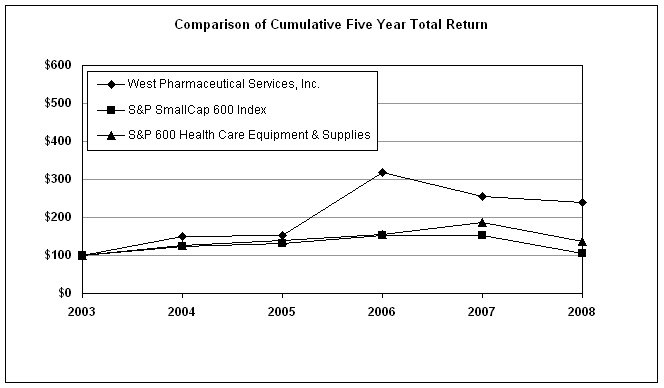
The
following graph compares the cumulative total return to holders of the Company’s
common stock with the cumulative total return of the Standard & Poor’s
SmallCap 600 Index and the Standard & Poor’s 600 Health Care Equipment &
Supplies for the five years ended December 31, 2008. Cumulative total return to
shareholders is measured by dividing total dividends (assuming dividend
reinvestment) plus the per-share price change for the period by the share price
at the beginning of the period. The Company’s cumulative shareholder return is
based on an investment of $100 on December 31, 2003 and is compared to the
cumulative total return of the SmallCap 600 Index and the 600 Health Care
Equipment & Supplies over the period with a like amount
invested.
ITEM 6. SELECTED FINANCIAL
DATA.
FIVE-YEAR
SUMMARY
West
Pharmaceutical Services, Inc. and Subsidiaries
|
(in
millions, except per share data)
|
2008
|
2007
|
2006
|
2005
|
2004
|
|||||||||||||||
|
SUMMARY
OF OPERATIONS
|
||||||||||||||||||||
|
Net
sales
|
$ | 1,051.1 | $ | 1,020.1 | $ | 913.3 | $ | 699.7 | $ | 541.6 | ||||||||||
|
Operating
profit
|
124.1 | 94.9 | 101.0 | 73.4 | 49.4 | |||||||||||||||
|
Income
from continuing operations
|
86.0 | 71.2 | 61.5 | 46.0 | 34.3 | |||||||||||||||
|
(Loss)
income from discontinued operations
|
- | (0.5 | ) | 5.6 | 0.4 | (14.1 | ) | |||||||||||||
|
Net
income
|
$ | 86.0 | $ | 70.7 | $ | 67.1 | $ | 46.4 | $ | 20.2 | ||||||||||
|
Income
per share from continuing operations:
|
||||||||||||||||||||
|
Basic
(1)
|
$ | 2.65 | $ | 2.18 | $ | 1.91 | $ | 1.48 | $ | 1.14 | ||||||||||
|
Assuming
dilution (2)
|
2.50 | 2.06 | 1.83 | 1.41 | 1.11 | |||||||||||||||
|
(Loss)
income per share from discontinued operations:
|
||||||||||||||||||||
|
Basic
(1)
|
- | (.02 | ) | .18 | .01 | (.47 | ) | |||||||||||||
|
Assuming
dilution (2)
|
- | (.01 | ) | .17 | .01 | (.46 | ) | |||||||||||||
|
Average
common shares outstanding
|
32.4 | 32.7 | 32.2 | 31.1 | 30.0 | |||||||||||||||
|
Average
shares assuming dilution
|
36.1 | 36.2 | 33.6 | 32.5 | 30.8 | |||||||||||||||
|
Dividends
declared per common share
|
$ | 0.58 | $ | 0.54 | $ | 0.50 | $ | 0.46 | $ | 0.43 | ||||||||||
|
YEAR-END
FINANCIAL POSITION
|
||||||||||||||||||||
|
Cash
and cash equivalents
|
$ | 87.2 | $ | 108.4 | $ | 47.1 | $ | 48.8 | $ | 68.8 | ||||||||||
|
Working
capital
|
207.1 | 229.4 | 124.8 | 118.8 | 115.7 | |||||||||||||||
|
Total
assets
|
1,168.7 | 1,185.6 | 918.2 | 833.5 | 657.8 | |||||||||||||||
|
Total
invested capital:
|
||||||||||||||||||||
|
Total
debt
|
386.0 | 395.1 | 236.3 | 281.0 | 160.8 | |||||||||||||||
|
Minority
interests
|
- | 5.6 | 4.8 | 4.1 | - | |||||||||||||||
|
Shareholders’
equity
|
487.1 | 485.3 | 414.5 | 339.9 | 306.8 | |||||||||||||||
|
Total
invested capital
|
$ | 873.1 | $ | 886.0 | $ | 655.6 | $ | 625.0 | $ | 467.6 | ||||||||||
|
PERFORMANCE
MEASUREMENTS (3)
|
||||||||||||||||||||
|
Gross
margin (a)
|
28.8 | % | 28.6 | % | 29.0 | % | 28.1 | % | 29.5 | % | ||||||||||
|
Operating
profitability (b)
|
11.8 | % | 9.3 | % | 11.1 | % | 10.5 | % | 9.1 | % | ||||||||||
|
Effective
tax rate
|
21.6 | % | 19.9 | % | 29.1 | % | 29.0 | % | 27.2 | % | ||||||||||
|
Return
on invested capital (c)
|
11.1 | % | 9.9 | % | 11.2 | % | 9.5 | % | 7.9 | % | ||||||||||
|
Net
debt-to-total invested capital (d)
|
38.0 | % | 36.9 | % | 31.1 | % | 40.3 | % | 23.1 | % | ||||||||||
|
Research
and development expenses
|
$ | 18.7 | $ | 16.1 | $ | 11.1 | $ | 7.9 | $ | 6.8 | ||||||||||
|
Operating
cash flow
|
135.0 | 129.2 | 139.4 | 85.6 | 81.0 | |||||||||||||||
|
Stock
price range
|
$ | 52.00-29.52 | $ | 54.83-35.20 | $ | 52.77-24.83 | $ | 29.99-18.58 | $ | 25.49-16.38 | ||||||||||
(1) Based
on average common shares outstanding.
(2) Based
on average shares, assuming dilution.
(3)
Performance measurements represent indicators commonly used in the financial
community. They are not measures of financial performance under U.S. generally
accepted accounting principles (GAAP).
(a) Net
sales minus cost of goods and services sold, including applicable depreciation
and amortization, divided by net sales.
(b)
Operating profit divided by net sales.
(c)
Operating profit multiplied by one minus the effective tax rate divided by
average total invested capital.
(d) Net
debt (total debt less cash and cash equivalents) divided by total invested
capital, net of cash and cash equivalents.
Factors
affecting the comparability of the information reflected in the selected
financial data:
|
§
|
Income
from continuing operations in 2008 includes a net pre-tax gain on contract
settlement proceeds of $4.2 million, restructuring and related charges of
$3.0 million and discrete income tax benefits of $3.5 million.
Collectively, these items totaled to a $1.2 million pre-tax benefit ($4.3
million after tax).
|
|
§
|
On
December 29, 2008, we purchased the remaining 10% minority ownership in
our Medimop subsidiary for $8.5 million, which resulted in a $5.4 million
reduction to the minority interest
balance.
|
|
§
|
2007
income from continuing operations includes the impact of the restructuring
charges at our Tech Group segment, an impairment loss on our Nektar
contract intangible asset for the Exubera device and our provisions for
Brazilian tax issues, totaling a $26.4 million pre-tax charge ($19.4
million, after tax). Our 2007 results also include the recognition of
discrete tax benefits totaling $8.2
million.
|
|
§
|
During
2007, we issued $161.5 million of convertible junior subordinated
debentures carrying a 4% coupon rate and due on March 15, 2047, resulting
in net cash proceeds of $156.3 million, after payment of underwriting and
other costs of $5.2 million. These debentures are convertible
into our common stock at any time at an initial conversion price of $56.07
per share. We have and may use the proceeds for general corporate
purposes, which include capital expenditures, working capital, possible
acquisitions of other businesses, technologies or products, repaying debt,
and repurchasing our common stock.
|
|
§
|
2006
income from continuing operations includes a pre-tax loss on
extinguishment of debt of $5.9 million ($4.1 million, net of tax) and a
gain on a tax refund of $0.6
million.
|
|
§
|
On
December 31, 2006, we adopted Statement of Financial Accounting Standard
No. 158, “Employers' Accounting for Defined Benefit Pension and Other
Postretirement Plans—an amendment of FASB Statements No. 87, 88, 106, and
132(R)” (“SFAS 158”), which requires the recognition of the overfunded or
underfunded status of a defined benefit postretirement plan as measured by
the difference between the fair value of plan assets and the benefit
obligation. The adoption of SFAS 158 resulted in a reduction of
shareholder’s equity of $19.7 million ($32.0 million pre-tax, less a $12.3
million deferred tax benefit) at December 31,
2006.
|
|
§
|
During
2005, we acquired the businesses of Monarch, TGI and Medimop. Our
financial statements include the results of acquired businesses for
periods subsequent to their acquisition
date.
|
|
§
|
2005
income from continuing operations includes incremental income tax expense
of $1.5 million associated with the repatriation of foreign sourced income
under the American Jobs Creation Act of 2004 and a reduction in an
estimate for restructuring costs which increased income from continuing
operations by $1.3 million.
|
|
§
|
On January
1, 2005 we adopted Statement of Financial Accounting Standard 123
“Share-Based Payment – Revised 2004” (“SFAS 123(R)”) which required the
recognition of compensation expense connected with our stock option and
employee stock purchase plan programs that did not require expense
recognition in 2004 and prior periods under previous accounting standards.
The application of SFAS 123 to the results of 2004 and 2003 would have
resulted in additional net of tax costs of $1.2 million and $1.5 million,
respectively.
|
|
§
|
2004
income from continuing operations includes incremental manufacturing costs
of $7.9 million (net of tax) in connection with the interim production
processes that were put in place following the Kinston accident, along
with Kinston related legal expenses of $1.2 million (net of tax);
restructuring charges related to the closure of a U.K. manufacturing plant
of $1.0 million; an affiliate real estate gain of $0.6 million; and $2.1
million of favorable tax adjustments resulting from a change in French tax
law extending the life of net operating loss carryforwards, the use of
U.S. foreign tax credits that were previously expected to expire
unutilized and the favorable resolution of several prior year tax
issues.
|
ITEM
7. MANAGEMENT’S DISCUSSION AND ANALYSIS OF FINANCIAL CONDITION AND
RESULTS OF OPERATIONS.
Management’s
discussion and analysis should be read in conjunction with the consolidated
financial statements and accompanying notes contained elsewhere in this Report
on Form 10-K.
COMPANY
OVERVIEW
West
Pharmaceutical Services, Inc. (which may be referred to as West, the Company, we, us or our) is a manufacturer of
components and systems for injectable drug delivery and plastic packaging and
delivery system components for the healthcare and consumer products industries.
The vast majority of our business is conducted in healthcare markets. Our
mission is to develop and apply proprietary technologies that improve the safety
and effectiveness of therapeutic and diagnostic healthcare delivery systems. Our
business is conducted through two segments - "Pharmaceutical Systems" and "Tech
Group." Pharmaceutical Systems focuses on primary packaging and systems for
injectable drug delivery, including stoppers and seals for vials, closures and
other components used in syringe, intravenous and blood collection systems,
prefillable syringe components, and safety and administration systems. The Tech
Group offers custom contract-manufacturing solutions using plastic injection
molding and manual and automated assembly processes targeted to the healthcare
and consumer products industries. Our customer base includes the leading global
producers and distributors of pharmaceuticals, biologics, medical devices and
personal care products.
West has
approximately 6,300 employees and generates more than half of its revenues
outside of the U.S., including 44% in Europe and 10% collectively in South
America, Asia, Australia and Israel. We have a global manufacturing footprint
with production and distribution facilities in North America, Europe, Latin
America, Asia and Australia. West has also formed global partnerships to share
technologies and market products with companies in Japan and
Mexico.
2008
Financial Performance Highlights
|
·
|
Net
sales were $1,051 million, an increase of $31 million compared to the
prior year, principally resulting from improved pricing and favorable
foreign currency exchange rates. Net sales grew despite regulatory and
insurance reimbursement related constraints and the
discontinuation of certain products, which resulted in lost sales of
$63 million for both segments
combined.
|
|
·
|
Gross
profit was $11 million higher than the prior year, and gross margin
improved slightly to 28.8% due to improved productivity, partially offset
by higher raw materials and energy costs, and the impact of the lost sales
items which totaled $25 million.
|
|
·
|
Operating
profit was $29 million higher than the prior year, including certain items
that are not indicative of ongoing operations. Included in 2008 operating
profit was a net gain of $1 million resulting from contract settlement
proceeds less costs incurred and the Tech Group restructuring and related
costs. Operating profit in 2007 included charges totaling $26 million
which were not allocated to our reporting segments. These items are
addressed in more detail within the Results of Operations section
below.
|
|
·
|
Net
income from continuing operations for 2008 was $86 million, or $2.50 per
diluted share compared to $71 million, or $2.06 per diluted share, in the
prior year.
|
|
·
|
Our
financial position remains very strong, with net cash flow from operations
totaling $135 million in 2008, increasing 4.5% compared to the prior
year.
|
|
·
|
At
December 31, 2008 our total debt was $386 million compared with $395
million in the prior year, and our net debt-to-total invested capital was
38.0%.
|
Recent
Trends and Developments
Pharmaceutical
Systems
The
majority of our sales growth in recent years has been generated by the
performance of Pharmaceutical Systems. Growth in 2008 was adversely affected by
isolated regulatory and insurance reimbursement changes that decreased the
demand for certain biotechnology customers’ products, our decision to cease
production of a low-margin disposable medical product component, and customer
inventory management initiatives in response to the recent global economic
turmoil. Despite these issues, we were successful in replacing the lost sales
and growing business through increased demand in certain global markets,
resulting in sales of $792 million, an increase of 7% over the prior year.
Pharmaceutical packaging components that include our post-manufacturing
value-added processes, including Westar® washing and FluroTec® and B-2 coatings,
continued to lead the demand for our products. Gross profit increased during the
year to $266 million, although the gross margin percentage decreased slightly
due to the lost sales issues described above and the increased raw material and
energy costs experienced during the year.
Tech
Group
Our Tech
Group segment had a challenging year in 2008 as it was forced to respond to the
loss of revenues associated with the Exubera inhalation device. In October 2007,
Pfizer Inc. discontinued marketing Exubera, a pulmonary insulin product
developed by our customer Nektar Therapeutics (“Nektar”) and licensed to Pfizer.
In addition to the lost business associated with Exubera, Tech Group experienced
decreased demand for an over-the-counter healthcare packaging product following
a significant 2007 market launch. At the same time, we experienced stronger than
expected demand for several other healthcare devices and consumer products. Tech
Group 2008 net sales were $271 million, 6% lower than the prior year, including
the impact of lost Exubera device sales of $33 million. Despite the drop in net
sales, operating profit increased $6 million, or over 50%, as a result of gains
in production efficiency and savings from restructuring and cost-cutting
activities.
In
December 2007, we announced a restructuring plan for our Tech Group which
proactively addressed anticipated changes in customers’ marketing plans for
certain products and aligned our plant capacity and workforce with the business
outlook and longer-term strategy of focusing the business on proprietary
products. As part of this plan, we implemented a series of restructuring
initiatives during 2008 to reduce production and engineering operations, reduce
administrative costs, and consolidate our tool shops into one location. During
2008 and 2007, we incurred restructuring costs totaling $3 million in each year,
and we will incur additional costs, not expected to exceed $1 million, during
the first half of 2009 as we complete this program. In the aggregate, expected
costs of this program consist of $4 million in severance and benefits for
approximately 326 employees, $2 million in asset-related charges, and $1 million
for contract termination fees and other expenses. Estimated cost savings were
approximately $5 million for 2008 and are expected to be approximately $6 to $7
million annually thereafter.
Business
Outlook
Management’s
operating priorities in 2009 will include a focus on generating organic growth,
improving operating margins and continuing to invest in the future. Now that the
Tech Group restructuring is substantially completed and we have implemented
other cost-reduction efforts throughout the organization, we expect to realize
incremental operating cost savings in 2009. We will continue to aggressively
manage the costs under our control, and take advantage of targeted restructuring
activities where necessary. Our business outlook remains positive for both
segments; however, we expect that sales growth will be hampered by the current
global economic conditions.
Pharmaceutical
Systems
Our 2009
revenue projections reflect the strengthening of the U.S. dollar versus the Euro
and certain other international currencies during the fourth quarter of 2008.
After taking into account an anticipated unfavorable foreign exchange impact of
8%, we expect full year revenues for Pharmaceutical Systems to be marginally
lower than those achieved in 2008. Growth, excluding the impact of currency, is
expected to continue to be driven by demand for our enhanced product offerings
including Westar® and advanced coated products, prefillable syringe components,
and safety and administration systems. We believe that the long-term drivers
remain strong and market dynamics support future growth with an aging
population, advances in treatments for chronic illnesses, many of which involve
biologic drugs, and a shift in the point-of-care from hospitals to specialty
clinics and homes.
Given our
positive growth outlook, we plan to continue funding the capital projects
necessary to meet customer demand and to provide for improved results in our
longer-term strategic plan. During 2008, we made significant strides in
increasing our plant capacity in Germany, Serbia, France, Singapore and the U.S.
We are also in the process of constructing a new facility in China, which will
manufacture plastic components for disposable medical products, and we continue
to evaluate opportunities for constructing rubber manufacturing facilities in
China and India. We expect our 2009 capital spending to be approximately equal
to the 2008 level, which will allow us to complete the ongoing expansion
projects, fund innovation for promising new products, replace certain
manufacturing and accounting information systems, and maintain our existing
facilities.
Tech
Group
We expect
full year 2009 revenues to be lower than those in 2008 by 5% to 7%, after taking
into account an expected unfavorable foreign exchange impact of approximately 3%
and lower plastic resin costs which are passed through to the majority of our
contract customers in the form of selling price adjustments. Excluding the
negative impact of these two items, growth is expected to come from demand in
healthcare devices and several new consumer product launches planned by our
customers. Although Tech Group is projecting lower sales for 2009, we believe
that the combination of a leaner cost structure, made possible by restructuring
initiatives, and increased operating efficiency at our production facilities
will provide for a consistent level of operating profit. On a longer-term basis,
we believe that the Tech Group segment will benefit from our innovation
initiatives in developing proprietary products incorporating new technologies
and advanced injection systems. With the expansion of our Grand Rapids, Michigan
plant now completed, the majority of our capital spending within the Tech Group
will be focused on the support of new products and routine facility and
equipment upgrades.
Research
& Development (“R&D”) and Innovation
We expect
2009 R&D spending to surpass 2008 levels by approximately 25% as we continue
to invest in advanced injectable packaging and delivery systems and safety and
reconstitution products. We anticipate that a majority of our developmental
medical devices will be manufactured by our Tech Group and marketed by
Pharmaceutical Systems. We believe that our commitment to develop and apply
proprietary technologies that improve the quality, safety and effectiveness of
therapeutic and diagnostic healthcare delivery systems will result in continued
long-term growth.
Global
Economic Conditions
Current
economic conditions in the U.S. and abroad are expected to have a moderate
impact on the sales growth of our products, as customers search for ways to cut
costs including rationalization of their inventories. In addition, we anticipate
that changes in foreign currency exchange rates will have an unfavorable impact
on consolidated sales of approximately 7% in 2009. After considering the
unfavorable foreign currency impact, we expect consolidated sales to be between
$1.01 billion and $1.03 billion, a reduction of 2% to 4% compared with those of
2008. Excluding the effects of changes in foreign currency translation, 2009
sales are expected to grow between 3.0% and 5.0%. Our financial projections for
2009 were prepared using a forecast of foreign currency exchange
rates for our various non-U.S. subsidiaries. As such, continued volatility
in key exchange rates during 2009 may result in significant differences in
U.S. dollar results, affecting the accuracy of our sales and earnings
projections.
In
addition to the impact on sales, the slowing economy and adverse conditions in
equity and debt markets contributed to a 25% decline in the value of our U.S.
pension assets, compared to a long-term rate of return assumption of 8%. As a
result of this and other changes in pension assumptions, we are expecting an
incremental pension expense of approximately $10 million in 2009. Continued
actual returns below our expected rate may also affect the amount and timing of
future contributions to the plan. We have no ERISA (Employee Retirement Income
Security Act) funding requirements in 2009; however, we have made a voluntary
pension contribution of $10 million in January 2009.
The
global reach of our business and the nature of our product portfolio that serves
primarily non-discretionary pharmaceutical and medical applications are expected
to limit the impact of temporary economic downturns. However, the world
financial markets have recently experienced extreme disruption and global
economic conditions have worsened. Accordingly, no assurance can be given that
the ongoing economic downturn will not have a material adverse effect on the
demand for our products.
RESULTS
OF OPERATIONS
Management’s
discussion and analysis of our operating results for the three years ended
December 31, 2008, and our financial position as of December 31, 2008, should be
read in conjunction with the accompanying consolidated financial statements and
footnotes appearing elsewhere in this report. Our financial statements include
the results of acquired businesses for periods subsequent to their acquisition
date. For the purpose of aiding the comparison of our year-to-year results,
reference is made in management's discussion and analysis to results excluding
the effects of changes in foreign exchange rates. Those re-measured period
results are not in conformity with U.S. generally accepted accounting principles
(“GAAP”) and are considered “non-GAAP financial measures.” The non-GAAP
financial measures are intended to explain or aid in the use of, not as a
substitute for, the related GAAP financial measures.
Percentages
in the following tables and throughout the Results of Operations section may
reflect rounding adjustments.
NET
SALES
The
following table summarizes net sales by reportable segment:
|
Year
Ended December 31,
|
%
Change
|
|||||||||||||||||||
|
($
in millions)
|
2008
|
2007
|
2006
|
08/07 | 07/06 | |||||||||||||||
|
Pharmaceutical
Systems
|
$ | 792.1 | $ | 741.8 | $ | 644.1 | 6.8 | % | 15.2 | % | ||||||||||
|
Tech
Group
|
270.5 | 289.2 | 279.2 | (6.5 | )% | 3.6 | % | |||||||||||||
|
Intersegment
sales
|
(11.5 | ) | (10.9 | ) | (10.0 | ) | - | - | ||||||||||||
|
Total
net sales
|
$ | 1,051.1 | $ | 1,020.1 | $ | 913.3 | 3.0 | % | 11.7 | % | ||||||||||
2008 compared to
2007
Consolidated
2008 net sales increased by $31.0 million, or 3.0%, over those achieved in the
prior year. Favorable foreign currency translation accounted for the vast
majority of the consolidated sales growth. Sales price increases contributed 2.3
percentage points to sales growth, as price increases including raw material
surcharges were implemented in response to rising raw material and energy costs
during the year. Substantially offsetting the impact of sales price increases
were lower volumes and unfavorable mix resulting from regulatory and insurance
reimbursement related constraints and the discontinuation of certain products,
which resulted in lost sales within both reporting segments.
Pharmaceutical Systems - This
segment contributed $50.3 million to the full year sales increase, including
$26.2 million resulting from favorable foreign currency translation. Excluding
currency translation effects, sales were $24.1 million, or 3.3%, above prior
year levels. Price increases contributed approximately 2.3 percentage points of
the sales increase over the prior year. Favorable sales volume and mix
contributed 1.0 percentage point, despite the loss of the discrete
pharmaceutical packaging and disposable medical components sales described
below.
Sales of
pharmaceutical packaging components were $45.0 million higher than the prior
year due to increased sales of stoppers and seals used in a variety of customer
products as well as favorable currency translation. These increases more than
compensated for a $17.4 million decline in sales of a prefillable syringe
component caused by regulatory and insurance reimbursement changes affecting the
demand for certain customer products designed to treat anemia in cancer and
other patients. Sales of disposable medical components were $13.2 million lower,
as sales of other syringe components replaced a portion of the $13.6 million of
2007 sales of a low-margin blood collection system component that we ceased
producing. Sales of safety and administration systems, and laboratory and other
services were $18.5 million higher than the prior year, most of which was due to
increased demand for our drug reconstitution products and higher tooling
activity.
Tech Group - Full year sales
were $18.7 million below 2007 levels, including $3.6 million of favorable
foreign currency translation. Excluding the impact of foreign currency
translation, sales were $22.3 million, or 7.7%, below prior year levels. Price
increases contributed 2.4 percentage points to sales, while increased consumer
products sales volume offset a small portion of the lost Exubera device
business.
Sales of
healthcare devices decreased $17.1 million compared with the prior year. After
considering the lost Exubera sales of $33 million, we experienced increased
sales volume of other healthcare devices including medical filter products,
self-injection pens, and intra-nasal drug delivery systems, partially offset by
a drop-off in sales of packaging for a customer’s over-the-counter weight loss
product following a June 2007 market launch. Sales of consumer products, tooling
and other services decreased by $1.6 million due to lower demand for certain
personal care products and tooling services, partially offset by increased
volume of juice and dairy carton closures. Intersegment sales of $11.1 million
and $10.5 million in 2008 and 2007, respectively, were eliminated in
consolidation.
2007 compared to
2006
Consolidated
2007 net sales increased by $106.8 million, or 11.7%, over those achieved in
2006. Foreign currency translation accounted for $41.4 million, or 4.5
percentage points, of the sales growth. Excluding foreign currency translation,
2007 net sales increased $65.4 million or 7.2% over the prior year.
Pharmaceutical Systems - The
Pharmaceutical Systems segment contributed $97.7 million of the full year sales
increase, including $37.8 million resulting from favorable foreign currency
translation. Excluding foreign currency translation, Pharmaceutical Systems
sales were $59.9 million, or 9.3%, above prior year levels. Price increases
contributed approximately 2.5 percentage points of the sales increase over the
prior year, with the remainder of the increase attributed to positive sales
volume. Sales growth was strong in all geographical regions of the segment,
driven by increased demand for serum stoppers used in vial packaging for
vaccines, injectable treatments for chronic diseases, and increased demand for
pre-filled injection system components.
Tech Group - Full year sales
in 2007 were $10.0 million above prior year levels, $3.6 million of which
resulted from foreign currency translation. Excluding foreign currency
translation, Tech Group segment sales were $6.4 million, or 2.3%, above prior
year levels. Price increases contributed approximately 0.8 percentage points of
the sales increase in the Tech Group, with the remainder of the increase
attributed to positive sales volume. The Tech Group sales increase included a
$3.6 million increase in sales to Nektar of the Exubera device resulting from
the timing of the product launch by Pfizer in the U.S. earlier in the
year. Tech Group sales also benefited from strong sales of weight
loss product packaging, an intra-nasal delivery system and surgery devices, but
these were largely offset by a $13.2 million decline in revenue from tooling and
design projects. Intersegment sales of $10.5 million and $9.8 million in 2007
and 2006, respectively, were eliminated in consolidation.
GROSS
PROFIT
The
following table summarizes our gross profit and related gross margins by
reportable segment:
|
Year
Ended December 31,
|
%
Change
|
|||||||||||||||||||
|
($
in millions)
|
2008
|
2007
|
2006
|
08/07 | 07/06 | |||||||||||||||
|
Pharmaceutical
Systems:
|
||||||||||||||||||||
|
Gross
Profit
|
$ | 265.7 | $ | 256.3 | $ | 224.5 | 3.7 | % | 14.2 | % | ||||||||||
|
Gross
Margin
|
33.5 | % | 34.5 | % | 34.8 | % | ||||||||||||||
|
Tech
Group:
|
||||||||||||||||||||
|
Gross
Profit
|
$ | 36.9 | $ | 35.5 | $ | 40.3 | 3.9 | % | (11.9 | )% | ||||||||||
|
Gross
Margin
|
13.7 | % | 12.3 | % | 14.4 | % | ||||||||||||||
|
Consolidated
gross profit
|
$ | 302.6 | $ | 291.8 | $ | 264.8 | 3.7 | % | 10.2 | % | ||||||||||
|
Consolidated
gross margin
|
28.8 | % | 28.6 | % | 29.0 | % | ||||||||||||||
2008 compared to
2007
Consolidated
gross profit increased by $10.8 million over 2007, including the favorable
effect from foreign currency translation of $9.4 million. The gross margin
percentage improved slightly despite the unfavorable impact on sales volume and
mix caused by the loss of discrete business described in the Net Sales section
above.
Pharmaceutical Systems - Gross
margin for Pharmaceutical Systems declined by one percentage point versus the
prior year. Approximately half of this decrease was due to unfavorable volume
and mix resulting from the regulatory and insurance reimbursement issues
affecting the demand for prefillable syringe components used in certain anemia
products. The remaining decline resulted from increased depreciation expense and
production cost increases, as the positive benefit of sales price increases
offset a majority of the increased costs of raw materials, wage increases and
utilities used to operate our production facilities.
Tech Group - Gross margins
improved by 1.4 percentage points in comparison to prior year results. The
improved gross margin performance was largely due to a significant reduction in
plant overhead and improved production efficiency which contributed 3.4
percentage points. These gains resulted from our restructuring efforts and
efficiencies from the completion of start-up activities at our expanded
production facility in Michigan. Partially offsetting these increases by 1.5
percentage points was the impact of lower sales and unfavorable mix. Despite
sales increases in consumer products and other healthcare devices, the loss of
business associated with the Exubera device and the prior year weight loss
product launch resulted in a decline in sales and negative impact on gross
margin. During the year, the majority of raw material, energy and wage cost
increases were passed on to customers in the form of increased selling
prices.
2007 compared to
2006
Consolidated
2007 gross profit increased by $27.0 million over 2006, consisting of a $31.8
million increase in Pharmaceutical Systems segment gross profit and a $4.8
million decrease in Tech Group segment gross profit. Foreign currency
translation accounted for $12.9 million of the increase in consolidated gross
profit.
Pharmaceutical Systems - The
gross margin within the Pharmaceutical Systems segment declined moderately
compared to that achieved in 2006, primarily due to higher plant overhead costs
including the addition of engineering and other staff in support of our
expansion projects, increased manufacturing, supply and maintenance costs
resulting from strained capacity levels at several facilities in Europe, and
higher depreciation charges on machinery and equipment upgrades.
Tech Group - The Tech Group
segment gross profit and gross margin declines primarily reflect $6.0 million of
incremental costs associated with the relocation and start-up of our new
facility in Michigan.
RESEARCH
AND DEVELOPMENT (“R&D”) COSTS
The
following table summarizes R&D costs by reportable segment:
|
($
in millions)
|
2008
|
2007
|
2006
|
|||||||||
|
Pharmaceutical
Systems
|
$ | 17.2 | $ | 14.0 | $ | 8.7 | ||||||
|
Tech
Group
|
1.5 | 2.1 | 2.4 | |||||||||
|
Total
R&D costs
|
$ | 18.7 | $ | 16.1 | $ | 11.1 | ||||||
R&D
costs during 2008 were $2.6 million higher than those incurred in 2007, mostly
due to three ongoing development projects in the Pharmaceutical Systems segment.
The first is our development of prefillable syringe systems that will use Daikyo
Seiko, Ltd. (“Daikyo”) Crystal Zenith® resin, a unique, transparent polymer that
can be used to produce vials and syringe barrels. Daikyo, our 25% owned
affiliate in Japan, is also our partner in a long-standing marketing and
technology transfer agreement that enables West and Daikyo to develop products
that help customers mitigate drug product development risks and enhance drug
performance and patient safety. The other major projects include an advanced
injection system using auto-injector technology, which was acquired during 2007,
and a passive needle safety device.
The
increase in 2007 over 2006 R&D costs reflected the formation of our
innovation group which is responsible for seeking new opportunities in
injectable packaging and delivery systems. Our development projects are a
response to the market opportunities created by the convergence of primary drug
packaging and delivery systems and include initiatives in traditional injection
systems, components for pen system applications and auto injectors with
cartridges.
SELLING,
GENERAL and ADMINISTRATIVE (“SG&A”) COSTS
The
following table summarizes SG&A costs by reportable segment including
corporate and unallocated costs:
|
($
in millions)
|
2008
|
2007
|
2006
|
|||||||||
|
Pharmaceutical
Systems SG&A costs
|
$ | 110.1 | $ | 98.3 | $ | 81.8 | ||||||
|
Pharmaceutical
Systems SG&A as a % of segment net sales
|
13.9 | % | 13.3 | % | 12.7 | % | ||||||
|
Tech
Group SG&A costs
|
$ | 17.9 | $ | 22.0 | $ | 19.3 | ||||||
|
Tech
Group SG&A as a % of segment net sales
|
6.6 | % | 7.6 | % | 6.9 | % | ||||||
|
Corporate
costs:
|
||||||||||||
|
General
corporate costs
|
$ | 18.9 | $ | 21.0 | $ | 23.8 | ||||||
|
Stock-based
compensation expense
|
6.4 | 5.1 | 14.5 | |||||||||
|
U.S.
pension plan expense
|
6.0 | 6.1 | 8.4 | |||||||||
|
Total
SG&A costs
|
$ | 159.3 | $ | 152.5 | $ | 147.8 | ||||||
|
Total
SG&A as a % of total net sales
|
15.2 | % | 14.9 | % | 16.2 | % | ||||||
2008 compared to
2007
Consolidated
SG&A expenses were $6.8 million above those recorded in 2007, but only
increased marginally as a percentage of total net sales. The impact of foreign
currency translation accounted for $3.3 million of the increase.
In
Pharmaceutical Systems, 2008 SG&A expenses increased by $11.8 million over
the prior year. Foreign currency translation accounted for $3.1 million of the
increase. Compensation costs were $4.4 million above those incurred in 2007 due
to the impact of annual pay increases, and increased staffing of information
technology support functions. Costs associated with our new information systems
implementation, including depreciation expense and third-party consulting fees,
accounted for $2.3 million of the increase. Various other increases including
utilities and other corporate facilities costs contributed to the remaining
increase in SG&A expense.
SG&A
costs in the Tech Group were $4.1 million lower than the amount incurred in
2007. A net reduction in headcount associated with our restructuring efforts
accounted for half of the reduction in SG&A. The remainder of the reduction
was attributable to lower amortization expense, resulting from the 2007 Nektar
contract intangible write-off, and a reduction in various third-party consulting
services.
General
corporate SG&A costs were $2.1 million favorable to 2007 levels. These costs
include executive and director compensation and other corporate administrative
and facilities expenses. The majority of the decrease is the result of lower
facilities and administrative-related costs. Also included in corporate SG&A
are any above or below-target performance adjustments for our worldwide cash
bonus program. Annual cash bonus payments are made based on the achievement of
sales, operating profit, earnings per share and cash flow targets, and certain
qualitative performance milestones. 2008 cash-based bonus costs were slightly
lower than those earned in the prior year based upon management’s achievement of
targets.
Stock-based
compensation costs for 2008 increased by $1.3 million due to the impact of
changes in our stock price on the fair value of our stock-price indexed deferred
compensation liabilities. During 2008, our stock price decreased $2.82 per
share, closing at $37.77 per share on December 31, 2008, while during 2007 our
stock price decreased $10.64 per share, closing at $40.59 per share on December
31, 2007. The costs of non-U.S. pension and other retirement benefits programs
are reflected in the operating profit of the respective segment for all periods
presented.
2007 compared to
2006
Consolidated
SG&A expenses in 2007 were $4.7 million above those recorded in 2006. In the
Pharmaceutical Systems segment, 2007 SG&A expenses increased by $16.5
million compared to the prior year. Approximately $6.1 million of the
increase was compensation related, including increased staffing of sales,
strategic marketing and information systems functions, the impact of annual
salary increases and higher incentive compensation program costs. Foreign
currency translation accounted for $4.6 million of the 2007 to 2006 increase in
Pharmaceutical System segment SG&A costs. Professional service and
consulting costs related to the implementation of new information systems in the
U.S. and sales commission charges were $4.1 million higher in 2007 than in 2006.
The remaining $1.7 million increase in SG&A costs consisted mostly of higher
software maintenance, computer related supply costs, and depreciation
expense.
2007
SG&A costs in the Tech Group segment were $2.7 million above the prior year.
Higher staffing levels in quality control, human resource and other functions
together with annual salary increases accounted for $1.4 million of the growth.
Sales commissions were $0.6 million higher than in 2006. Foreign currency
translation, travel costs and bad debt expense contributed equally to the
remaining $0.7 million increase.
General
corporate SG&A costs were $2.8 million lower in 2007 than in 2006. Incentive
compensation costs in 2007 were $2.9 million lower than the prior year,
primarily due to the achievement of above target performance levels resulting in
above target bonus payouts in 2006, compared to 2007 incentive compensation
which was below target.
Stock-based
compensation costs for 2007 decreased by $9.4 million when compared to those
recorded in 2006, due primarily to a decrease in West stock-price indexed
compensation costs, partially offset by higher stock option and employee stock
purchase plan costs. Our stock price decreased $10.64 per share during 2007,
closing at $40.59 per share on December 31, 2007. In 2006, our stock price
increased $26.20 per share closing at $51.23 per share at December 31,
2006.
U.S.
pension plan expenses in 2007 were $2.3 million lower than those incurred during
2006. The decrease largely resulted from a 2006 amendment to our qualified
defined benefit pension plan in the U.S. Under the amended plan, benefits earned
under the plan’s pension formulas were frozen as of December 31, 2006 and
replaced with new cash-balance formulas resulting in a reduction of our
projected benefit obligation.
RESTRUCTURING,
IMPAIRMENT AND OTHER ITEMS
Other
income and expense items, consisting of gains, losses or impairments of segment
assets, foreign exchange transaction gains and losses, miscellaneous royalties
and sundry transactions are generally recorded within the respective segment.
Certain restructuring and other items considered outside the control of segment
management are not allocated to our reporting segments. The following table
summarizes our restructuring charges and other income and expense items for each
of the three years ended December 31:
|
($
in millions)
|
2008
|
2007
|
2006
|
|||||||||
|
Pharmaceutical
Systems
|
$ | 1.7 | $ | 2.1 | $ | 4.3 | ||||||
|
Tech
Group
|
(0.3 | ) | (0.2 | ) | 0.5 | |||||||
|
Corporate
|
0.3 | - | - | |||||||||
|
Unallocated
charges (credits):
|
||||||||||||
|
Impairment
charge, contract settlement and related gain, net
|
(4.2 | ) | 12.9 | - | ||||||||
|
Restructuring
and related charges
|
3.0 | 3.4 | - | |||||||||
|
Brazilian
excise tax and other charges
|
- | 10.1 | 0.1 | |||||||||
|
Total
unallocated charges (credits)
|
(1.2 | ) | 26.4 | 0.1 | ||||||||
|
Total
restructuring, impairment and other charges
|
$ | 0.5 | $ | 28.3 | $ | 4.9 | ||||||
The
year-over-year reduction in other expense for Pharmaceutical Systems is
attributable to net foreign exchange gains on intercompany and third-party
transactions recognized during 2008. Other expense in 2006 included a $2.5
million impairment charge for productive assets and royalties stemming from a
discontinued product. After taking this charge into consideration, the amounts
recognized in 2007 and 2006 are fairly consistent. For Tech Group, the reduction
in other expense in 2007 versus 2006 resulted from the recognition of income
from 2007 government grants in Europe. The majority of Tech Group other expense
in 2006 related to the sale or disposal of surplus equipment. The miscellaneous
charges recorded in 2008 corporate expense represent foreign exchange
transaction losses.
Impairment charge, contract
settlement and related gain, net - In the fourth quarter of 2007, we
recorded a $12.9 million impairment charge representing our net book value in
the Nektar contract intangible asset associated with the Exubera device. Under
an agreement reached with Nektar in February 2008, we received full
reimbursement for, among other things, severance related employee costs,
equipment, purchased raw materials and components, leases and other facility
costs associated with the shutdown of manufacturing operations related to this
device. During 2008, we received payments from Nektar which more than offset the
related costs incurred, resulting in a net gain of $4.2 million.
Restructuring and related
charges - We incurred $3.0 million and $3.4 million in 2008 and 2007,
respectively, of restructuring and related charges as part of our 2007 plan to
align the plant capacity and workforce of the Tech Group with the revised
business outlook for that segment. We expect to incur additional amounts, not to
exceed $1.0 million, during the first half of 2009 as these restructuring
activities are concluded.
Brazil excise tax and other
charges - During 2007, we increased our accruals for a series of social,
excise and other tax contingencies in Brazil by $10.1 million. These charges
followed a detailed review of several related tax cases pending in the Brazilian
courts, which indicated that it was probable that our positions taken on
previous tax returns, some of which date back to the late 1990’s, would not be
sustained. This matter is currently awaiting final disposition in the Brazilian
court system.
OPERATING
PROFIT
Operating
profit (loss) by reportable segment, corporate and other unallocated costs was
as follows:
|
($
in millions)
|
2008
|
2007
|
2006
|
|||||||||
|
Pharmaceutical
Systems
|
$ | 136.7 | $ | 141.9 | $ | 129.7 | ||||||
|
Tech
Group
|
17.8 | 11.6 | 18.1 | |||||||||
|
Corporate
and other unallocated costs:
|
||||||||||||
|
General
corporate costs
|
(19.2 | ) | (21.0 | ) | (23.9 | ) | ||||||
|
Stock-based
compensation costs
|
(6.4 | ) | (5.1 | ) | (14.5 | ) | ||||||
|
U.S.
pension expenses
|
(6.0 | ) | (6.1 | ) | (8.4 | ) | ||||||
|
Other
unallocated items
|
1.2 | (26.4 | ) | - | ||||||||
|
Consolidated
Operating Profit
|
$ | 124.1 | $ | 94.9 | $ | 101.0 | ||||||
2008 compared to
2007
Pharmaceutical
Systems operating profit was lower than prior year results by $5.2 million,
including a foreign currency translation benefit of $5.5 million. The impact of
higher sales and gross profit was more than offset by higher spending on
information systems and research and development initiatives as we replace
outdated management reporting systems and invest in innovative products for the
future.
Tech
Group operating profit was $6.2 million above that achieved in the prior year,
including a foreign currency benefit of $0.3 million, largely due to savings
resulting from the restructuring program initiated in late 2007, and production
efficiencies coming from higher throughput at our newly expanded Michigan
facility.
General
corporate costs declined as a result of lower compensation costs under our
annual performance-based bonus plan, and stock-based compensation costs
increased due to the impact of changes in our stock price on deferred
compensation obligations which are indexed to our stock price.
Other
unallocated income for 2008 totaled $1.2 million, consisting of a $3.0 million
restructuring charge and $4.2 million in proceeds less costs of transition
activities at our former Exubera device production facility. Other unallocated
expense for 2007 was $26.4 million including a $3.4 million restructuring
charge, a $12.9 million impairment loss on our customer contract intangible for
the Exubera device, and a $10.1 million provision for social, excise and other
tax liabilities in Brazil.
2007 compared to
2006
Our 2007
consolidated operating profit decreased by $6.1 million from that achieved in
2006. Operating profit for 2007 included $26.4 million in unallocated costs as
described above. The Pharmaceutical Systems segment’s 2007 results exceed those
of the prior year by $12.2 million, benefiting from sales growth, a favorable
product mix and the $7.6 million impact of foreign currency translation, which
combined to more than offset other cost increases.
Tech
Group segment operating profit was $6.5 million below that achieved in the prior
year, largely due to costs incurred during the relocation and validation of a
newly expanded production facility in Michigan.
General
corporate, stock-based compensation and U.S. pension plan costs were all lower
than those incurred in the prior year, with the significant decrease in
stock-price indexed deferred compensation programs attributed to the decline in
our stock price during 2007 compared to the strong increase in stock price
experienced in 2006.
LOSS
ON DEBT EXTINGUISHMENT
On
February 27, 2006 we prepaid $100.0 million in senior notes carrying a 6.81%
interest rate and a maturity date of April 8, 2009. Under the terms of the
original note purchase agreement dated April 8, 1999, the prepayment of the
notes entitled note holders to a “make whole” amount of $5.9 million in order to
compensate them for interest rate differentials between the 6.81% yield on the
notes and current market rates for the remaining term of the note. The
prepayment was financed by issuing €81.5 million (approximately $100.0 million)
of new senior unsecured notes at a weighted average interest rate of 4.34%,
before costs.
INTEREST
EXPENSE, NET
The
following table summarizes our net interest expense:
|
($
in millions)
|
2008
|
2007
|
2006
|
|||||||||
|
Interest
expense
|
$ | 18.6 | $ | 16.4 | $ | 13.4 | ||||||
|
Capitalized
interest
|
(2.6 | ) | (1.9 | ) | (0.7 | ) | ||||||
|
Interest
income
|
(1.4 | ) | (6.0 | ) | (2.1 | ) | ||||||
|
Interest
expense, net
|
$ | 14.6 | $ | 8.5 | $ | 10.6 | ||||||
2008 compared to
2007
Interest
expense for 2008, before capitalized interest and interest income, was $2.2
million above that recorded in the prior year. The timing of our issuance of
$161.5 million in convertible debt in March and April of 2007 accounted for $1.3
million of the year-to-date increase, as the notes were outstanding for the
entire 2008 year compared to a partial year in 2007. The impact of changes in
foreign exchange rates and bank commitment fees accounted for another $1.0
million of the increase. The decrease in interest income is also largely due to
the timing of the convertible debt issuance, as a portion of the proceeds was
invested in money market accounts and a strategic cash management fund in the
first half of 2007, and then subsequently used in our stock buy-back program and
in our capital expansion programs. In addition, interest income was reduced by
other-than-temporary losses on our strategic cash management fund investment
totaling $1.4 million in 2008. Capitalized interest increased as a result of our
Pharmaceutical Systems capital expansion projects in Europe.
2007 compared to
2006
Our 2007
net interest expense was $2.1 million lower than that incurred in 2006 due
largely to refinancing and investing activities and higher capitalized interest
on our capital expansion projects in Europe and in Michigan. During 2007, we
issued $161.5 million of convertible debt at a 4% fixed interest
rate. Interest expense on the convertible notes totaled $5.3 million
for the year ended December 31, 2007. The incremental interest expense from the
convertible notes was partially offset in the comparison of the 2007 and 2006
periods by favorable rate and volume variances totaling $1.3 million and $1.0
million, respectively, resulting from reduced borrowing levels on our revolving
credit facility and our 2006 refinancing activities. Our 2007 interest income is
$3.9 million favorable to that recorded in 2006. The additional interest income
was generated from the investment of a substantial portion of the proceeds from
our convertible debt offering.
INCOME
TAXES
Our
effective tax rate was 21.6% in 2008, 19.9% in 2007 and 29.1% in
2006. The following factors impacted the comparability of the tax
rate in 2008 versus 2007:
|
·
|
A
2008 agreement with the Republic of Singapore reduced our income tax rate
in that country for a period of 10 years, on a retroactive basis back to
July 2007, resulting in a $1.0 million tax
benefit.
|
|
·
|
A
2008 United Kingdom tax law change effectively eliminated a portion of our
capital allowance carryforwards, resulting in a $1.2 million increase in
our tax provision.
|
|
·
|
In
2008, we recognized a $3.4 million net tax provision benefit resulting
from the expiration of open audit years in various tax jurisdictions, and
$0.3 million in other discrete benefits including reversals of U.S. state
valuation allowances and provision adjustments for returns filed in
2008.
|
|
·
|
In
2007, we recognized a $3.2 million provision benefit related to tax
credits originally generated and fully reserved in previous
periods.
|
|
·
|
In
2007, we recognized a $3.7 million provision benefit principally resulting
from the revision of tax planning strategies and the completion of related
documentation supporting prior year R&D credits, and a $1.3 million
tax benefit due to the closure of certain U.S. federal and state tax audit
years.
|
The
impact of these items reduced our effective tax rate by 3.2 percentage points in
2008 and 9.5 percentage points in 2007. After considering these items, the
remaining decrease in the 2008 effective tax rate was primarily due to a change
in mix of earnings to jurisdictions where we are subject to lower tax rates and
an increase in R&D tax benefits in the U.S. and Ireland.
In
addition to the 2007 factors listed above, the following items impacted the
comparability of the tax rate in 2007 versus 2006:
|
·
|
2006
included a net $0.7 million favorable provision adjustment resulting from
the closure of the 2002 U.S. federal tax audit
year.
|
|
·
|
In
2006, we recognized a $0.4 million provision benefit from a tax refund
associated with the disposition of our former plastic molding facility in
Puerto Rico.
|
The
combined impact of these two items reduced our 2006 effective tax rate by 1.4
percentage points. After considering these items, the remaining decrease in the
2007 effective tax rate was primarily due to a change in mix of foreign versus
U.S. earnings.
EQUITY
IN NET INCOME OF AFFILIATES
Equity in
net income from our 25% ownership interest in Daikyo in Japan and our 49%
ownership interest in three companies in Mexico was $0.8 million, $2.5 million,
and $1.9 million for the years 2008, 2007 and 2006, respectively. Our 2008
equity income was $1.7 million lower than the prior year due to reduced earnings
of Daikyo. The lower earnings were primarily the result of plant demolition and
disposal costs, as well as incremental depreciation expense associated with a
significant Crystal Zenith® capital expansion project and higher pension
costs.
The
increase in equity earnings in 2007 versus 2006 came from Daikyo, as their net
income was $0.6 million above that recorded in 2006. Daikyo’s sales were 5%
above prior year levels, their gross margins improved by three percentage
points, and there were no unusual charges in 2007 unlike 2006 when a $0.7
million charge was incurred related to a decision by Daikyo to demolish an
existing facility. These favorable items were partially offset by a loss on sale
of an investment security.
Purchases
from affiliates totaled $36.3 million in 2008, $31.3 million in 2007 and $24.1
million in 2006, the majority of which relate to a distributorship agreement
with Daikyo which allows us to purchase and re-sell Daikyo products. Sales to
affiliates were $1.7 million, $0.9 million and $0.8 million in 2008, 2007 and
2006, respectively.
INCOME
FROM CONTINUING OPERATIONS
Net
income from continuing operations in 2008 was $86.0 million, or $2.50 per
diluted share. Our 2008 results included a net gain on contract settlement
proceeds of $4.2 million, restructuring and related charges of $3.0 million, and
discrete income tax benefits of $3.5 million. Collectively, these items totaled
$1.2 million pre-tax ($4.3 million after tax, or $0.12 per diluted
share).
Net
income from continuing operations in 2007 was $71.2 million, or $2.06 per
diluted share. Our 2007 results include the impact of restructuring charges, an
impairment loss on our customer contract intangible asset with Nektar, and our
provisions for Brazilian tax issues which collectively totaled $26.4 million
pre-tax ($19.4 million after tax, or $0.54 per diluted share). Also included in
2007 results was the recognition of discrete tax benefits totaling $8.2 million,
or $0.23 per diluted share. After considering the impact of these items, income
from continuing operations in 2008 was slightly above the prior year
amount.
2006 net
income from continuing operations was $61.5 million, or $1.83 per diluted share.
Our 2006 results included a $5.9 million pre-tax loss on debt extinguishment
($4.1 million after tax, or $0.12 per diluted share) and the favorable
resolution of a claim for a tax refund associated with the disposition of our
former plastic molding facility in Puerto Rico. This resulted in the recognition
in income from continuing operations of $0.6 million, or $0.02 per diluted
share, consisting of a $0.4 million tax benefit and related interest income, net
of tax, of $0.2 million.
DISCONTINUED
OPERATIONS
Our 2007
results included a $0.5 million provision for claims anticipated from the 2005
divestiture of our former drug delivery business.
Our 2006
income from discontinued operations was $5.6 million, or $0.17 per diluted
share. As a result of a favorable outcome to our claim for tax benefits relating
to the 2001 sale of our former contract manufacturing and packaging business, we
received a tax refund resulting in the recognition of a $4.0 million tax
benefit. The settlement of this claim also resulted in pre-tax interest income
of $0.6 million ($0.4 million after taxes). We also recognized a $1.2 million
favorable adjustment to tax accruals associated with our former Drug Delivery
Systems segment primarily as a result of the closure of the 2002 U.S. federal
tax audit year.
FINANCIAL
CONDITION, LIQUIDITY AND CAPITAL RESOURCES
Cash
Flows
The
following table and explanations provide cash flow data from continuing
operations for the years ended December 31,
|
($
in millions)
|
2008
|
2007
|
2006
|
|||||||||
|
Net
cash provided by operating activities
|
$ | 135.0 | $ | 129.2 | $ | 139.4 | ||||||
|
Net
cash used in investing activities
|
$ | (128.2 | ) | $ | (155.9 | ) | $ | (89.9 | ) | |||
|
Net
cash provided by (used in) financing activities
|
$ | (20.9 | ) | $ | 84.6 | $ | (60.2 | ) | ||||
Cash Flows from Operating Activities
- - Our 2008 operating cash flows increased $5.8 million compared to the
prior year, including $16.7 million in proceeds received from our contract
settlement with Nektar, partially offset by related cash costs of $7.0 million.
Our favorable cash flow from operating results and the impact of this contract
settlement was reduced by the 2008 payment of income and other tax-related
liabilities in Brazil totaling $12.7 million. Operating cash flows in 2007 also
reflected unusually high payments related to tax issues in Brazil. During 2007,
we paid $11.7 million to escrow representing judicial deposits for the benefit
of the Brazil government to avoid further accretion of interest and penalties on
tax-related liabilities. After considering these items, the 2008 cash flows from
operating activities were slightly lower than 2007, as increased earnings in
2008 were offset by cash outflows for changes in working capital and other
assets and liabilities.
Cash flow
from operations in 2007 decreased $10.2 million versus 2006. Cash flow in 2007
was reduced by the $11.7 million payment to escrow for the benefit of the Brazil
government. Our operating cash flow in 2006 included the impact of a $5.9
million “make-whole” payment incurred as part of the extinguishment of our
former senior note agreement.
Cash Flows from Investing Activities
– In 2008, cash flows used in investing activities were $27.7 million
less, despite a $9.2 million increase in capital spending and the acquisition of
the remaining minority ownership (10%) of the Medimop companies for $8.5
million. The majority of the year-over-year decrease resulted from $16.8 million
in redemptions from the Columbia Strategic Cash Portfolio Fund, compared to
$22.7 million in net purchases in 2007. Our investment in this enhanced money
fund, which began an orderly liquidation in December 2007, is discussed in more
detail in Note 14, Fair Value
Measurements, to the consolidated financial statements. In 2007 compared
to 2006, the majority of the increase in cash flows used in investing activities
resulted from increased capital spending.
Capital
spending in 2008 totaled $138.6 million, a $9.2 million increase over the prior
year. Pharmaceutical Systems spending was $122.3 million, an increase of $14.2
million over the prior year. The increase is related to major projects to
increase our manufacturing capacity, including the expansion of our rubber
compounding capacity in Kinston, North Carolina, and ongoing plant expansion
projects in Europe and Asia. A portion of the total spending increase pertains
to information technology as we replaced our financial reporting, cash
disbursements and order-to-cash systems in North America. The second phase of
this project, focusing on procurement and plant operations, is currently in
progress and is expected to be completed in the fourth quarter of 2009. Tech
Group capital spending was $9.2 million, a decrease of $11.7 million compared to
the prior year. Spending in 2007 was higher due to our Grand Rapids, Michigan
plant expansion project. The remainder of the change relates to a $6.8 million
decrease in the 2008 balance of accrued capital spending compared to the
December 31, 2007 balance.
Capital
spending in 2007 totaled $129.4 million, a $39.1 million increase over 2006.
Pharmaceutical Systems added $108.1 million in capital, compared to $62.3
million in 2006. The increase was largely due to significant projects to expand
the molding, production and tooling capacity at our existing facilities in
Europe and Singapore. Our 2007 capital spending also included $9.9 million in
connection with the construction of a new manufacturing facility in China, and
$7.7 million for information system projects in North America. Tech Group 2007
capital spending was $20.9 million, compared to $26.7 million in
2006. During 2007, we completed our plant relocation and expansion
project in Michigan. Other 2007 investing cash flows included an acquisition of
patents and other technology-related assets totaling $4.7 million.
Cash Flows from Financing Activities
– In 2008, the majority of the year-over-year decrease in cash flows from
financing activities resulted from the 2007 issuance of long-term debt,
partially offset by stock repurchase activity. Cash flows used in financing
activities for 2008 included $12.3 million in net repayment of borrowings under
our revolving debt facility and $3.1 million in new issuances of short-term
notes payable. We paid cash dividends totaling $18.6 million ($0.57 per share)
during the current year, compared to $17.5 million and $15.9 million in 2007 and
2006, respectively. We expect to continue our quarterly dividend program,
subject to annual Board of Directors’ approval.
Cash
flows provided by financing activities for 2007 included the issuance of $161.5
million of convertible junior subordinated debentures carrying a 4% coupon rate
and due in March of 2047, resulting in net cash proceeds of $156.3 million,
after payment of underwriting and other costs of $5.2 million. These net
proceeds provided funds used in the reduction of revolving credit facility
borrowings totaling $19.1 million. During 2007, we initiated and completed an
open-market repurchase program under which we acquired 980,300 shares of common
stock at total cost of $39.4 million ($40.23 per share).
Liquidity
Measures
The table
below displays key liquidity measures for West as of December 31,
|
($
in millions)
|
2008
|
2007
|
2006
|
|||||||||
|
Cash
and cash equivalents
|
$ | 87.2 | $ | 108.4 | $ | 47.1 | ||||||
|
Working
capital
|
$ | 207.1 | $ | 229.4 | $ | 124.8 | ||||||
|
Current
ratio
|
2.3
to 1
|
2.3
to 1
|
1.8
to 1
|
|||||||||
|
Total
debt
|
$ | 386.0 | $ | 395.1 | $ | 236.3 | ||||||
|
Net
debt-to-total invested capital
|
38.0 | % | 36.9 | % | 31.1 | % | ||||||
Short-term
investments that have maturities of ninety days or less when purchased are
considered cash equivalents. Working capital is defined as current assets less
current liabilities. Current ratio is defined as the ratio of current assets to
current liabilities. Net debt is defined as total debt less cash and cash
equivalents, and total invested capital is defined as the sum of net debt,
minority interests and shareholders' equity. The majority of the change in key
liquidity measures in 2007 compared to 2006 resulted from the 2007 issuance of
convertible debt, net of our share buyback activity in that year.
Included
in other current assets and working capital at December 31, 2008 and December
31, 2007 were $9.3 million and $10.5 million, respectively, held in escrow
representing judicial deposits to the government of Brazil. The liability
associated with these tax exposures was recorded in taxes other than income on
the consolidated balance sheets and was also reflected as a component of working
capital in the table above.
Based on
our business outlook and our capital structure at the close of 2008, we believe
that we have ample liquidity to fund our business needs, new product
development, capital expansion, pension and other post-retirement benefits and
to pay dividends. Our 2009 capital spending budget is set at approximately
$140.0 million, a portion of which could be reduced at our discretion if global
economic conditions worsen or our market outlook changes
drastically.
We expect
that our cash requirements for the foreseeable future will be met primarily
through our cash flows from operations, cash and cash equivalents on hand, and
amounts available under our $200.0 million multi-currency unsecured committed
revolving credit agreement, which we generally use for working capital
requirements. As of December 31, 2008, we had available $165.0 million of
borrowing capacity under this facility, and we have not experienced any limit on
our ability to access this source of funds. This facility expires in 2011, and
market conditions at that time could affect the cost and terms of the
replacement facility, as well as terms of other debt instruments we enter into
from time to time.
Current
Market Conditions
Current
global economic conditions and instability in the financial markets have
increased our exposure to the possible liquidity and default risks of our
vendors, suppliers and other counterparties with which we conduct business. We
expect that some of our customers and vendors may experience difficulty in
obtaining the liquidity required to buy inventory or raw materials. We
periodically monitor our customers’ and key vendors’ financial condition and
assess their liquidity in order to mitigate our counterparty risks. If our key
suppliers are unable to provide raw materials needed for our products, we may be
unable to fulfill sales orders in a timely manner due to the rigorous
qualification process. To date, we have not experienced any significant increase
in customer collectibility risks, nor have we experienced increased supply risks
due to vendor insolvency. We do not expect that recent global credit market
conditions will have a significant impact on our liquidity; however, the world
financial markets have recently experienced extreme disruption. Accordingly, no
assurance can be given that the ongoing economic downturn will not have a
material adverse effect on our liquidity or capital resources.
Commitments
and Contractual Obligations
The
following table summarizes our contractual obligations and commitments at
December 31, 2008. These obligations are not expected to have a material impact
on liquidity.
|
Payments
Due By Period
|
||||||||||||||||||||
|
($
in millions)
|
Less
than 1 year
|
1
to 3 years
|
3
to 5 years
|
More
than 5 years
|
Total
|
|||||||||||||||
|
Purchase
obligations
|
$ | 12.6 | $ | 0.2 | $ | - | $ | - | $ | 12.8 | ||||||||||
|
Notes
payable and long-term debt
|
3.9 | 30.2 | 79.2 | 272.7 | 386.0 | |||||||||||||||
|
Interest
on long-term debt and interest rate swaps (1)
|
16.2 | 31.6 | 26.2 | 224.9 | 298.9 | |||||||||||||||
|
Operating
lease obligations
|
11.2 | 18.6 | 11.3 | 20.2 | 61.3 | |||||||||||||||
|
Pensions/other
post-retirement obligations
|
13.1 | - | - | - | 13.1 | |||||||||||||||
|
Total
contractual obligations
|
$ | 57.0 | $ | 80.6 | $ | 116.7 | $ | 517.8 | $ | 772.1 | ||||||||||
|
(1)
|
For
fixed-rate long-term debt, interest was based on principal amounts and
fixed coupon rates at year end. Future interest payments on variable-rate
debt were calculated using principal amounts and the applicable ending
interest rate at year end. Interest on fixed-rate derivative instruments
was based on notional amounts and fixed interest rates contractually
obligated at year end.
|
Reserves for uncertain tax
positions - The table above does not include $7.9 million of the total
unrecognized tax benefits for uncertain tax positions and approximately $1.0
million of associated accrued interest as of December 31, 2008. Due to the high
degree of uncertainty regarding the timing of potential cash flows, we cannot
reasonably estimate the settlement periods and amounts which may be
paid.
Letters of credit - We have
letters of credit totaling $5.1 million supporting the reimbursement of workers’
compensation and other claims paid on our behalf by insurance carriers and to
guarantee equipment lease payments in Ireland and the payment of sales tax
liabilities in the U.S. The accrual for insurance obligations was $5.2 million
at December 31, 2008.
Purchase obligations – Our
business creates a need to enter into various commitments with suppliers. In
accordance with GAAP, these unconditional purchase obligations are not reflected
in the accompanying consolidated balance sheets. These purchase commitments do
not exceed our projected requirements and are in the normal course of
business.
Foreign currency contracts –
We periodically enter into foreign currency contracts to reduce our exposure to
variability in cash flows related to anticipated purchases of raw materials and
other inventory denominated in non-functional currencies. We also enter into
forward exchange contracts to mitigate exposure of non-functional currency asset
and liability balances to changes in exchange rates. As of December 31, 2008,
these hedges resulted in a combined liability at a fair value of $2.0 million,
which is not reflected in the above table.
Pension/other post-retirement
obligations – Our objective in funding the domestic tax-qualified pension
plan is to accumulate funds sufficient to provide for all benefits and to
satisfy the minimum contribution requirements of ERISA. Our annual funding
decision also takes into account the extent to which the benefit obligation
exceeds its corresponding funded status. Outside of the U.S., our objective is
to fund the retirement costs over time within the limits of minimum requirements
and allowable tax deductions. The table above reflects a voluntary contribution
made in January 2009 to the U.S. qualified pension plan of $10.0 million. The
amounts and timing of future company contributions to the defined benefit and
other post-retirement pension plans are unknown because they are dependent on
pension fund asset performance, as well as other factors. The non-qualified
defined benefit pension plans and post-retirement medical plans are generally
not funded in advance.
OFF-BALANCE
SHEET AGREEMENTS
At
December 31, 2008, the Company had no off-balance sheet financing arrangements
other than operating leases and unconditional purchase obligations incurred in
the ordinary course of business and outstanding letters of credit related to
various insurance programs and leased equipment and sales tax liability
guarantees as noted above.
CRITICAL
ACCOUNTING POLICIES AND ESTIMATES
Management’s
discussion and analysis addresses consolidated financial statements that are
prepared in accordance with accounting principles generally accepted in the U.S.
The application of these principles requires management to make estimates and
assumptions, some of which are subjective and complex, that affect the amounts
reported in the consolidated financial statements. We believe the following
accounting policies and estimates are critical to understanding and evaluating
our results of operations and financial position:
REVENUE RECOGNITION: The majority of our
revenue is generated from our product manufacturing operations which convert
rubber, metal, and plastic raw materials into parts used in closure systems and
syringe components for use with injectable drugs and drug delivery
devices. Sales of manufactured components are recorded at the time
title and risk of loss passes to the customer. Some customers receive pricing
rebates upon attaining established sales volumes. Management records rebate
costs when the sales occur based on its assessment of the likelihood that these
volumes will be attained. We also establish product return liabilities for
customer quality claims when such amounts are deemed probable and can be
reasonably estimated.
IMPAIRMENT OF LONG-LIVED
ASSETS: We review goodwill and other long-lived assets annually and
whenever circumstances indicate that the carrying value of these assets may not
be recoverable. Goodwill is tested for impairment as part of the reporting unit
to which it belongs. Our reporting units are the same as our operating segments,
which we have determined to be the Americas and Europe/Asia Pacific divisions of
the Pharmaceutical Systems segment and the Americas and Europe divisions of the
Tech Group segment. For assets held and used in the business, management
estimates the future cash flows to be derived from the related asset or business
unit. When assets are held for sale, management determines fair value by
estimating the anticipated proceeds to be received upon the sale of the asset,
less disposition costs. Changes in the estimate of fair value,
including the estimate of future cash flows, could have a material impact on our
future results of operations and financial position.
EMPLOYEE BENEFITS: The
measurement of the annual cost and obligations under our defined benefit pension
and postretirement medical plans is subject to a number of assumptions. SFAS 87,
“Employers’ Accounting for Pensions”, as amended by SFAS 158, requires companies
to use an expected long-term rate of asset return assumption for computing
current year pension expense. For U.S. plans, which account for 91% of global
plan assets, the long-term rate of return assumption was 8.0% in 2008 and the
prior two years. This assumption is reviewed annually and determined by the
projected return for our target mix of plan assets (approximately 65% equity and
35% debt securities). Differences between the actual and expected returns are
recognized in accumulated other comprehensive income (loss) and subsequently
amortized into earnings as actuarial gains or losses. SFAS 87 also requires
companies to discount future obligations back to today’s dollars using an
appropriate discount rate. The discount rate selected is the single rate
equivalent for a theoretical portfolio of high quality corporate bonds that
produces a cash flow pattern equivalent to our plans’ projected benefit
payments. An increase in the discount rate decreases the pension benefit
obligation. This decrease is recognized in accumulated other comprehensive
income (loss) and subsequently amortized into earnings as an actuarial
gain.
Changes
in key assumptions, including the market performance of plan assets and other
actuarial assumptions, could have a material impact on our future results of
operations and financial position. We estimate that every 25 basis point
reduction in the long-term rate of return assumption would increase pension
expense by $0.3 million, and a 25 basis point reduction in the discount rate
would increase pension expense by $0.5 million.
The
discount rate used in determining the U.S. pension plans’ benefit obligation at
December 31, 2008 increased 25 basis points to 6.50%, to reflect market
conditions at that time. As of December 31, 2008, pre-tax actuarial losses
recognized in accumulated other comprehensive income (loss) related to pension
and other retirement benefits were $96.6 million, including a current year
actuarial loss of $52.2 million, which was the result of poor investment
performance. We estimate that the impact of these actuarial losses will increase
our 2009 pension expense by approximately $10 million compared with the current
year.
On
December 31, 2006, we adopted SFAS No. 158, “Employers' Accounting for Defined
Benefit Pension and Other Postretirement Plans—an amendment of FASB Statements
No. 87, 88, 106, and 132(R)”. SFAS 158 requires the recognition of an asset or
liability for the funded status of a defined benefit postretirement plan as
measured by the difference between the fair value of plan assets and the benefit
obligation. For a pension plan, the benefit obligation is the projected benefit
obligation; for any other postretirement plan, such as a retiree health plan,
the benefit obligation is the accumulated postretirement benefit
obligation.
Due to
poor investment performance during 2008, our funded status has been negatively
impacted as the value of our plan assets has declined significantly. Partially
offsetting this was an increase in our weighted average discount rate, which
lowered our pension plan liability. Based on full year negative plan asset
returns as of December 31, 2008 and a weighted average discount rate of 6.46%,
we were required to recognize a net pension underfunded balance of $73.0 million
compared to $14.8 million at December 31, 2007, and a decrease in accumulated
other comprehensive income of $34.9 million after-tax. Our underfunded balance
for other postretirement benefits was $15.0 million and $14.1 million at
December 31, 2008 and 2007, respectively.
INCOME TAXES: We estimate
income taxes payable based upon current domestic and international tax
legislation. In addition, deferred income tax assets and liabilities are
established to recognize differences between the tax basis and financial
statement carrying values of assets and liabilities. We maintain valuation
allowances where it is more likely than not that all or a portion of a deferred
tax asset will not be realized. The recoverability of tax assets is subject to
our estimates of future profitability, generally at the respective subsidiary
company and country level. Changes in tax legislation, business plans and other
factors may affect the ultimate recoverability of tax assets or final tax
payments, which could result in adjustments to tax expense in the period such
change is determined.
On
January 1, 2007, we adopted FIN 48. This interpretation clarifies the
accounting for uncertainty in income taxes recognized in financial statements.
FIN 48 prescribes a more-likely-than-not threshold for financial statement
recognition and measurement of a tax position taken or expected to be taken in a
tax return. The adoption of FIN 48 resulted in the recognition of net tax assets
that met the more-likely-than-not threshold of $21.6 million and was reflected
as an adjustment to the opening balance of retained earnings for
2007.
Please
refer to Note 1, Summary of
Significant Accounting Policies, and Note 18, New Accounting Standards, of
the Notes to Consolidated Financial Statements included within Item 8 of
this report for additional information on accounting and reporting standards
considered in the preparation and presentation of our financial
statements.
ITEM
7A. QUANTITATIVE AND QUALITATIVE DISCLOSURE ABOUT MARKET
RISK.
We are
exposed to various market risk factors such as fluctuating interest rates and
foreign currency rate fluctuations. These risk factors can impact results of
operations, cash flows and financial position. From time to time, we manage
these risks using derivative financial instruments such as interest rate swaps
and forward exchange contracts. Derivatives used by us are highly
effective as all of the critical terms of the derivative instruments match the
hedged item. Effectiveness is measured on a quarterly basis. In
accordance with Company policy, derivative financial instruments are not used
for speculation or trading purposes. All debt securities and derivative
instruments are considered non-trading.
Foreign Currency Exchange
Risk
We have
subsidiaries outside the U.S. accounting for approximately 54% of consolidated
net sales. Virtually all of these sales and related operating costs are
denominated in the currency of the local country and translated into U.S.
dollars. Although the majority of the assets and liabilities of these
subsidiaries are in the local currency of the subsidiary, they may also hold
assets or liabilities not denominated in their local currency. These items may
give rise to foreign currency transaction gains and losses. As a result, our
results of operations and financial position are exposed to changing exchange
rates. We periodically use forward contracts to hedge certain transactions or to
neutralize month-end balance sheet exposures on cross-currency intercompany
loans.
We have
entered into a series of foreign currency hedge contracts which are designed to
eliminate the currency risk associated with forecasted U.S. dollar (USD)
denominated inventory purchases made by certain European subsidiaries. As of
December 31, 2008, there were eleven monthly contracts outstanding at $0.9
million each, for an aggregate notional amount of $9.9 million. The fair value
of these contracts at December 31, 2008 was $0.5 million and was recorded within
other current liabilities. The last contract matures on December 15, 2009. The
contracts effectively fix the Euro to USD exchange rate for 40% of our
anticipated needs at a maximum of 1.2800 USD per Euro while allowing us to
benefit from any currency movement between 1.2800 and 1.4620 USD per Euro. As of
December 31, 2008, the Euro was equal to 1.4094 USD.
In
addition to these contracts, we have other forward exchange contracts hedging
various obligations for a fair value of $1.5 million at December 31,
2008.
We have
designated our €81.5 million Euro-denominated notes as a hedge of our investment
in the net assets of our European operations. A cumulative foreign currency
translation loss of $9.1 million (net of tax of $5.7 million) on the €81.5
million debt is recorded within accumulated other comprehensive income as of
December 31, 2008. We also have a 2.7 billion Yen-denominated note payable which
has been designated as a hedge of our investment in a Japanese
affiliate. At December 31, 2008, a foreign currency translation loss
on the Yen-denominated debt of $4.4 million (net of tax of $2.7 million) is
included within accumulated other comprehensive income.
Interest Rate
Risk
As a
result of our normal borrowing activities, we are exposed to fluctuations in
interest rates which we manage primarily through our financing activities. We
have long-term debt with both fixed and variable interest rates. Long-term debt
consists of senior notes, convertible debentures, revolving credit facilities
and capital lease obligations. Portions of long-term debt which are
payable during 2009 are classified as short-term liabilities as of December 31,
2008.
The
following table summarizes our interest rate risk-sensitive
instruments:
|
($
in millions)
|
2009
|
2010
|
2011
|
2012
|
2013
|
Thereafter
|
Carrying
Value
|
Fair
Value
|
||||||||||||||||||||||||
|
Current
Debt and Capital Leases:
|
||||||||||||||||||||||||||||||||
|
U.S.
dollar denominated
|
$ | 3.5 | $ | - | $ | - | $ | - | $ | - | $ | - | $ | 3.5 | $ | 3.5 | ||||||||||||||||
|
Average
interest rate – fixed
|
2.4 | % | - | - | - | - | - | |||||||||||||||||||||||||
|
Euro
denominated
|
$ | 0.4 | - | - | - | - | - | $ | 0.4 | $ | 0.4 | |||||||||||||||||||||
|
Average
interest rate – fixed
|
5.4 | % | - | - | - | - | - | |||||||||||||||||||||||||
|
Long-Term
Debt and Capital Leases:
|
||||||||||||||||||||||||||||||||
|
U.S.
dollar denominated (1)
|
- | - | - | $ | 50.0 | - | $ | 25.0 | $ | 75.0 | $ | 62.1 | ||||||||||||||||||||
|
Average
interest rate – variable
|
- | - | - | 4.3 | % | - | 4.4 | % | ||||||||||||||||||||||||
|
U.S.
dollar denominated
|
- | - | - | - | - | $ | 161.5 | $ | 161.5 | $ | 118.5 | |||||||||||||||||||||
|
Average
interest rate – fixed
|
- | - | - | - | - | 4.0 | % | |||||||||||||||||||||||||
|
Euro
denominated
|
- | - | $ | 0.3 | $ | 0.5 | $ | 28.7 | $ | 86.2 | $ | 115.7 | $ | 105.9 | ||||||||||||||||||
|
Average
interest rate – fixed
|
- | - | 5.5 | % | 5.3 | % | 4.2 | % | 4.4 | % | ||||||||||||||||||||||
|
Yen
denominated
|
- | - | $ | 29.9 | - | - | - | $ | 29.9 | $ | 28.6 | |||||||||||||||||||||
|
Average
interest rate – variable
|
- | - | 1.7 | % | - | - | - | |||||||||||||||||||||||||
(1) As of
December 31, 2008, we have two interest rate swap agreements outstanding which
are designed to protect against volatility in variable interest rates payable on
a $50.0 million note maturing on July 28, 2012 (“Series A Note”) and a $25.0
million note maturing July 28, 2015 (“Series B Note”). The first
interest-rate swap agreement has a notional amount of $50.0 million and
corresponds to the maturity date of the Series A Note and the second interest
rate swap agreement has a notional amount of $25.0 million and corresponds with
the maturity date of the Series B Note. Under each of the swap
agreements we will receive variable interest rate payments based on three-month
LIBOR in return for making quarterly fixed payments. Including the applicable
margin, the interest-rate swap agreements effectively fix the interest rates
payable on Series A and B notes payable at 5.32% and 5.51%,
respectively. At December 31, 2008, the interest rate-swap agreements
had a fair value of $8.2 million, unfavorable to the Company, and are recorded
as a noncurrent liability.
ITEM
8. FINANCIAL STATEMENTS AND SUPPLEMENTARY DATA.
CONSOLIDATED
STATEMENTS OF INCOME
West
Pharmaceutical Services, Inc. and Subsidiaries for the years ended December 31,
2008, 2007 and 2006
|
(in
millions, except per share data)
|
2008
|
2007
|
2006
|
|||||||||
|
Net
sales
|
$ | 1,051.1 | $ | 1,020.1 | $ | 913.3 | ||||||
|
Cost
of goods and services sold
|
748.5 | 728.3 | 648.5 | |||||||||
|
Gross
profit
|
302.6 | 291.8 | 264.8 | |||||||||
|
Research
and development
|
18.7 | 16.1 | 11.1 | |||||||||
|
Selling,
general and administrative expenses
|
159.3 | 152.5 | 147.8 | |||||||||
|
Restructuring
and other items
|
0.5 | 28.3 | 4.9 | |||||||||
|
Operating
profit
|
124.1 | 94.9 | 101.0 | |||||||||
|
Loss
on debt extinguishment
|
- | - | 5.9 | |||||||||
|
Interest
expense
|
16.0 | 14.5 | 12.7 | |||||||||
|
Interest
income
|
(1.4 | ) | (6.0 | ) | (2.1 | ) | ||||||
|
Income
before income taxes and minority interests
|
109.5 | 86.4 | 84.5 | |||||||||
|
Income
tax expense
|
23.7 | 17.2 | 24.6 | |||||||||
|
Minority
interests
|
0.6 | 0.5 | 0.3 | |||||||||
|
Income
from consolidated operations
|
85.2 | 68.7 | 59.6 | |||||||||
|
Equity
in net income of affiliated companies
|
0.8 | 2.5 | 1.9 | |||||||||
|
Income
from continuing operations
|
86.0 | 71.2 | 61.5 | |||||||||
|
(Loss)
income from discontinued operations, net of tax
|
- | (0.5 | ) | 5.6 | ||||||||
|
Net
income
|
$ | 86.0 | $ | 70.7 | $ | 67.1 | ||||||
|
Net
income per share:
|
||||||||||||
|
Basic:
|
||||||||||||
|
Continuing
operations
|
$ | 2.65 | $ | 2.18 | $ | 1.91 | ||||||
|
Discontinued
operations
|
- | (0.02 | ) | .18 | ||||||||
| $ | 2.65 | $ | 2.16 | $ | 2.09 | |||||||
|
Assuming
dilution:
|
||||||||||||
|
Continuing
operations
|
$ | 2.50 | $ | 2.06 | $ | 1.83 | ||||||
|
Discontinued
operations
|
- | (0.01 | ) | .17 | ||||||||
| $ | 2.50 | $ | 2.05 | $ | 2.00 | |||||||
|
Average
common shares outstanding
|
32.4 | 32.7 | 32.2 | |||||||||
|
Average
shares assuming dilution
|
36.1 | 36.2 | 33.6 | |||||||||
The
accompanying notes are an integral part of the consolidated financial
statements.
CONSOLIDATED
STATEMENTS OF COMPREHENSIVE INCOME
West
Pharmaceutical Services, Inc. and Subsidiaries for the years ended December 31,
2008, 2007 and 2006
|
(in
millions)
|
2008
|
2007
|
2006
|
|||||||||
|
Net
income
|
$ | 86.0 | $ | 70.7 | $ | 67.1 | ||||||
|
Other
comprehensive (loss) income, net of tax (tax amounts shown below for 2008,
2007, 2006, respectively):
|
||||||||||||
|
Foreign
currency translation adjustments
|
(37.5 | ) | 19.9 | 20.5 | ||||||||
|
Minimum
pension liability adjustments
|
- | - | (0.1 | ) | ||||||||
|
Defined
benefit pension and other postretirement plans:
|
||||||||||||
|
Prior
service cost arising during period, net of tax of $0, $(0.7) and
$0
|
- | (1.2 | ) | - | ||||||||
|
Net
actuarial (loss) gain arising during period, net of tax of $(21.6), $3.4
and $0
|
(34.9 | ) | 6.4 | - | ||||||||
|
Less:
amortization of actuarial loss, net of tax of $0.6, $1.0 and
$0
|
1.0 | 1.6 | - | |||||||||
|
Less:
amortization of prior service credit included in net periodic benefit
cost, net of tax of $(0.4), $(0.4) and $0
|
(0.6 | ) | (0.7 | ) | - | |||||||
|
Less:
amortization of transition obligation included in net periodic benefit
cost
|
0.1 | 0.1 | - | |||||||||
|
Net
unrealized (losses) gains on securities of affiliates, net of tax of
$(1.6), $(0.4) and $0.4
|
(2.2 | ) | (0.6 | ) | 0.6 | |||||||
|
Net
unrealized (losses) gains on derivatives, net of tax of $(2.8), $(1.3) and
$0.3
|
(4.4 | ) | (2.1 | ) | 0.4 | |||||||
|
Other
comprehensive (loss) income, net of tax
|
(78.5 | ) | 23.4 | 21.4 | ||||||||
|
Comprehensive
income
|
$ | 7.5 | $ | 94.1 | $ | 88.5 | ||||||
The
accompanying notes are an integral part of the consolidated financial
statements.
CONSOLIDATED
BALANCE SHEETS
West
Pharmaceutical Services, Inc. and Subsidiaries at December 31, 2008 and
2007
|
(in
millions, except per share data)
|
2008
|
2007
|
||||||
|
ASSETS
|
||||||||
|
Current
assets:
|
||||||||
|
Cash,
including cash equivalents
|
$ | 87.2 | $ | 108.4 | ||||
|
Accounts
receivable, net
|
128.6 | 136.1 | ||||||
|
Inventories
|
115.7 | 111.8 | ||||||
|
Short-term
investments
|
4.3 | 21.0 | ||||||
|
Deferred
income taxes
|
5.1 | 5.3 | ||||||
|
Other
current assets
|
25.3 | 29.7 | ||||||
|
Total
current assets
|
366.2 | 412.3 | ||||||
|
Property,
plant and equipment
|
965.0 | 897.7 | ||||||
|
Less
accumulated depreciation and amortization
|
434.0 | 416.0 | ||||||
|
Property,
plant and equipment, net
|
531.0 | 481.7 | ||||||
|
Investments
in affiliated companies
|
33.6 | 31.7 | ||||||
|
Goodwill
|
105.3 | 109.2 | ||||||
|
Pension
asset
|
- | 13.0 | ||||||
|
Deferred
income taxes
|
63.7 | 61.0 | ||||||
|
Intangible
assets, net
|
50.0 | 55.0 | ||||||
|
Other
assets
|
18.9 | 21.7 | ||||||
|
Total
Assets
|
$ | 1,168.7 | $ | 1,185.6 | ||||
|
LIABILITIES
AND SHAREHOLDERS’ EQUITY
|
||||||||
|
Current
liabilities:
|
||||||||
|
Notes
payable and other current debt
|
$ | 3.9 | $ | 0.5 | ||||
|
Accounts
payable
|
67.6 | 80.4 | ||||||
|
Pension
and other postretirement benefits
|
2.0 | 1.8 | ||||||
|
Accrued
salaries, wages and benefits
|
42.3 | 38.1 | ||||||
|
Income
taxes payable
|
2.7 | 9.8 | ||||||
|
Taxes
other than income
|
7.0 | 17.7 | ||||||
|
Deferred
income taxes
|
0.9 | 2.5 | ||||||
|
Other
current liabilities
|
32.7 | 32.1 | ||||||
|
Total
current liabilities
|
159.1 | 182.9 | ||||||
|
Long-term
debt
|
382.1 | 394.6 | ||||||
|
Deferred
income taxes
|
20.4 | 46.6 | ||||||
|
Pension
and other postretirement benefits
|
86.0 | 40.1 | ||||||
|
Other
long-term liabilities
|
34.0 | 30.5 | ||||||
|
Total
Liabilities
|
681.6 | 694.7 | ||||||
|
Commitments
and contingencies (Note 17)
|
||||||||
|
Minority
interests
|
- | 5.6 | ||||||
|
Shareholders’
equity:
|
||||||||
|
Preferred
stock, 3.0 million shares authorized; no shares issued and outstanding in
2008 and 2007
|
- | - | ||||||
|
Common
stock, par value $.25 per share; 50.0 million shares authorized; shares
issued: 34.3 million in 2008 and 2007; shares outstanding: 32.7 million in
2008 and 32.3 million in 2007
|
8.6 | 8.6 | ||||||
|
Capital
in excess of par value
|
69.3 | 64.3 | ||||||
|
Retained
earnings
|
517.3 | 450.3 | ||||||
|
Accumulated
other comprehensive income
|
(44.9 | ) | 33.6 | |||||
|
Treasury
stock, at cost (1.6 million shares in 2008; 2.1 million shares in
2007)
|
(63.2 | ) | (71.5 | ) | ||||
|
Total
shareholders’ equity
|
487.1 | 485.3 | ||||||
|
Total
Liabilities and Shareholders’ Equity
|
$ | 1,168.7 | $ | 1,185.6 | ||||
The
accompanying notes are an integral part of the consolidated financial
statements.
CONSOLIDATED
STATEMENTS OF SHAREHOLDERS’ EQUITY
West
Pharmaceutical Services, Inc. and Subsidiaries for the years ended December 31,
2008, 2007 and 2006
|
Common
Stock
|
Treasury
Stock
|
|||||||||||||||||||||||||||||||
|
(in
millions, except per share data)
|
Number
of shares
|
Common
Stock
|
Capital
in excess of par value
|
Retained
earnings
|
Accumulated
other comprehensive income (loss)
|
Number
of shares
|
Treasury
Stock
|
Total
|
||||||||||||||||||||||||
|
Balance,
December 31, 2005
|
34.3 | $ | 8.6 | $ | 39.3 | $ | 325.0 | $ | 8.9 | (2.6 | ) | $ | (41.9 | ) | $ | 339.9 | ||||||||||||||||
|
Net
income
|
67.1 | 67.1 | ||||||||||||||||||||||||||||||
|
Shares
issued under stock plans
|
2.6 | 1.2 | 10.0 | 12.6 | ||||||||||||||||||||||||||||
|
Shares
repurchased for employee tax withholdings
|
- | (1.3 | ) | (1.3 | ) | |||||||||||||||||||||||||||
|
Excess
tax benefit from stock option exercises
|
10.9 | 10.9 | ||||||||||||||||||||||||||||||
|
Cash
dividends declared ($0.50 per share)
|
(16.4 | ) | (16.4 | ) | ||||||||||||||||||||||||||||
|
Changes
– other comprehensive income
|
21.4 | 21.4 | ||||||||||||||||||||||||||||||
|
Adjustment
to initially apply SFAS 158, net of tax
|
(19.7 | ) | (19.7 | ) | ||||||||||||||||||||||||||||
|
Balance,
December 31, 2006
|
34.3 | $ | 8.6 | $ | 52.8 | $ | 375.7 | $ | 10.6 | (1.4 | ) | $ | (33.2 | ) | $ | 414.5 | ||||||||||||||||
|
Cumulative
effect of adoption of FIN 48 (Note 5)
|
21.6 | 21.6 | ||||||||||||||||||||||||||||||
|
Net
income
|
70.7 | 70.7 | ||||||||||||||||||||||||||||||
|
Shares
issued under stock plans
|
9.3 | 0.4 | 3.7 | 13.0 | ||||||||||||||||||||||||||||
|
Shares
purchased under stock repurchase program
|
(1.0 | ) | (39.4 | ) | (39.4 | ) | ||||||||||||||||||||||||||
|
Shares
repurchased for employee tax withholdings
|
(1.0 | ) | (0.1 | ) | (2.6 | ) | (3.6 | ) | ||||||||||||||||||||||||
|
Excess
tax benefit from stock option exercises
|
3.2 | 3.2 | ||||||||||||||||||||||||||||||
|
Cash
dividends declared ($0.54 per share)
|
(17.7 | ) | (17.7 | ) | ||||||||||||||||||||||||||||
|
Affiliate
adoption of SFAS 158, net of tax
|
(0.4 | ) | (0.4 | ) | ||||||||||||||||||||||||||||
|
Changes
– other comprehensive income
|
23.4 | 23.4 | ||||||||||||||||||||||||||||||
|
Balance,
December 31, 2007
|
34.3 | $ | 8.6 | $ | 64.3 | $ | 450.3 | $ | 33.6 | (2.1 | ) | $ | (71.5 | ) | $ | 485.3 | ||||||||||||||||
|
Net
income
|
86.0 | 86.0 | ||||||||||||||||||||||||||||||
|
Shares
issued under stock plans
|
(0.9 | ) | 0.6 | 13.5 | 12.6 | |||||||||||||||||||||||||||
|
Shares
repurchased for employee tax withholdings
|
(0.1 | ) | (5.2 | ) | (5.2 | ) | ||||||||||||||||||||||||||
|
Excess
tax benefit from stock option exercises
|
5.9 | 5.9 | ||||||||||||||||||||||||||||||
|
Cash
dividends declared ($0.58 per share)
|
(19.0 | ) | (19.0 | ) | ||||||||||||||||||||||||||||
|
Changes
– other comprehensive loss
|
(78.5 | ) | (78.5 | ) | ||||||||||||||||||||||||||||
|
Balance,
December 31, 2008
|
34.3 | $ | 8.6 | $ | 69.3 | $ | 517.3 | $ | (44.9 | ) | (1.6 | ) | $ | (63.2 | ) | $ | 487.1 | |||||||||||||||
The
accompanying notes are an integral part of the consolidated financial
statements.
CONSOLIDATED
STATEMENTS OF CASH FLOWS
West
Pharmaceutical Services, Inc. and Subsidiaries for the years ended December 31,
2008, 2007 and 2006
|
(in
millions)
|
2008
|
2007
|
2006
|
|||||||||
|
Cash
flows from operating activities:
|
||||||||||||
|
Net
income
|
$ | 86.0 | $ | 70.7 | $ | 67.1 | ||||||
|
Adjustments
to reconcile net income to net cash provided by operating activities of
continuing operations:
|
||||||||||||
|
Loss
(gain) from discontinued operations, net of tax
|
- | 0.5 | (5.6 | ) | ||||||||
|
Depreciation
|
56.1 | 51.6 | 48.1 | |||||||||
|
Amortization
|
4.5 | 5.0 | 4.6 | |||||||||
|
Stock-based
compensation
|
6.4 | 5.1 | 14.5 | |||||||||
|
Loss
on sales of equipment and asset impairments
|
- | 13.7 | 4.0 | |||||||||
|
Deferred
income taxes
|
7.3 | (6.4 | ) | 4.9 | ||||||||
|
Pension
and other retirement plans
|
4.9 | 5.9 | 8.9 | |||||||||
|
Equity
in undistributed earnings of affiliates, net of dividends
|
(0.7 | ) | (2.4 | ) | (1.9 | ) | ||||||
|
Changes
in assets/liabilities, net of discontinued operations and
acquisitions:
|
||||||||||||
|
Decrease
(increase) in accounts receivable
|
1.9 | (20.5 | ) | 2.8 | ||||||||
|
Increase
in inventories
|
(13.4 | ) | (9.0 | ) | (22.8 | ) | ||||||
|
(Increase)
decrease in other current assets
|
(0.7 | ) | 3.9 | (3.1 | ) | |||||||
|
(Decrease)
increase in accounts payable
|
(3.3 | ) | 16.0 | 15.8 | ||||||||
|
Changes
in other assets and liabilities
|
(14.0 | ) | (4.9 | ) | 2.1 | |||||||
|
Net
cash provided by operating activities
|
135.0 | 129.2 | 139.4 | |||||||||
|
Cash
flows from investing activities:
|
||||||||||||
|
Capital
expenditures
|
(138.6 | ) | (129.4 | ) | (90.3 | ) | ||||||
|
Proceeds
from sale of investment
|
- | 0.7 | - | |||||||||
|
Acquisition
of 10% minority ownership in Medimop
|
(8.5 | ) | - | - | ||||||||
|
Acquisition
of patents and other assets
|
(0.5 | ) | (4.7 | ) | - | |||||||
|
Redemptions
(purchase) of investments, net
|
16.8 | (22.7 | ) | - | ||||||||
|
Other
|
2.6 | 0.2 | 0.4 | |||||||||
|
Net
cash used in investing activities
|
(128.2 | ) | (155.9 | ) | (89.9 | ) | ||||||
|
Cash
flows from financing activities:
|
||||||||||||
|
Issuance
of long-term debt
|
- | 156.3 | 100.1 | |||||||||
|
Prepayment
of senior notes
|
- | - | (100.0 | ) | ||||||||
|
Repayments
under revolving credit agreements, net
|
(12.3 | ) | (19.1 | ) | (57.7 | ) | ||||||
|
Changes
in other debt, including overdrafts
|
3.1 | 0.3 | (2.0 | ) | ||||||||
|
Dividend
payments
|
(18.6 | ) | (17.5 | ) | (15.9 | ) | ||||||
|
Shares
purchased under stock repurchase program
|
- | (39.4 | ) | - | ||||||||
|
Issuance
of common stock under employee stock plans
|
6.2 | 4.4 | 5.7 | |||||||||
|
Excess
tax benefit from stock option exercises
|
5.9 | 3.2 | 10.9 | |||||||||
|
Shares
repurchased for employee tax withholdings
|
(5.2 | ) | (3.6 | ) | (1.3 | ) | ||||||
|
Net
cash (used in) provided by financing activities
|
(20.9 | ) | 84.6 | (60.2 | ) | |||||||
|
Cash
flows from discontinued operations:
|
||||||||||||
|
Net
cash provided by operating activities
|
- | - | 4.4 | |||||||||
|
Net
cash provided by discontinued operations
|
- | - | 4.4 | |||||||||
|
Effect
of exchange rates on cash
|
(7.1 | ) | 3.4 | 4.6 | ||||||||
|
Net
(decrease) increase in cash and cash equivalents
|
(21.2 | ) | 61.3 | (1.7 | ) | |||||||
|
Cash
and cash equivalents at beginning of period
|
108.4 | 47.1 | 48.8 | |||||||||
|
Cash
and cash equivalents at end of period
|
$ | 87.2 | $ | 108.4 | $ | 47.1 | ||||||
|
Supplemental
cash flow information:
|
||||||||||||
|
Interest
paid, net of amounts capitalized
|
$ | 15.9 | $ | 12.2 | $ | 14.0 | ||||||
|
Income
taxes paid, net
|
$ | 25.0 | $ | 25.3 | $ | 15.0 | ||||||
|
Dividends
declared, not paid
|
$ | 4.9 | $ | 4.5 | $ | 4.3 | ||||||
The
accompanying notes are an integral part of the consolidated financial
statements.
NOTES
TO CONSOLIDATED FINANCIAL STATEMENTS
Note
1: Summary of Significant Accounting Policies
Principles of
Consolidation: The
consolidated financial statements include the accounts of West Pharmaceutical
Services, Inc. and its majority-owned subsidiaries (which may be referred to as
“West”, the “Company”, “we”, “us” or “our”) after the elimination of
intercompany transactions. We have no participation or other rights in variable
interest entities.
Use of Estimates: The
financial statements are prepared in conformity with generally accepted
accounting principles in the United States (“U.S.”). These principles require
management to make estimates and assumptions that affect the reported amounts of
assets, liabilities, revenues and expenses and the disclosure of contingencies
in the financial statements. Actual amounts realized may differ from these
estimates.
Cash and Cash
Equivalents: Cash equivalents include time deposits,
certificates of deposit and all highly liquid debt instruments with maturities
of three months or less at the time of purchase.
Accounts Receivable: Our
accounts receivable balance at December 31, 2008 and 2007 was net of an
allowance for doubtful accounts of $0.7 million and $0.6 million, respectively.
We record the allowance based on a specific identification
methodology.
Inventories: Inventories are
valued at the lower of cost or market. Cost is determined using the
first-in-first-out (“FIFO”) method. The following is a summary of inventories at
December 31:
|
($
in millions)
|
2008
|
2007
|
||||||
|
Finished
goods
|
$ | 46.9 | $ | 45.1 | ||||
|
Work
in process
|
18.8 | 16.5 | ||||||
|
Raw
materials
|
50.0 | 50.2 | ||||||
| $ | 115.7 | $ | 111.8 | |||||
Short-Term Investments:
Short-term investments represent our investment in the Columbia Strategic
Cash Portfolio Fund, which is an enhanced cash fund managed by the Bank of
America. When it is determined that an other-then-temporary decline in net asset
value has occurred, the investment is written down with a charge to the
statement of income. See Note 14, Fair Value Measurements, for
a more detailed discussion.
Property, Plant and Equipment:
Property, plant and equipment assets are carried at cost. Maintenance and minor
repairs and renewals are charged to expense as incurred. Costs incurred for
computer software developed or obtained for internal use are capitalized for
application development activities and immediately expensed for preliminary
project activities or post-implementation activities. Upon sale or retirement of
depreciable assets, costs and related accumulated depreciation are eliminated,
and gains or losses are recognized in restructuring and other items.
Depreciation and amortization are computed principally using the straight-line
method over the estimated useful lives of the assets, or the remaining term of
the lease, if shorter.
Goodwill and Other
Intangibles: Goodwill and indefinite-lived intangibles are tested at
least annually for impairment in the fourth quarter following the completion of
our annual budget and long-range plan process, or more frequently in certain
circumstances. Intangible assets with finite lives are amortized using the
straight-line method over their estimated useful lives, and reviewed for
impairment if an event occurs that indicates that there may be an impairment.
The goodwill impairment test first requires a comparison of the fair value of
each reporting unit to its carrying amount, including goodwill. If the carrying
amount exceeds fair value, a second step must be performed. The second step
requires the comparison of the carrying amount of the goodwill to its implied
fair value, which is calculated as if the reporting unit had just been acquired
as of the testing date. Any excess of the carrying amount of goodwill over the
implied fair value would represent an impairment loss. Certain trademarks have
been determined to have indefinite lives and therefore are not subject to
amortization.
Impairment
testing for indefinite-lived intangibles requires a comparison between the fair
value and carrying value of the asset, and any excess carrying value would
represent an impairment. Fair values are primarily determined using discounted
cash flow analyses.
Impairment of Long-Lived
Assets: Long-lived assets, including property, plant and equipment, and
intangible assets subject to amortization, are reviewed for impairment whenever
circumstances indicate that the carrying value of these assets may not be
recoverable. An asset is considered impaired if the carrying value of the asset
exceeds the sum of the future expected undiscounted cash flows to be derived
from the asset. Once an asset is considered impaired, an impairment loss is
recorded within restructuring and other items for the difference between the
asset's carrying value and its fair value. For assets to be held and used in the
business, management determines fair value using estimated future cash flows to
be derived from the asset discounted to a net present value using an appropriate
discount rate. For assets held for sale or for investment purposes, management
determines fair value by estimating the proceeds to be received upon sale of the
asset, less costs to sell.
Employee Benefits: The
measurement of the obligations under our defined benefit pension and
postretirement medical plans are subject to a number of assumptions. These
include the rate of return on plan assets and the rate at which the future
obligations are discounted to present value.
On
December 31, 2006, we adopted SFAS No. 158, “Employers' Accounting for Defined
Benefit Pension and Other Postretirement Plans—an amendment of FASB Statements
No. 87, 88, 106, and 132(R)” (“SFAS 158”). This standard requires the
recognition of an asset or liability for the funded status of a defined benefit
postretirement plan as measured by the difference between the fair value of plan
assets and the benefit obligation. For a pension plan, the benefit obligation is
the projected benefit obligation; for any other postretirement plan, such as a
retiree health plan, the benefit obligation is the accumulated postretirement
benefit obligation. The adoption of SFAS 158 resulted in a reduction of
shareholders’ equity of $19.7 million ($32.0 million pre-tax, less a $12.3
million deferred tax benefit) at December 31, 2006. See Note 13,
Benefit Plans, for a
more detailed discussion of our pension and other retirement plans.
Financial Instruments: All
derivatives are recognized as either assets or liabilities in the balance sheet
and recorded at their fair value. We use financial instruments such as interest
rate swaps and foreign currency hedge contracts to minimize the exposure related
to fluctuating interest and foreign exchange rates. For a derivative designated
as hedging the exposure to variable cash flows of a forecasted transaction
(referred to as a cash flow hedge), the effective portion of the derivative's
gain or loss is initially reported as a component of other comprehensive income,
net of tax, and subsequently reclassified into earnings when the forecasted
transaction affects earnings. For a derivative designated as hedging the
exposure to changes in the fair value of a recognized asset or liability or a
firm commitment (referred to as a fair value
hedge), the derivative’s gain or loss is recognized in
earnings in the period of change together with the offsetting loss or gain on
the hedged item. For a derivative designated as hedging the foreign
currency exposure of a net investment in a foreign operation, the gain or loss
is reported in other comprehensive income, net of tax, as part of the cumulative
translation adjustment. The ineffective portion of any derivative used in a
hedging transaction is recognized immediately into earnings. We do not purchase
or hold any derivative financial instrument for investment or trading
purposes.
Foreign Currency Translation:
Foreign currency transaction gains and losses are recognized in the
determination of net income. Foreign currency translation adjustments of
subsidiaries and affiliates operating outside the U.S. are accumulated in other
comprehensive income, a separate component of shareholders' equity.
Revenue Recognition: The
majority of our revenue is generated from our standard product manufacturing
operations which convert rubber, metal, and plastic raw materials into component
parts used in closure systems and syringe components for use with injectable
drugs and drug delivery devices. Sales of manufactured components are
recorded at the time title and risk of loss passes to the customer. Some
customers receive pricing rebates upon attaining established sales volumes. We
record rebate costs when sales occur based on our assessment of the likelihood
that these volumes will be attained. We also establish product return
liabilities for customer quality claims when such amounts are deemed probable
and can be reasonably estimated.
Shipping and Handling Costs:
Shipping and handling costs are included in cost of goods and services sold.
Shipping and handling costs billed to customers in connection with the sale are
included in net sales.
Research and Development:
Research and development expenditures are for the creation, engineering and
application of new or improved products and processes. Expenditures include
primarily salaries and outside services for those directly involved in research
and development activities and are expensed as incurred.
Environmental Remediation and
Compliance Costs: Environmental remediation costs are accrued when such
costs are probable and reasonable estimates are determinable. Cost estimates are
not discounted and include investigation, cleanup and monitoring activities;
such estimates are adjusted, if necessary, based on additional findings. In
general, environmental compliance costs are expensed as incurred.
Litigation: From time to time,
we are involved in product liability matters and other legal proceedings and
claims generally incidental to our normal business activities. In accordance
with SFAS No. 5, “Accounting for Contingencies”, we accrue for loss
contingencies when it is probable that a liability has been incurred and the
amount of the loss can be reasonably estimated. These estimates are based on an
analysis made by internal and external legal counsel considering information
known at the time. Legal costs in connection with loss contingencies are
expensed as incurred.
Income Taxes: Income taxes are
accounted for in accordance with SFAS No. 109, “Accounting for Income Taxes.”
Deferred income taxes are recognized by applying enacted statutory tax rates,
applicable to future years, to temporary differences between the tax basis and
financial statement carrying values of our assets and liabilities. Valuation
allowances are established when it is more likely than not that all or a portion
of a deferred tax asset will not be realized. No provision is made for the U.S.
income taxes on the undistributed earnings of wholly-owned foreign subsidiaries
as such earnings are intended to be permanently reinvested. We
recognize interest costs related to income taxes in interest expense and
penalties within restructuring and other items. The tax law ordering approach is
used for purposes of determining whether an excess tax benefit has been realized
during the year.
Stock-Based Compensation: We
account for stock-based compensation in accordance with the provisions of SFAS
No. 123(R), “Share Based Payment - Revised 2004.” Under the fair value
provisions of this statement, stock-based compensation cost is measured at the
grant date based on the value of the award and is recognized as expense over the
vesting period. In order to determine the fair value of stock options on the
grant date, the company uses the Black-Scholes valuation model.
Net Income Per Share: Basic
net income per share is computed by dividing net income by the weighted average
number of shares of common stock outstanding during each period. Net income per
share assuming dilution considers the dilutive effect of outstanding stock
options and other stock awards, based on the treasury stock method, as well as,
convertible debt, based on the if-converted method. The treasury stock method
assumes the use of exercise proceeds to repurchase common stock at the average
fair market value in the period. The if-converted method assumes conversion of
the debt at the beginning of the reporting period (or at time of issuance, if
later). In addition, interest charges applicable to the convertible debt, net of
tax, are added back to net income for the purpose of this
calculation.
Note
2: Discontinued Operations
In 2007,
we recorded a $0.5 million provision, or ($0.01) per diluted share, for
potential claims resulting from the 2005 divestiture of our former drug delivery
business.
Our 2006
income from discontinued operations was $5.6 million, or $0.17 per diluted
share. As a result of a favorable outcome to our claim for tax benefits relating
to the 2001 sale of our former contract manufacturing and packaging business, we
received a tax refund resulting in the recognition of a $4.0 million tax
benefit. The settlement of this claim also resulted in pre-tax interest income
of $0.6 million ($0.4 million after taxes). We also recognized a $1.2 million
favorable adjustment to tax accruals associated with our former Drug Delivery
Systems segment primarily as a result of the closure of the 2002 U.S. federal
tax audit year.
Note
3: Restructuring and Other Items
Restructuring
and other items consisted of:
|
($
in millions)
|
2008
|
2007
|
2006
|
|||||||||
|
Restructuring
and related charges
|
||||||||||||
|
Severance
and post-employment benefits
|
$ | 1.4 | $ | 2.0 | $ | - | ||||||
|
Asset
write-offs
|
1.0 | 1.1 | - | |||||||||
|
Other
|
0.6 | 0.3 | - | |||||||||
|
Total
restructuring and related charges
|
3.0 | 3.4 | - | |||||||||
|
Impairment
charges
|
- | 12.9 | 2.5 | |||||||||
|
Other
items:
|
||||||||||||
|
Contract
settlement and related costs (gain)
|
(4.2 | ) | - | - | ||||||||
|
Brazilian
excise and other tax related charges
|
- | 10.1 | 0.1 | |||||||||
|
Foreign
exchange losses
|
1.6 | 0.7 | 0.7 | |||||||||
|
Loss
on sales of equipment
|
0.7 | 1.1 | 1.5 | |||||||||
|
Other
|
(0.6 | ) | 0.1 | 0.1 | ||||||||
|
Total
other items
|
(2.5 | ) | 12.0 | 2.4 | ||||||||
|
Total
restructuring and other items
|
$ | 0.5 | $ | 28.3 | $ | 4.9 | ||||||
Restructuring
and Related Charges
During
2008 and 2007, we incurred $3.0 million and $3.4 million, respectively, in
restructuring and related charges as part of our 2007 plan to align the plant
capacity and workforce of the Tech Group with its revised business outlook and
as part of a longer-term strategy of focusing the business on proprietary
products. We expect to incur additional severance and related costs of no more
than $1.0 million during the first half of 2009 as these restructuring
activities are concluded.
The
following table details activity related to our restructuring
obligations:
|
($
in millions)
|
Severance
and benefits
|
Other
Costs
|
Total
|
|||||||||
|
Balance,
December 31, 2006
|
$ | - | $ | - | $ | - | ||||||
|
Charges
|
2.0 | 1.4 | 3.4 | |||||||||
|
Non-cash
asset write-offs
|
- | (1.1 | ) | (1.1 | ) | |||||||
|
Cash
payments
|
(0.1 | ) | - | (0.1 | ) | |||||||
|
Balance,
December 31, 2007
|
1.9 | 0.3 | 2.2 | |||||||||
|
Charges
|
1.4 | 1.6 | 3.0 | |||||||||
|
Non-cash
asset write-offs
|
- | (0.6 | ) | (0.6 | ) | |||||||
|
Cash
payments
|
(3.1 | ) | (0.9 | ) | (4.0 | ) | ||||||
|
Balance,
December 31, 2008
|
$ | 0.2 | $ | 0.4 | $ | 0.6 | ||||||
We expect
all payments associated with the plan to be completed by the end of the second
quarter of 2009.
Impairment
Charges
In the
fourth quarter of 2007, we recorded a $12.9 million impairment charge
representing our net book value in the Nektar contract intangible asset
associated with the Exubera device.
During
2006, Pharmaceutical Systems recorded a $2.5 million charge related to a
discontinued product, including a $1.6 million reduction to the value of the
respective production assets, a $0.5 million minimum royalty payment called for
under a licensing agreement and a $0.4 million decrease in the value of our
licensing rights.
Other
Items
Under an
agreement reached with Nektar in February 2008, we received full reimbursement
for, among other things, severance-related employee costs, equipment, purchased
raw materials and components, leases and other facility costs associated with
the shutdown of manufacturing operations related to the Exubera device. During
2008, we received payments from Nektar which more than offset the related costs
incurred, resulting in a net gain of $4.2 million.
During
2007, we increased our accruals in Brazil for a series of excise, gross receipts
and value-added tax contingencies by $10.1 million. The increased provisions
followed a detailed review of several related tax cases pending in the Brazilian
courts, which indicated that it was probable that the positions taken on
previous tax filings, some of which date back to the late 1990’s, would not be
sustained.
Note
4: Income Taxes
Financial
Accounting Standards Board (“FASB”) Interpretation No. 48
On
January 1, 2007, we adopted FASB Interpretation No. 48, “Accounting for
Uncertainty in Income Taxes”, an interpretation of SFAS No. 109, “Accounting for
Income Taxes” (“FIN 48”). This interpretation clarifies the accounting for
uncertainty in income taxes recognized in financial statements. FIN 48
prescribes a more-likely-than-not threshold for financial statement recognition
and measurement of a tax position taken or expected to be taken in a tax return.
The adoption of FIN 48 resulted in the recognition of net tax assets that met
the more-likely-than-not threshold of $21.6 million and was reflected as an
adjustment to the opening balance of retained earnings for 2007.
Because
we are a global organization, we and our subsidiaries file income tax returns in
the U.S. Federal jurisdiction and various state and foreign jurisdictions.
During 2008, the statute of limitations for the 2004 U.S. Federal tax year
lapsed, leaving tax years 2005 through 2008 open to examination in the U.S.
Federal tax jurisdiction. We are also subject to examination in various state
and foreign jurisdictions for tax years 2000 through 2008.
A
reconciliation of the beginning and ending amount of unrecognized tax benefits
is as follows:
|
($
in millions)
|
2008
|
2007
|
||||||
|
Balance
at January 1
|
$ | 10.2 | $ | 10.1 | ||||
|
Additions
for tax positions taken in the current year
|
0.3 | 0.7 | ||||||
|
Additions
for tax positions of prior years
|
0.8 | 0.7 | ||||||
|
Reduction
for expiration of statute of limitations
|
(3.4 | ) | (1.3 | ) | ||||
|
Balance
at December 31
|
$ | 7.9 | $ | 10.2 | ||||
In
addition, we had accrued interest and penalties of $1.0 million and $0.7 million
at December 31, 2008 and 2007, respectively. During both 2008 and 2007, we
recognized pre-tax expense of $0.1 million for interest and penalties. As of
December 31, 2008, we had approximately $7.9 million of total gross unrecognized
tax benefits, which, if recognized, would favorably impact the effective income
tax rate. We anticipate that the amount of unrecognized tax benefits may change
in the next 12 months; however, due to uncertainties in timing, it is not
reasonably possible to estimate a range of the possible change.
SFAS
No. 109 Disclosures:
The
components of income before income taxes and minority interests
are:
|
($
in millions)
|
2008
|
2007
|
2006
|
|||||||||
|
U.S.
operations
|
$ | 27.4 | $ | 25.6 | $ | 17.8 | ||||||
|
International
operations
|
82.1 | 60.8 | 66.7 | |||||||||
|
Total
income before income taxes and minority interests
|
$ | 109.5 | $ | 86.4 | $ | 84.5 | ||||||
The
related provision for income taxes from continuing operations consists
of:
|
($
in millions)
|
2008
|
2007
|
2006
|
|||||||||
|
Current:
|
||||||||||||
|
Federal
|
$ | (2.8 | ) | $ | 0.5 | $ | 0.4 | |||||
|
State
|
- | - | (0.5 | ) | ||||||||
|
International
|
19.2 | 23.1 | 19.8 | |||||||||
|
Current
income tax provision
|
16.4 | 23.6 | 19.7 | |||||||||
|
Deferred:
|
||||||||||||
|
Federal
|
7.5 | 0.3 | 3.1 | |||||||||
|
International
|
(0.2 | ) | (6.7 | ) | 1.8 | |||||||
|
Deferred
income tax provision
|
7.3 | (6.4 | ) | 4.9 | ||||||||
|
Provision
for income taxes, continuing operations
|
$ | 23.7 | $ | 17.2 | $ | 24.6 | ||||||
The
components of deferred income taxes recognized in the balance sheet at December
31 are as follows:
|
($
in millions)
|
2008
|
2007
|
||||||
|
Current
assets
|
$ | 5.1 | $ | 5.3 | ||||
|
Noncurrent
assets
|
87.1 | 88.0 | ||||||
|
Noncurrent
valuation allowance
|
(23.4 | ) | (27.0 | ) | ||||
|
Current
liabilities
|
(0.9 | ) | (2.5 | ) | ||||
|
Noncurrent
liabilities
|
(20.4 | ) | (46.6 | ) | ||||
|
Deferred
tax asset
|
$ | 47.5 | $ | 17.2 | ||||
Deferred
income taxes result from temporary differences between the amount of assets and
liabilities recognized for financial reporting and tax purposes. The significant
components of our deferred tax assets and liabilities at December 31
are:
|
($
in millions)
|
2008
|
2007
|
||||||
|
Deferred
tax assets
|
||||||||
|
Net
operating loss carryforwards
|
$ | 36.9 | $ | 32.2 | ||||
|
Tax
credit carryforwards
|
21.1 | 17.8 | ||||||
|
Restructuring
and impairment charges
|
0.2 | 5.2 | ||||||
|
Capital
loss carryforwards
|
1.1 | 1.4 | ||||||
|
Pension
and deferred compensation
|
47.4 | 15.2 | ||||||
|
Other
|
10.1 | 15.2 | ||||||
|
Valuation
allowance
|
(23.4 | ) | (27.0 | ) | ||||
|
Total
deferred tax assets
|
93.4 | 60.0 | ||||||
|
Deferred
tax liabilities:
|
||||||||
|
Accelerated
depreciation
|
40.1 | 34.7 | ||||||
|
Other
|
5.8 | 8.1 | ||||||
|
Total
deferred tax liabilities
|
45.9 | 42.8 | ||||||
|
Net
deferred tax asset
|
$ | 47.5 | $ | 17.2 | ||||
A
reconciliation of the U.S. statutory corporate tax rate to our effective
consolidated tax rate on income before income taxes from continuing operations
follows:
|
2008
|
2007
|
2006
|
||||||||||
|
U.S.
statutory corporate tax rate
|
35.0 | % | 35.0 | % | 35.0 | % | ||||||
|
Tax
on international operations less than U.S. tax rate
|
(7.6 | ) | (4.2 | ) | (2.6 | ) | ||||||
|
Non-benefited
losses
|
0.5 | 2.5 | 1.5 | |||||||||
|
Reversal
of prior valuation allowance
|
(1.2 | ) | (4.2 | ) | (1.9 | ) | ||||||
|
Reversal
of reserves related to closed years
|
(3.1 | ) | (1.5 | ) | (1.4 | ) | ||||||
|
U.S.
tax on international earnings, net of foreign tax credits
|
(0.9 | ) | (4.1 | ) | (1.3 | ) | ||||||
|
State
income taxes, net of federal tax benefit
|
0.2 | (3.2 | ) | (3.4 | ) | |||||||
|
Other
|
(1.3 | ) | (0.4 | ) | 3.2 | |||||||
|
Effective
tax rate, continuing operations
|
21.6 | % | 19.9 | % | 29.1 | % | ||||||
During
the first half of 2008, we completed an agreement with the Republic of Singapore
which reduces our Singapore income tax rate for a period of 10 years on a
retroactive basis back to June 2007. As a result of this agreement, our 2008
results contain a $1.0 million tax benefit which represents the remeasurement of
our current and deferred income tax liabilities at the new rate. In addition,
during 2008, we recorded an unrelated $3.4 million net tax benefit resulting
from the expiration of open audit years in certain tax
jurisdictions.
At
December 31, 2008, we had U.S. federal net operating loss carryforwards of $41.8
million and state operating loss carryforwards of $233.3 million, which created
deferred tax assets of $14.7 million and $13.7 million, respectively; and
foreign operating loss carryforwards of $33.9 million, which created a deferred
tax asset of $8.5 million. Management estimates that certain state
and foreign operating loss carryforwards are unlikely to be utilized and the
associated deferred tax assets have been fully reserved. Federal net operating
loss carryforwards expire after 2024. State loss carryforwards expire as
follows: $10.0 million in 2009 and $223.0 million thereafter. Foreign loss
carryforwards will begin to expire in 2012, while $29.7 million of the total
$33.9 million will not expire.
As of
December 31, 2008, we had available foreign tax credit carryforwards of $13.9
million expiring as follows: $0.2 million in 2011, $2.6 million in 2012, $0.4
million in 2014, $3.5 million in 2015, $1.8 million in 2016, $2.9 million in
2017 and $2.5 million in 2018. We have U.S. federal and foreign research and
development credit carryforwards of $6.3 million and $0.9 million,
respectively. The $6.3 million of U.S. federal research and
development credits expire as follows: $0.4 million expire in 2021, $0.5 million
expire in 2022 and $5.4 million expire after 2022. The foreign research and
development credits have an indefinite carryforward.
As of
December 31, 2008, we had U.S. capital loss carryforwards of $2.9 million, which
created a deferred tax asset of $1.1 million, which is fully reserved. During
2007, as the result of an Internal Revenue Service closing agreement, we
realized an additional $8.1 million benefit in the basis of an investment
related to the disposition of our former drug delivery business, creating a
deferred tax asset of $3.2 million which is fully reserved. The U.S. capital
loss carryforwards will begin to expire in 2012.
Undistributed
earnings of foreign subsidiaries amounted to $404.5 million at December 31,
2008, on which deferred income taxes have not been provided because such
earnings are intended to be reinvested indefinitely outside of the
U.S.
Note
5: Segment Information
Our
operations are comprised of two reportable segments: “Pharmaceutical Systems”
and “Tech Group”. Pharmaceutical Systems focuses on the design,
manufacture and distribution of elastomer and metal components used in
parenteral drug delivery for customers in the pharmaceutical and
biopharmaceutical industries. The Tech Group offers custom
contract-manufacturing solutions utilizing plastic injection molding processes
targeted to the healthcare and consumer product industries. Pharmaceutical
Systems has two operating segments: the Americas and Europe/Asia Pacific. Tech
Group is also split into two operating segments: the Americas and Europe. These
operating segments are aggregated for reporting purposes as they have common
economic characteristics, produce and sell a similar range of products, use a
similar distribution process and have a similar customer base.
Our
executive management evaluates the performance of these operating segments based
on operating profit and cash flow generation. General corporate
expenses, restructuring charges and other items considered outside the control
of segment management are not allocated to the segments. Corporate assets
include pension assets, investments in affiliated companies and net assets of
discontinued operations. The accounting policies of the segments are
the same as those described in the summary of significant accounting
policies.
The
following table provides information on sales by significant product
group:
|
($
in millions)
|
2008
|
2007
|
2006
|
|||||||||
|
Pharmaceutical
packaging
|
$ | 622.8 | $ | 577.8 | $ | 495.8 | ||||||
|
Disposable
medical components
|
107.2 | 120.4 | 109.2 | |||||||||
|
Safety
and administration systems
|
33.1 | 25.5 | 21.0 | |||||||||
|
Laboratory
and other services
|
29.0 | 18.1 | 18.1 | |||||||||
|
Pharmaceutical
Systems
|
792.1 | 741.8 | 644.1 | |||||||||
|
Healthcare
devices
|
171.7 | 188.8 | 155.6 | |||||||||
|
Consumer
products
|
74.1 | 73.3 | 84.4 | |||||||||
|
Tooling
and other services
|
24.7 | 27.1 | 39.2 | |||||||||
|
Tech
Group
|
270.5 | 289.2 | 279.2 | |||||||||
|
Intersegment
sales
|
(11.5 | ) | (10.9 | ) | (10.0 | ) | ||||||
|
Net
sales
|
$ | 1,051.1 | $ | 1,020.1 | $ | 913.3 | ||||||
We do not
have any customers accounting for greater than 10% of consolidated net
sales.
The
following table presents sales and net property, plant and equipment, by the
country in which the legal subsidiary is domiciled and assets are
located.
|
Sales
|
Property,
Plant and Equipment, Net
|
|||||||||||||||||||||||
|
($
in millions)
|
2008
|
2007
|
2006
|
2008
|
2007
|
2006
|
||||||||||||||||||
|
United
States
|
$ | 488.5 | $ | 496.4 | $ | 464.5 | $ | 238.9 | $ | 209.9 | $ | 185.3 | ||||||||||||
|
Germany
|
145.4 | 114.7 | 97.7 | 119.9 | 111.0 | 78.5 | ||||||||||||||||||
|
France
|
100.7 | 99.8 | 73.7 | 43.4 | 43.1 | 38.2 | ||||||||||||||||||
|
Other
European countries
|
211.5 | 193.6 | 174.4 | 72.6 | 70.8 | 51.5 | ||||||||||||||||||
|
Other
|
105.0 | 115.6 | 103.0 | 56.2 | 46.9 | 31.2 | ||||||||||||||||||
| $ | 1,051.1 | $ | 1,020.1 | $ | 913.3 | $ | 531.0 | $ | 481.7 | $ | 384.7 | |||||||||||||
The
following table provides summarized financial information for our
segments:
|
($
in millions)
|
Pharmaceutical
Systems
|
Tech
Group
|
Corporate
and Eliminations
|
Consolidated
|
||||||||||||
|
2008
|
||||||||||||||||
|
Net
sales
|
$ | 792.1 | $ | 270.5 | $ | (11.5 | ) | $ | 1,051.1 | |||||||
|
Income
before income taxes and minority interests
|
136.7 | 17.8 | (45.0 | ) | 109.5 | |||||||||||
|
Segment
assets
|
816.3 | 227.5 | 124.9 | 1,168.7 | ||||||||||||
|
Capital
expenditures
|
129.2 | 9.0 | 0.4 | 138.6 | ||||||||||||
|
Depreciation
and amortization expense
|
43.9 | 14.9 | 1.8 | 60.6 | ||||||||||||
|
2007
|
||||||||||||||||
|
Net
sales
|
$ | 741.8 | $ | 289.2 | $ | (10.9 | ) | $ | 1,020.1 | |||||||
|
Income
before income taxes and minority interests
|
141.9 | 11.6 | (67.1 | ) | 86.4 | |||||||||||
|
Segment
assets
|
737.7 | 247.4 | 200.5 | 1,185.6 | ||||||||||||
|
Capital
expenditures
|
108.1 | 20.9 | 0.4 | 129.4 | ||||||||||||
|
Depreciation
and amortization expense
|
39.0 | 15.9 | 1.7 | 56.6 | ||||||||||||
|
2006
|
||||||||||||||||
|
Net
sales
|
$ | 644.1 | $ | 279.2 | $ | (10.0 | ) | $ | 913.3 | |||||||
|
Income
before income taxes and minority interests
|
129.7 | 18.1 | (63.3 | ) | 84.5 | |||||||||||
|
Segment
assets
|
576.7 | 248.2 | 93.3 | 918.2 | ||||||||||||
|
Capital
expenditures
|
62.3 | 26.7 | 1.3 | 90.3 | ||||||||||||
|
Depreciation
and amortization expense
|
34.4 | 16.6 | 1.7 | 52.7 | ||||||||||||
Note
6: Net Income Per Share
The
following table reconciles net income and shares used in the calculation of
basic net income per share to those used for diluted net income per
share.
|
($
and shares in millions)
|
2008
|
2007
|
2006
|
|||||||||
|
Income
from continuing operations
|
$ | 86.0 | $ | 71.2 | $ | 61.5 | ||||||
|
Discontinued
operations, net of tax
|
- | (0.5 | ) | 5.6 | ||||||||
|
Net
income, as reported, for basic net income per share
|
86.0 | 70.7 | 67.1 | |||||||||
|
Plus:
interest expense on convertible debt, net of tax
|
4.3 | 3.4 | - | |||||||||
|
Net
income for diluted net income per share
|
$ | 90.3 | $ | 74.1 | $ | 67.1 | ||||||
|
Weighted
average common shares outstanding
|
32.4 | 32.7 | 32.2 | |||||||||
|
Assumed
stock options exercised, based on the treasury stock
method
|
0.8 | 1.2 | 1.4 | |||||||||
|
Assumed
conversion of convertible debt, based on the if-converted
method
|
2.9 | 2.3 | - | |||||||||
|
Weighted
average shares assuming dilution
|
36.1 | 36.2 | 33.6 | |||||||||
Options
outstanding but not included in the computation of diluted earnings per share
because their impact was antidilutive were 0.6 million, 0.3 million and 0.3
million for fiscal years 2008, 2007 and 2006, respectively.
Note
7: Comprehensive Income
Comprehensive
income consists of reported net income and other comprehensive income, which
reflects revenues, expenses and gains and losses that generally accepted
accounting principles exclude from net income. For us, the items excluded from
current net income were cumulative foreign currency translation adjustments,
unrealized gains or losses on available-for-sale securities of affiliates, fair
value adjustments on derivative financial instruments and pension liability
adjustments.
The
components of accumulated other comprehensive income, net of tax, at December 31
are as follows:
|
($
in millions)
|
2008
|
2007
|
||||||
|
Foreign
currency translation
|
$ | 16.0 | $ | 53.5 | ||||
|
Unrealized
(losses) gains on securities of affiliates
|
(0.9 | ) | 1.7 | |||||
|
Unrealized
losses on derivatives
|
(5.4 | ) | (1.0 | ) | ||||
|
Defined
benefit pension and other postretirement plans
|
(54.6 | ) | (20.6 | ) | ||||
| $ | (44.9 | ) | $ | 33.6 | ||||
Defined
benefit pension and other postretirement plan adjustments for 2007 include the
adoption of SFAS 158 by one of our affiliates in the amount of $(0.4) million
(see Note 11, Affiliated
Companies).
Note
8: Stock Repurchase Program
On August
8, 2007, our Board of Directors authorized a share repurchase program of up to
one million shares of our common stock. The program allowed us to repurchase our
shares on the open market or in privately negotiated transactions in accordance
with the requirements of the Securities and Exchange Commission. During the year
ended December 31, 2007, we purchased 980,300 shares of common stock under this
program at a cost of $39.4 million, or an average price of $40.23 per share. On
February 27, 2008, we announced that we did not intend to make further share
repurchases under this program.
Note
9: Goodwill and Intangibles
The
changes in the carrying amount of goodwill by reportable segment are as
follows:
|
($
in millions)
|
Pharmaceutical
Systems
|
Tech
Group
|
Total
|
|||||||||
|
Balance,
December 31, 2006
|
$ | 69.4 | $ | 33.4 | $ | 102.8 | ||||||
|
Foreign
currency translation
|
5.7 | 0.7 | 6.4 | |||||||||
|
Balance,
December 31, 2007
|
75.1 | 34.1 | 109.2 | |||||||||
|
Additions
|
3.1 | - | 3.1 | |||||||||
|
Foreign
currency translation
|
(6.9 | ) | (0.1 | ) | (7.0 | ) | ||||||
|
Balance,
December 31, 2008
|
$ | 71.3 | $ | 34.0 | $ | 105.3 | ||||||
On
December 29, 2008, we purchased the remaining 10% minority ownership in our
Medimop subsidiary for $8.5 million, which resulted in additional goodwill of
$3.1 million.
Intangible
assets and accumulated amortization as of December 31 were as
follows:
|
2008
|
2007
|
|||||||||||||||||||||||
|
($
in millions)
|
Cost
|
Accumulated
Amortization
|
Net
|
Cost
|
Accumulated
Amortization
|
Net
|
||||||||||||||||||
|
Technology
and patents
|
$ | 10.7 | $ | (3.5 | ) | $ | 7.2 | $ | 10.8 | $ | (2.7 | ) | $ | 8.1 | ||||||||||
|
Trademarks
|
11.2 | (0.3 | ) | 10.9 | 11.4 | (0.3 | ) | 11.1 | ||||||||||||||||
|
Customer
relationships
|
29.3 | (6.0 | ) | 23.3 | 30.5 | (4.3 | ) | 26.2 | ||||||||||||||||
|
Customer
contracts
|
8.2 | (1.5 | ) | 6.7 | 8.3 | (1.1 | ) | 7.2 | ||||||||||||||||
|
Non-compete
agreements
|
3.9 | (2.0 | ) | 1.9 | 3.8 | (1.4 | ) | 2.4 | ||||||||||||||||
| $ | 63.3 | $ | (13.3 | ) | $ | 50.0 | $ | 64.8 | $ | (9.8 | ) | $ | 55.0 | |||||||||||
During
2008, Pharmaceutical Systems acquired licenses for a total of $0.5 million, to
be amortized over 5 years.
In the
fourth quarter of 2007, we recorded a $12.9 million impairment charge on our
Nektar contract intangible asset, which represented a cost of $14.8 million less
accumulated amortization of $1.9 million as of December 31, 2007. This loss was
included in restructuring and other items.
The cost
basis of intangible assets includes the effects of foreign currency translation
adjustments, which were $2.0 million and $1.6 million for the twelve months
ended December 31, 2008 and 2007, respectively. Amortization expense
for the years ended December 31, 2008, 2007 and 2006 was $3.5 million, $4.4
million and $4.2 million, respectively. Estimated future annual amortization
expense is as follows: 2009 to 2011 - $3.5 million, 2012 - $3.2 million and 2013
- - $2.9 million. Trademarks with a carrying amount of $10.0 million were
determined to have indefinite lives and therefore do not require
amortization.
Note
10: Property, Plant and Equipment
A summary
of gross property, plant and equipment at December 31 is presented in the
following table:
|
($
in millions)
|
Expected
useful lives (years)
|
2008
|
2007
|
|||||||||
|
Land
|
$ | 9.5 | $ | 12.6 | ||||||||
|
Buildings
and improvements
|
5-50 | 220.7 | 215.1 | |||||||||
|
Machinery
and equipment
|
10-15 | 499.6 | 496.7 | |||||||||
|
Molds
and dies
|
4-7 | 73.1 | 72.1 | |||||||||
|
Computer
hardware and software
|
3-10 | 20.1 | 3.7 | |||||||||
|
Construction
in progress
|
142.0 | 97.5 | ||||||||||
| $ | 965.0 | $ | 897.7 | |||||||||
Depreciation
expense for the years ended December 31, 2008, 2007 and 2006 was $56.1 million,
$51.6 million and $48.1 million, respectively.
We are in
the process of implementing SAP, an enterprise resource planning (“ERP”) system,
over a multi-year period for our North American operations. During the second
quarter of 2008, we successfully replaced our financial reporting, cash
disbursement and order-to-cash systems. The second phase of this SAP project,
focusing on procurement and plant operations, started in late 2008 and is
expected to continue on a plant-by-plant basis through 2009.
Capitalized
leases included in ‘buildings and improvements’ were $2.5 million and $3.2
million at December 31, 2008 and 2007, respectively. Capitalized leases included
in ‘machinery and equipment’ were $2.2 million and $2.3 million at December 31,
2008 and 2007, respectively. Accumulated depreciation on all
property, plant and equipment accounted for as capitalized leases was $1.9
million and $1.6 million at December 31, 2008 and 2007,
respectively.
We
capitalize interest on borrowings during the active construction period of major
capital projects. Capitalized interest
is added to the cost of the underlying assets and is amortized over the useful
lives of the assets. Capitalized interest for the years ended December 31, 2008,
2007 and 2006 was $2.6 million, $1.9 million and $0.7 million,
respectively.
Note
11: Affiliated Companies
At
December 31, 2008, the following affiliated companies were accounted for under
the equity method:
|
Location
|
Ownership
interest
|
||||
|
West
Pharmaceutical Services Mexico, S.A. de C.V.
|
Mexico
|
49 | % | ||
|
Aluplast
S.A. de C.V.
|
Mexico
|
49 | % | ||
|
Pharma
Tap S.A. de C.V.
|
Mexico
|
49 | % | ||
|
Daikyo
Seiko, Ltd. (“Daikyo”)
|
Japan
|
25 | % | ||
Unremitted
income of affiliated companies included in consolidated retained earnings
amounted to $24.7 million, $24.0 million and $21.6 million at December 31, 2008,
2007 and 2006, respectively. Dividends received from affiliated companies were
$0.1 million annually for 2008, 2007 and 2006.
Our
equity in unrealized (losses) gains of Daikyo's investment in securities
available-for-sale and derivative instruments, included in accumulated other
comprehensive income, a separate component of shareholders' equity, was $(0.9)
million, $1.7 million and $2.3 million at December 31, 2008, 2007 and 2006,
respectively. Our equity in Daikyo’s cumulative effect of their adoption of SFAS
158, also included in accumulated other comprehensive income, was $(0.4) million
at December 31, 2007.
Our
purchases and royalty payments made to affiliates totaled $36.3 million, $31.3
million and $24.1 million, respectively, in 2008, 2007 and 2006, of which $3.7
million and $4.3 million was due and payable as of December 31, 2008 and 2007,
respectively. These transactions primarily relate to a distributorship agreement
allowing us to purchase and re-sell Daikyo products. Sales to affiliates were
$1.7 million, $0.9 million and $0.8 million, respectively, in 2008, 2007 and
2006, of which $0.2 million was receivable as of December 31, 2008 and
2007.
We also
have affiliates that are accounted for as cost investments, which are carried at
the lower of cost or market. In March 2007, the Tech Group sold its investment
in a tool shop located in Ireland for $0.7 million and recorded a $0.4 million
gain on sale of this investment.
At
December 31, the aggregate carrying amount of investments in affiliated
companies was as follows:
|
($
in millions)
|
2008
|
2007
|
||||||
|
Equity
companies
|
$ | 32.8 | $ | 30.6 | ||||
|
Cost
companies
|
0.8 | 1.1 | ||||||
| $ | 33.6 | $ | 31.7 | |||||
Note
12: Debt
At
December 31, 2008 and 2007, we had short-term obligations under capital leases
of $0.4 million and $0.5 million, respectively, denominated in Euros and
carrying a weighted average interest rate of 5.4%. In December 2008, we issued a
note payable for $3.5 million which matures in June 2009 and carries an interest
rate of 2.4%.
The
following table summarizes our long-term debt obligations at December
31:
|
($
in millions)
|
2008
|
2007
|
||||||
|
Capital
leases, due 2011 (5.5%)
|
$ | 0.3 | $ | 0.5 | ||||
|
Capital
leases, due 2012 (5.3%)
|
0.5 | 0.7 | ||||||
|
Revolving
credit facility, due 2011 (1.7%)
|
29.9 | 36.9 | ||||||
|
Series
A floating rate notes, due 2012 (4.3%)
|
50.0 | 50.0 | ||||||
|
Series
B floating rate notes, due 2015 (4.4%)
|
25.0 | 25.0 | ||||||
|
Euro
note A, due 2013 (4.2%)
|
28.7 | 30.0 | ||||||
|
Euro
note B, due 2016 (4.4%)
|
86.2 | 90.0 | ||||||
|
Convertible
debt, due 2047 (4.0%)
|
161.5 | 161.5 | ||||||
| $ | 382.1 | $ | 394.6 | |||||
Our
long-term capital lease obligations as of December 31, 2008 are in connection
with the financing of equipment purchases and are denominated in
Euros.
As of
December 31, 2008, we have $29.9 million of borrowings under our multi-currency
revolving credit agreement due in 2011, all of which is denominated in Japanese
Yen. This Yen-denominated note is accounted for as a hedge of our net investment
in our Japanese affiliate. Borrowings under the revolving credit facility are at
variable rates determined by reference to the applicable London Interbank
Offering Rates (“LIBOR”) plus a margin ranging from 0.5 percentage points to
1.375 percentage points determined by our leverage ratio. Under the leverage
ratio, our total indebtedness cannot exceed three-and one-half (3.5) times our
earnings before income tax, depreciation and amortization for any period of four
consecutive quarters. Our credit agreement contains a $200 million committed
credit facility and an “accordion” feature under which the credit facility may
be temporarily increased to $250 million. We pay a quarterly commitment fee
ranging from 0.125% to 0.30% as determined by the leverage ratio on any unused
commitments. The borrowings under the revolving credit agreement of $29.9
million together with outstanding letters of credit of $5.1 million result in an
unused commitment level of $165.0 million under the facility at December 31,
2008.
In 2005,
we concluded a private placement of $75.0 million in senior floating rate
notes. The total amount of the private placement was divided into two
tranches with $50.0 million maturing on July 28, 2012 (“Series A Notes”) and
$25.0 million maturing on July 28, 2015 (“Series B Notes”). The two
tranches have interest payable based on LIBOR rates, with the Series A Notes at
LIBOR plus 0.8 percentage points and the Series B Notes at LIBOR plus 0.9
percentage points. We entered into two interest-rate swap agreements
to protect against volatility in the interest rates payable on the Series A and
B floating rate notes (discussed in Note 15, Financial Instruments), which
effectively fixed the interest rates at 5.32% and 5.51%,
respectively.
In 2006,
we issued Euro-denominated notes totaling €81.5 million. Euro note A of €20.4
million (or $28.7 million at December 31, 2008) has a term of 7 years due
February 27, 2013 with a fixed annual interest rate of 4.215% while Euro note B
of €61.1 million ($86.2 million at December 31, 2008) has a term of 10 years due
February 27, 2016 at a fixed annual interest rate of 4.38%. These
Euro-denominated notes are accounted for as a hedge of our net investment in our
European subsidiaries. The proceeds of the Euro notes were used to prepay $100.0
million of our 6.81% senior notes with an original maturity date of April 8,
2009. As required by the note purchase agreement, we incurred costs of $5.9
million in connection with the prepayment, which was accounted for as a loss on
debt extinguishment.
On March
14, 2007, the Company issued $150.0 million of Convertible Junior Subordinated
Debentures (“debentures”) due March 15, 2047. On April 3, 2007, the underwriters
exercised an over-allotment option resulting in the issuance of an additional
$11.5 million of debentures, bringing the total aggregate principal amount
outstanding to $161.5 million. The debentures bear interest at a rate of 4%
annually and are convertible into shares of our common stock at an initial
conversion rate, subject to adjustment, of 17.8336 shares per $1,000 of
principal amount, which equals a conversion price of approximately $56.07 per
share. The holders may convert their debentures at any time prior to maturity.
On or after March 20, 2012, if our common stock closing price exceeds 150% of
the then prevailing conversion price for at least 20 trading days during any 30
consecutive trading day period, we have the option to cause the debentures to be
automatically converted into West shares at the prevailing conversion rate. As
of December 31, 2008, no debentures have been converted.
Total net
proceeds from this offering were $156.3 million. We have and may use the
proceeds for general corporate purposes, which include capital expenditures,
working capital, possible acquisitions of other businesses, technologies or
products, repaying debt, and repurchasing our capital stock. In connection with
the offering, we incurred debt issuance costs in the amount of $5.2 million,
consisting of underwriting discounts and commissions, legal and other
professional fees. These costs are recorded as a noncurrent asset and are being
amortized as additional interest expense over the term of the
debentures.
Covenants
included in our senior debt agreements conform to those in our revolving credit
agreement.
Interest
costs incurred during 2008, 2007 and 2006 were $18.6 million, $16.4 million and
$13.4 million, respectively, of which $2.6 million, $1.9 million and $0.7
million, respectively, were capitalized as part of the cost of constructing
property, plant and equipment. The aggregate annual maturities of long-term debt
are as follows: 2011 - $30.2 million, 2012 - $50.5 million, 2013 - $28.7 million
and thereafter - $272.7 million.
Note
13: Benefit Plans
Certain
of our U.S. and international subsidiaries sponsor defined benefit pension
plans. In addition, we provide minimal life insurance benefits for certain U.S.
retirees and pay a portion of healthcare costs for retired U.S. salaried
employees and their dependents. Benefits for participants are coordinated with
Medicare and the plan mandates Medicare risk (“HMO”) coverage wherever possible
and caps the total contribution for non-HMO coverage. We also sponsor
a defined contribution savings plan for certain salaried and hourly U.S.
employees.
On
October 17, 2006, our Board of Directors approved an amendment to our U.S.
qualified defined benefit pension plan, effective January 1, 2007. Benefits
earned under the former plan’s pension formulas and accruals for both hourly and
salaried participants were frozen as of December 31, 2006. Under the
amended plan, new cash-balance formulas were implemented for covered hourly and
salaried participants and new hires, pursuant to which a percentage of each
participant’s compensation will be credited to a participant account each year.
This amendment resulted in an $18.8 million reduction in our projected benefit
obligations at December 31, 2006. The impact of this plan amendment
will be recognized as a reduction to pension expense over a 12 year period
representing the estimated average remaining service period of plan participants
affected by the amendment. Our Board also adopted certain ‘safe harbor’ features
to our 401(k) savings plan, covering certain salaried and hourly U.S. employees,
effective January 1, 2007. In addition, the Company increased its
contributions to a 100% match on the first 3% of employee base compensation
contributions, and a 50% match on the next 2% of employee
contributions. Our 401(k) plan contributions were $2.5 million, $2.3
million and $1.4 million for 2008, 2007 and 2006, respectively.
Pension
and Other Retirement Benefits
The
components of net periodic benefit cost and other amounts recognized in other
comprehensive income are as follows:
|
Pension
benefits
|
Other
retirement benefits
|
|||||||||||||||||||||||
|
($
in millions)
|
2008
|
2007
|
2006
|
2008
|
2007
|
2006
|
||||||||||||||||||
|
Net
periodic benefit cost:
|
||||||||||||||||||||||||
|
Service
cost
|
$ | 7.7 | $ | 7.7 | $ | 5.4 | $ | 0.8 | $ | 1.0 | $ | 1.0 | ||||||||||||
|
Interest
cost
|
14.2 | 13.3 | 13.2 | 0.8 | 0.9 | 0.8 | ||||||||||||||||||
|
Expected
return on assets
|
(16.6 | ) | (16.2 | ) | (14.8 | ) | - | - | - | |||||||||||||||
|
Amortization
of prior service (credit) cost
|
(1.1 | ) | (1.2 | ) | 0.7 | 0.1 | 0.1 | 0.1 | ||||||||||||||||
|
Amortization
of transition obligation
|
0.1 | 0.1 | 0.1 | - | - | - | ||||||||||||||||||
|
Recognized
actuarial losses
|
1.6 | 2.6 | 3.9 | - | - | - | ||||||||||||||||||
|
Net
periodic benefit cost
|
$ | 5.9 | $ | 6.3 | $ | 8.5 | $ | 1.7 | $ | 2.0 | $ | 1.9 | ||||||||||||
|
Other
changes in plan assets and benefit obligations recognized in other
comprehensive income, pre-tax:
|
||||||||||||||||||||||||
|
Net
loss (gain) arising during period
|
$ | 56.8 | $ | (7.8 | ) | $ | - | $ | (0.3 | ) | $ | (2.0 | ) | $ | - | |||||||||
|
Prior
service cost arising during period
|
- | 1.9 | - | - | - | - | ||||||||||||||||||
|
Amortization
of prior service credit (cost)
|
1.1 | 1.2 | - | (0.1 | ) | (0.1 | ) | - | ||||||||||||||||
|
Amortization
of transition obligation
|
(0.1 | ) | (0.1 | ) | - | - | - | - | ||||||||||||||||
|
Amortization
of actuarial loss
|
(1.6 | ) | (2.6 | ) | - | - | - | - | ||||||||||||||||
|
Minimum
pension liability adjustments
|
- | - | 0.1 | - | - | - | ||||||||||||||||||
|
Total
recognized in other comprehensive income
|
$ | 56.2 | $ | (7.4 | ) | $ | 0.1 | $ | (0.4 | ) | $ | (2.1 | ) | $ | - | |||||||||
|
Total
recognized in net periodic benefit cost and other comprehensive
income
|
$ | 62.1 | $ | (1.1 | ) | $ | 8.6 | $ | 1.3 | $ | (0.1 | ) | $ | 1.9 | ||||||||||
Net
periodic benefit cost by geographic location is as follows:
|
Pension
benefits
|
Other
retirement benefits
|
|||||||||||||||||||||||
|
($
in millions)
|
2008
|
2007
|
2006
|
2008
|
2007
|
2006
|
||||||||||||||||||
|
U.S.
plans
|
$ | 4.3 | $ | 4.1 | $ | 6.5 | $ | 1.7 | $ | 2.0 | $ | 1.9 | ||||||||||||
|
International
plans
|
1.6 | 2.2 | 2.0 | - | - | - | ||||||||||||||||||
|
Net
periodic benefit cost
|
$ | 5.9 | $ | 6.3 | $ | 8.5 | $ | 1.7 | $ | 2.0 | $ | 1.9 | ||||||||||||
The
following tables present the changes in the benefit obligation and the fair
value of plan assets, as well as the funded status of the plans:
|
Pension
benefits
|
Other
retirement benefits
|
|||||||||||||||
|
($
in millions)
|
2008
|
2007
|
2008
|
2007
|
||||||||||||
|
Change
in benefit obligation:
|
||||||||||||||||
|
Benefit
obligation, January 1
|
$ | (231.7 | ) | $ | (226.6 | ) | $ | (14.1 | ) | $ | (14.6 | ) | ||||
|
Service
cost
|
(7.7 | ) | (7.7 | ) | (0.8 | ) | (1.0 | ) | ||||||||
|
Interest
cost
|
(14.2 | ) | (13.3 | ) | (0.8 | ) | (0.9 | ) | ||||||||
|
Participants’
contributions
|
- | - | (0.4 | ) | (0.4 | ) | ||||||||||
|
Actuarial
gain
|
11.4 | 9.4 | 0.4 | 2.0 | ||||||||||||
|
Amendments/transfers
in
|
(0.4 | ) | (1.7 | ) | - | - | ||||||||||
|
Benefits/expenses
paid
|
10.1 | 10.1 | 0.7 | 0.8 | ||||||||||||
|
Foreign
currency translation
|
7.3 | (1.9 | ) | - | - | |||||||||||
|
Benefit
obligation, December 31
|
$ | (225.2 | ) | $ | (231.7 | ) | $ | (15.0 | ) | $ | (14.1 | ) | ||||
|
Pension
benefits
|
Other
retirement benefits
|
|||||||||||||||
|
($
in millions)
|
2008
|
2007
|
2008
|
2007
|
||||||||||||
|
Change
in plan assets:
|
||||||||||||||||
|
Fair
value of assets, January 1
|
$ | 216.9 | $ | 210.5 | $ | - | $ | - | ||||||||
|
Actual
return on assets
|
(52.2 | ) | 14.0 | - | - | |||||||||||
|
Employer
contribution
|
2.4 | 2.0 | 0.3 | 0.4 | ||||||||||||
|
Participants’
contribution
|
- | - | 0.4 | 0.4 | ||||||||||||
|
Benefits/expenses
paid
|
(10.1 | ) | (10.1 | ) | (0.7 | ) | (0.8 | ) | ||||||||
|
Foreign
currency translation
|
(4.8 | ) | 0.5 | - | - | |||||||||||
|
Fair
value of plan assets, December 31
|
$ | 152.2 | $ | 216.9 | $ | - | $ | - | ||||||||
|
Funded
status at end of year
|
$ | (73.0 | ) | $ | (14.8 | ) | $ | (15.0 | ) | $ | (14.1 | ) | ||||
International
pension plan assets, at fair value, included in the preceding table were $13.4
million and $20.8 million at December 31, 2008 and 2007,
respectively.
Amounts
recognized in the balance sheet are as follows:
|
Pension
benefits
|
Other
retirement benefits
|
|||||||||||||||
|
($
in millions)
|
2008
|
2007
|
2008
|
2007
|
||||||||||||
|
Pension
asset
|
$ | - | $ | 13.0 | $ | - | $ | - | ||||||||
|
Current
liabilities
|
(0.9 | ) | (0.9 | ) | (1.1 | ) | (0.9 | ) | ||||||||
|
Noncurrent
liabilities
|
(72.1 | ) | (26.9 | ) | (13.9 | ) | (13.2 | ) | ||||||||
| $ | (73.0 | ) | $ | (14.8 | ) | $ | (15.0 | ) | $ | (14.1 | ) | |||||
The
amounts in accumulated other comprehensive income, pre-tax, consist
of:
|
Pension
benefits
|
Other
retirement benefits
|
|||||||||||||||
|
($
in millions)
|
2008
|
2007
|
2008
|
2007
|
||||||||||||
|
Net
actuarial loss (gain)
|
$ | 98.5 | $ | 42.9 | $ | (1.9 | ) | $ | (1.6 | ) | ||||||
|
Transition
obligation
|
0.7 | 1.1 | - | - | ||||||||||||
|
Prior
service (credit) cost
|
(9.6 | ) | (10.6 | ) | 0.4 | 0.5 | ||||||||||
|
Accumulated
other comprehensive income
|
$ | 89.6 | $ | 33.4 | $ | (1.5 | ) | $ | (1.1 | ) | ||||||
The
actuarial net loss, transition obligation and prior service credit for the
defined benefit pension plans that will be amortized from accumulated other
comprehensive income into net pension expense over the next fiscal year are $6.7
million, $0.1 million and $(1.1) million, respectively. The prior service cost
for the other retirement benefit plan that will be amortized from accumulated
other comprehensive income into net pension expense over the next fiscal year is
$0.1 million.
The
accumulated benefit obligation for all defined benefit pension plans was $223.3
million and $229.5 million at December 31, 2008 and 2007, respectively,
including $27.9 million and $37.3 million, respectively, for international
pension plans.
The
aggregate projected benefit obligation and fair value of plan assets for pension
plans with projected benefit obligations in excess of plan assets were $225.2
million and $152.2 million, respectively, as of December 31, 2008 and $48.6
million and $20.8 million, respectively, as of December 31, 2007. The aggregate
accumulated benefit obligation and fair value of plan assets for pension plans
with accumulated benefit obligations in excess of plan assets were $223.3
million and $152.2 million, respectively, as of December 31, 2008 and $46.4
million and $20.8 million, respectively, as of December 31, 2007.
Benefit
payments expected to be paid under our defined benefit pension plans in the next
ten years are as follows:
|
($
in millions)
|
Domestic
Plans
|
International
Plans
|
Total
|
|||||||||
|
2009
|
$ | 11.8 | $ | 1.0 | $ | 12.8 | ||||||
|
2010
|
13.2 | 1.1 | 14.3 | |||||||||
|
2011
|
14.7 | 2.0 | 16.7 | |||||||||
|
2012
|
16.5 | 1.1 | 17.6 | |||||||||
|
2013
|
17.8 | 1.6 | 19.4 | |||||||||
|
2014
to 2018
|
111.6 | 9.1 | 120.7 | |||||||||
| $ | 185.6 | $ | 15.9 | $ | 201.5 | |||||||
In 2009,
we expect to contribute approximately $12.0 million to pension plans, of which
$1.5 million is for international plans. Included in this amount is a voluntary
contribution to the U.S. qualified pension plan of $10.0 million, which was made
in January 2009. We also expect to contribute $1.1 million to other retirement
plans in 2009. We periodically consider additional, voluntary
contributions depending on the investment returns generated by pension plan
assets, changes in benefit obligation projections and other
factors.
Weighted
average assumptions used to determine net periodic benefit cost are as
follows:
|
Pension
benefits
|
Other
retirement benefits
|
|||||||||||||||||||||||
|
2008
|
2007
|
2006
|
2008
|
2007
|
2006
|
|||||||||||||||||||
|
Discount
rate
|
6.22 | % | 5.86 | % | 5.52 | % | 6.00 | % | 5.70 | % | 5.65 | % | ||||||||||||
|
Rate
of compensation increase
|
4.85 | % | 4.73 | % | 4.68 | % | - | - | - | |||||||||||||||
|
Long-term
rate of return on assets
|
7.79 | % | 7.86 | % | 7.85 | % | - | - | - | |||||||||||||||
Weighted
average assumptions used to determine the benefit obligations are as
follows:
|
Pension
benefits
|
Other
retirement benefits
|
|||||||||||||||
|
2008
|
2007
|
2008
|
2007
|
|||||||||||||
|
Discount
rate
|
6.46 | % | 6.15 | % | 6.25 | % | 6.00 | % | ||||||||
|
Rate
of compensation increase
|
4.85 | % | 4.73 | % | - | - | ||||||||||
The
discount rate used to determine the benefit obligations for U.S. pension plans
was 6.50% and 6.25% for the years ended December 31, 2008 and 2007,
respectively. The weighted average discount rate used to determine
the benefit obligations for all international plans was 6.17% and 5.67% for the
years ended December 31, 2008 and 2007, respectively. The rate of
compensation increase for U.S. plans was 5.00% for all years presented while the
weighted average rate for all international plans was 2.66% for 2008 and 2.88%
for 2007. Other retirement benefits were only available to U.S.
employees. The long-term rate of return for U.S. plans, which accounts for 91%
of global plan assets, was 8.00% for the years ended December 31, 2008, 2007 and
2006.
The
assumed healthcare cost trend rate used to determine benefit obligations is
8.50% for all participants in 2008, decreasing to 5.00% by 2014. Increasing or
decreasing the assumed healthcare cost trend rate by one percentage point would
result in a $0.8 million increase or decrease, respectively, in the
postretirement obligation. The assumed healthcare cost trend rate used to
determine net periodic benefit cost is 9.50% for all participants in 2008,
decreasing to 5.50% by 2012. The effect of a one percentage point change in the
rate would result in a $0.1 million increase or decrease in the aggregate
service and interest cost components.
The
weighted average asset allocations by asset category for our pension plans, at
December 31, are as follows:
|
2008
|
2007
|
|||||||
|
Equity
securities
|
61 | % | 66 | % | ||||
|
Debt
securities
|
39 | % | 33 | % | ||||
|
Cash
|
- | 1 | % | |||||
| 100 | % | 100 | % | |||||
Our U.S.
pension plan is managed as a balanced portfolio comprised of two components:
equity and fixed income debt securities. Equity investments are used to maximize
the long-term real growth of fund assets, while fixed income investments are
used to generate current income, provide for a more stable periodic return, and
to provide some protection against a prolonged decline in the market value of
equity investments. Temporary funds may be held as cash. We maintain a long-term
strategic asset allocation policy which provides guidelines for ensuring that
the fund's investments are managed with the short-term and long-term financial
goals of the fund but provide the flexibility to allow for changes in capital
markets.
The
following are our target asset allocations and acceptable allocation
ranges:
|
Target
allocation
|
Allocation
range
|
|||||||
|
Equity
securities
|
65%
|
60%-70%
|
||||||
|
Debt
securities
|
35%
|
30%-40%
|
||||||
|
Other
|
0%
|
0%-5%
|
||||||
Diversification
across and within asset classes is the primary means by which we mitigate risk.
We maintain guidelines for all asset and sub-asset categories in order to avoid
excessive investment concentrations. Fund assets are monitored on a regular
basis. If at any time the fund asset allocation is not within the acceptable
allocation range, funds will be reallocated. We also review the fund on a
regular basis to ensure that the investment returns received are consistent with
the short-term and long-term goals of the fund and with comparable market
returns. We are prohibited from pledging of securities and from investing
pension fund assets in the following: our own stock, securities on margin and
derivative securities.
We
provide certain post-employment benefits for terminated and disabled employees,
including severance pay, disability-related benefits and healthcare benefits.
These costs are accrued over the employee's active service period or, under
certain circumstances, at the date of the event triggering the
benefit.
Note
14: Fair Value Measurements
On
January 1, 2008, we adopted SFAS No. 157, “Fair Value Measurements” (“SFAS 157”)
for financial assets and liabilities. SFAS 157 defines fair value, establishes a
framework for measuring fair value in GAAP, and expands disclosures about fair
value measurements. Although the adoption of SFAS 157 did not change our
valuation of assets or liabilities, we are now required to provide additional
disclosures as part of our financial statements.
SFAS 157
defines fair value as the price that would be received to sell an asset or paid
to transfer a liability (exit price) in an orderly transaction between market
participants at the measurement date. SFAS 157 also establishes a fair value
hierarchy that classifies the inputs to valuation techniques used to measure
fair value into one of the following three levels:
|
·
|
Level 1:
Unadjusted quoted prices in active markets for identical assets or
liabilities.
|
|
·
|
Level 2: Inputs
other than quoted prices that are observable for the asset or liability,
either directly or indirectly. These include quoted prices for similar
assets or liabilities in active markets and quoted prices for identical or
similar assets or liabilities in markets that are not
active.
|
|
·
|
Level 3:
Unobservable inputs that reflect the reporting entity’s own
assumptions.
|
The
following table summarizes the assets and liabilities that are measured at fair
value on a recurring basis in the balance sheet:
|
Basis
of Fair Value Measurements
|
||||||||||||||||
|
Balance
at
|
||||||||||||||||
|
December
31,
|
||||||||||||||||
|
($
in millions)
|
2008
|
Level
1
|
Level
2
|
Level
3
|
||||||||||||
|
Assets:
|
||||||||||||||||
|
Short-term
investments (a)
|
$ | 4.3 | $ | - | $ | 4.3 | $ | - | ||||||||
|
Deferred
compensation asset (b)
|
2.8 | 2.8 | - | - | ||||||||||||
|
Long-term
investments (a)
|
0.8 | - | 0.8 | - | ||||||||||||
| $ | 7.9 | $ | 2.8 | $ | 5.1 | $ | - | |||||||||
|
Liabilities:
|
||||||||||||||||
|
Foreign
currency hedge contracts (c)
|
$ | 2.0 | $ | - | $ | 2.0 | $ | - | ||||||||
|
Interest
rate swap contracts (d)
|
8.2 | - | 8.2 | - | ||||||||||||
| $ | 10.2 | $ | - | $ | 10.2 | $ | - | |||||||||
|
(a)
|
Represents
our remaining investment in the Columbia Strategic Cash Portfolio Fund.
See discussion below regarding
valuation.
|
|
(b)
|
Included
in other assets. Valuation is based on quoted market prices in an active
market.
|
|
(c)
|
Included
in other current liabilities. Valued using quoted forward foreign exchange
rates and spot rates at the reporting
date.
|
|
(d)
|
Included
in other long-term liabilities. Valued using a discounted cash flow
analysis based on the terms of the contract and observable market inputs
(i.e. LIBOR, Eurodollar forward rates, and swap
spreads).
|
In
October 2008, the FASB issued FSP No. 157-3, “Determining the Fair Value of a
Financial Asset When the Market for That Asset Is Not Active.” This FSP
clarifies the application of SFAS 157 in a market that is not active and
provides an example to illustrate key considerations in determining the fair
value of a financial asset when the market for that financial asset is not
active. FSP No. 157-3 was effective upon issuance, including prior periods for
which financial statements had not been issued. We considered this guidance in
our determination of fair values as of December 31, 2008.
Columbia
Strategic Cash Portfolio Fund
We hold
an investment in the Columbia Strategic Cash Portfolio Fund, which is an
enhanced cash fund that includes investments in certain asset-backed securities
and structured investment vehicles that are collateralized by sub-prime mortgage
securities or related to mortgage securities, among other assets. In December
2007, as a result of adverse market conditions, the fund ceased accepting cash
redemption requests and changed to a floating net asset value. The fund then
began an orderly liquidation that is expected to continue through 2009 and has
restricted redemptions to a pro-rata distribution of the underlying securities
held by the fund. Our initial investment in 2007 was $25.0 million and a total
of $2.3 million had been redeemed in December of 2007. During 2008, we received
an additional $16.8 million in redemptions.
We
assessed the fair value of the fund based on the value of the underlying
securities as determined by fund management. This value was
determined using a market approach, which employs various indications of value
including, but not limited to, broker-dealer quotations and other widely
available market data. During 2008, we recognized an unrealized loss of $1.4
million related to these securities, which was recorded within interest income
in the accompanying consolidated statements of income. At the end of 2008, an
investment balance of $5.1 million remained, with $4.3 million in short-term
investments and $0.8 million in other assets on the consolidated balance sheet,
reflecting information received from the fund manager regarding the expected
timing of distributions. These investments are subject to credit, liquidity,
market and interest rate risks, and there may be further declines in the value
up to the carrying amount of this investment.
Note
15: Financial Instruments
Cash and
cash equivalents, accounts receivable and short-term debt, due to their short
maturity, are held at carrying values that approximate fair value. Interest rate
swaps are valued using a discounted cash flow analysis based on the terms of the
contract and observable market inputs, and foreign exchange hedge contracts are
valued using quoted forward foreign exchange rates and spot rates at the
reporting date. The fair values of long-term debt and derivative financial
instruments are based on quoted market prices or pricing models using current
market rates. The estimated fair value of our short- and long-term debt was
$319.0 million and $375.1 million at December 31, 2008 and 2007,
respectively.
As of
December 31, 2008 and 2007, we held investments in the Columbia Strategic Cash
Portfolio Fund totaling $5.1 million and $23.3 million, respectively. We
assessed the fair value of the fund based on the value of the underlying
securities as determined by the fund management. See Note 14, Fair Value Measurements, for
further discussion.
We
account for derivatives under SFAS No. 133, “Accounting for Derivative
Instruments and Hedging Activities” as amended by SFAS No. 138 and SFAS No. 149.
The standard requires that all derivative instruments be recorded on the balance
sheet at fair value and establishes criteria for designation and effectiveness
of the hedging relationships. We use certain derivative financial instruments to
enhance our ability to manage risk, including interest rate, foreign currency
and commodity risks that exist as part of ongoing business operations.
Derivative instruments are entered into for periods consistent with and for
notional amounts equal to or less than the related underlying exposures. We do
not purchase or hold any derivative financial instruments for investment or
trading purposes.
On July
28, 2005, we entered into two interest-rate swap agreements to protect against
volatility in the interest rates payable on Series A and B floating rate notes.
The first interest rate swap agreement has a seven-year term with a notional
amount of $50.0 million under which we will receive variable interest rate
payments based on three-month LIBOR in return for making quarterly fixed
payments. The second interest rate swap agreement has a ten-year term with a
notional amount of $25.0 million under which we receive variable interest rate
payments based on 3-month LIBOR in return for making quarterly fixed payments.
The interest-rate swap agreements effectively fix the interest rates payable on
the Series A and B floating rate notes at 5.32% and 5.51%, respectively. The
fair value of these agreements was $8.2 million and $1.4 million at December 31,
2008 and 2007, respectively.
We have
entered into a series of foreign currency hedge contracts which are designed to
eliminate the currency risk associated with forecasted U.S. dollar (USD)
denominated raw material and other inventory purchases made by certain European
subsidiaries. As of December 31, 2008, there were eleven monthly contracts
outstanding at $0.9 million each, for an aggregate notional amount of $9.9
million. The fair value of these contracts at December 31, 2008 was $0.5 million
and was recorded within other current liabilities. The last contract matures on
December 15, 2009. The contracts effectively fix the Euro to USD exchange rate
for 40% of our anticipated needs at a maximum of 1.2800 USD per Euro while
allowing us to benefit from any currency movement between 1.2800 and 1.4620 USD
per Euro. As of December 31, 2008, the Euro was equal to 1.4094
USD.
In
addition to these contracts, we had other forward currency contracts hedging
various obligations for a fair value of $1.5 million and $0.1 million at
December 31, 2008 and 2007, respectively.
Note
16: Stock-Based Compensation
At
December 31, 2008, there were approximately 2,832,135 shares remaining in the
2007 Omnibus Incentive Compensation Plan (the “2007 Plan”) for future grants.
The 2007 Plan provides for the granting of stock options, stock appreciation
rights, performance vesting share awards, performance vesting unit awards, and
other stock awards to employees and non-employee directors. The terms and
conditions of awards to be granted are determined by our Board’s nominating and
compensation committees. Vesting requirements vary by award.
Stock
options and stock appreciation rights reduce the number of shares available for
grant by one share for each share granted. All other awards under the 2007 Plan
will reduce the total number of shares available for grant by an amount equal to
2.5 times the number of shares awarded. If any awards made under the 2004
Stock-Based Compensation Plan would entitle a plan participant to an amount of
Company stock in excess of the target amount, the additional shares (up to a
maximum threshold) would also be distributed under the 2007 Plan.
The
following table summarizes our stock-based compensation expense for the years
ended December 31:
|
($
in millions)
|
2008
|
2007
|
2006
|
|||||||||
|
Stock
option and appreciation rights
|
$ | 3.3 | $ | 3.0 | $ | 2.4 | ||||||
|
Performance
vesting shares
|
1.8 | 3.2 | 3.5 | |||||||||
|
Performance
vesting units
|
0.1 | 0.1 | 0.2 | |||||||||
|
Performance
vesting shares/units dividend equivalents
|
0.1 | 0.1 | - | |||||||||
|
Employee
stock purchase plan
|
0.4 | 0.4 | 0.2 | |||||||||
|
Deferred
compensation plans
|
0.7 | (1.7 | ) | 8.2 | ||||||||
|
Total
stock-based compensation expense
|
$ | 6.4 | $ | 5.1 | $ | 14.5 | ||||||
The
amount of unrecognized compensation expense for all nonvested awards as of
December 31, 2008, was approximately $9.6 million, which is expected to be
recognized over a weighted average period of 1.7 years. This amount excludes the
employee stock purchase plan.
Stock
Options
Stock
options granted to employees vest in equal annual increments over 4 years of
continuous service, while the stock options granted to non-employee directors
vest one year from the date of grant. All awards expire ten years from the date
of grant. Upon the exercise of stock options, shares are issued in exchange for
the exercise price of the options.
The
following table summarizes changes in outstanding options:
|
(in
millions, except per share data)
|
2008
|
2007
|
2006
|
|||||||||
|
Options
outstanding, January 1
|
2.7 | 2.7 | 3.9 | |||||||||
|
Granted
|
0.5 | 0.3 | 0.3 | |||||||||
|
Exercised
|
(0.5 | ) | (0.2 | ) | (1.4 | ) | ||||||
|
Forfeited
|
(0.1 | ) | (0.1 | ) | (0.1 | ) | ||||||
|
Options
outstanding, December 31
|
2.6 | 2.7 | 2.7 | |||||||||
|
Options
exercisable, December 31
|
1.6 | 1.9 | 1.9 | |||||||||
|
Weighted
Average Exercise Price
|
2008
|
2007
|
2006
|
|||||||||
|
Options
outstanding, January 1
|
$ | 21.89 | $ | 18.32 | $ | 15.44 | ||||||
|
Granted
|
42.50 | 44.96 | 33.30 | |||||||||
|
Exercised
|
14.09 | 15.10 | 13.69 | |||||||||
|
Forfeited
|
39.87 | 17.81 | 19.95 | |||||||||
|
Options
outstanding, December 31
|
$ | 29.91 | $ | 21.89 | $ | 18.32 | ||||||
|
Options
exercisable, December 31
|
$ | 20.64 | $ | 17.02 | $ | 15.12 | ||||||
As of
December 31, 2008, the weighted average remaining contractual life of options
outstanding and of options exercisable was 5.6 years and 4.4 years,
respectively.
As of
December 31, 2008, the aggregate intrinsic value of total options outstanding
was $28.3 million, of which $28.1 million represented vested
options.
The fair
value of the options was estimated on the date of grant using a Black-Scholes
option valuation model that uses the following weighted average assumptions in
2008, 2007 and 2006: a risk-free interest rate of 3.0%, 4.5% and 4.7%,
respectively; stock volatility of 24.5%, 30.3% and 29.3%, respectively; and
dividend yields of 1.3%, 1.2% and 1.4%, respectively. Stock volatility is
estimated based on historical data as well as any expected future
trends. Expected lives, which are based on prior experience, averaged
5 years for 2008 and 2007 and 6 years for options granted in
2006. The weighted average grant date fair value of options granted
in 2008, 2007 and 2006 was $9.94, $13.93 and $10.86, respectively.
For the
years ended December 31, 2008, 2007 and 2006, the intrinsic value of options
exercised was $18.0 million, $9.0 million and $34.0 million
respectively. The grant date fair value of options vested during
those same periods was $3.0 million, $2.5 million and $1.9 million,
respectively.
Stock
Appreciation Rights
Stock
appreciation rights (“SARs”) granted to eligible international employees vest in
equal annual increments over 4 years of continuous service. All awards expire
ten years from the date of grant. The fair value of each SAR is adjusted at the
end of each reporting period with the resulting change reflected in expense.
Upon exercise of a SAR, the employee receives cash for the difference between
the grant price and the fair market value of the Company’s stock on the date of
exercise. As a result of the cash settlement feature, SAR awards are recorded
within other long-term liabilities.
The
following table summarizes changes in outstanding SARs:
|
2008
|
2007
|
2006
|
||||||||||
|
SARs
outstanding, January 1
|
40,339 | 22,154 | - | |||||||||
|
Granted
|
24,062 | 20,413 | 22,154 | |||||||||
|
Exercised
|
(4,208 | ) | (557 | ) | - | |||||||
|
Forfeited
|
(4,181 | ) | (1,671 | ) | - | |||||||
|
SARs
outstanding, December 31
|
56,012 | 40,339 | 22,154 | |||||||||
|
SARs
exercisable, December 31
|
10,196 | 4,979 | - | |||||||||
|
Weighted
Average Exercise Price
|
2008
|
2007
|
2006
|
|||||||||
|
SARs
outstanding, January 1
|
$ | 38.85 | $ | 32.59 | $ | - | ||||||
|
Granted
|
41.70 | 44.97 | 32.59 | |||||||||
|
Exercised
|
32.59 | 32.59 | - | |||||||||
|
Forfeited
|
40.39 | 32.59 | - | |||||||||
|
SARs
outstanding, December 31
|
$ | 40.43 | $ | 38.85 | $ | 32.59 | ||||||
|
SARs
exercisable, December 31
|
$ | 37.98 | $ | 32.59 | $ | - | ||||||
Performance
Awards
In
addition to stock options and SAR awards, we grant performance vesting share
(“PVS”) awards and performance vesting unit (“PVU”) awards. These
awards are based on the Company’s performance against pre-established targets,
including annual growth rate of revenue and return on invested capital (“ROIC”),
over a specified performance period. Depending on the achievement of the
targets, recipients of PVS awards are entitled to receive a certain number of
shares of common stock, whereas, recipients of PVU awards are entitled to
receive a payment in cash per unit based on the fair market value of a share of
our common stock at the end of the performance period.
The
following table summarizes changes in our outstanding PVS awards:
|
2008
|
2007
|
2006
|
||||||||||
|
Non-vested
PVS awards, January 1
|
261,131 | 275,145 | 319,899 | |||||||||
|
Granted
at target level
|
158,795 | 94,571 | 89,012 | |||||||||
|
Above
target awards
|
45,015 | 66,391 | 28,950 | |||||||||
|
Vested
and converted
|
(123,891 | ) | (171,891 | ) | (144,750 | ) | ||||||
|
Forfeited
|
(10,592 | ) | (3,085 | ) | (17,966 | ) | ||||||
|
Non-vested
PVS awards, December 31
|
330,458 | 261,131 | 275,145 | |||||||||
|
Weighted
Average Grant Date Fair Value
|
2008
|
2007
|
2006
|
|||||||||
|
Non-vested
PVS awards, January 1
|
$ | 34.81 | $ | 25.35 | $ | 21.00 | ||||||
|
Granted
at target level
|
42.45 | 44.96 | 32.69 | |||||||||
|
Above
target awards
|
24.86 | 19.41 | 19.41 | |||||||||
|
Vested
and converted
|
25.14 | 19.41 | 19.41 | |||||||||
|
Forfeited
|
40.28 | 28.79 | 22.67 | |||||||||
|
Non-vested
PVS awards, December 31
|
$ | 40.62 | $ | 34.81 | $ | 25.35 | ||||||
The
actual payout of PVS awards may vary from 0% to 200% of an employee’s targeted
amount. The fair value of PVS awards is based on the market price of
our stock at the grant date and is recognized as an expense over the performance
period. The weighted average grant date fair value of PVS awards granted during
the years 2008, 2007 and 2006 was $42.45, $44.96 and $32.69, respectively. We
expect that the PVS awards will vest at 65% of their target award amounts
converting to 223,000 shares to be issued over an average remaining term of 1.8
years.
In
addition to the PVS awards, we granted 8,523 PVU awards in 2008. The fair value
of PVU awards is also based on the market price of our stock at the grant date.
These awards are revalued at the end of each quarter based on changes in our
stock price. As a result of the cash settlement feature, PVU awards are recorded
within other long-term liabilities.
The
following table summarizes our PVU awards outstanding as of December 31, 2008,
and changes during the year then ended:
|
PVU
awards
|
Weighted
Average Grant Date Fair Value per award
|
|||||||
|
Non-vested
PVU awards, January 1
|
12,632 | $ | 38.29 | |||||
|
Granted
at target level
|
8,523 | 41.70 | ||||||
|
Above
target awards
|
- | - | ||||||
|
Vested
and converted
|
- | - | ||||||
|
Forfeited
|
(1,809 | ) | 37.73 | |||||
|
Non-vested
PVU awards, December 31
|
19,346 | $ | 39.85 | |||||
Employee
Stock Purchase Plan
We also
offer an Employee Stock Purchase Plan (ESPP) which provides for the sale of our
common stock to substantially all employees at 85% of the current market price
on the last trading day of each quarterly offering period. Payroll deductions
are limited to 25% of the employee's base salary. In addition, employees may not
buy more than 1,000 shares during any offering period (4,000 shares per year)
nor can they buy more than $25 thousand worth of stock in any one calendar year.
Purchases under the ESPP were 53,029 shares, 50,181 shares and 31,719 shares for
the years 2008, 2007 and 2006, respectively. At December 31, 2008,
there were approximately 2.4 million shares available for issuance under the
ESPP.
Deferred
Compensation Plans
Our
deferred compensation programs include a Non-Qualified Deferred Compensation
Plan for Non-Employee Directors, under which non-employee directors may defer
all or part of their annual cash retainers and meeting fees. The deferred fees
may be credited to a stock-equivalent account. Amounts credited to this account
are converted into deferred stock units based on the fair market value of one
share of our common stock on the last day of the quarter. Deferred stock units
are ultimately paid in cash at an amount determined by multiplying the number of
units by the fair market value of our common stock at the date of termination.
Similarly, a non-qualified deferred compensation plan for designated executive
officers provides for the investment in deferred stock units. As of December 31,
2008, the two deferred compensation plans held a total of 294,809 deferred stock
units, which, due to their cash settlement feature, are recorded within other
long-term liabilities. The liabilities are valued at the closing market price of
our stock at the end of each period with the resulting change in value recorded
in our income statement for the respective period. The Non-Qualified Deferred
Compensation Plan for Non-Employee Directors also holds 39,859 deferred stock
awards.
Management
Incentive Plan
Under our
management incentive plan, participants are paid bonuses on the attainment of
certain financial goals, which they can elect to receive in either cash or
shares of our common stock. If the employee elects payment in shares,
they are also given a restricted incentive stock award equal to one share for
each four bonus shares issued. The incentive stock awards vest at the
end of four years provided that the participant has not made a disqualifying
disposition of their bonus shares. Incentive stock award grants were 5,700
shares, 4,800 shares and 5,200 shares in 2008, 2007 and 2006,
respectively. Incentive stock forfeitures of 600 shares, 1,200 shares
and 1,900 shares occurred in 2008, 2007 and 2006, respectively. Compensation
expense is recognized over the vesting period based on the fair market value of
common stock on the award date: $41.70 per share granted in 2008, $44.97 per
share granted in 2007 and $32.59 per share granted in 2006.
Note
17: Commitments and Contingencies
At
December 31, 2008, we were obligated under various operating lease agreements
with terms ranging from one month to 20 years. Net rental expense in 2008, 2007
and 2006 was $11.2 million, $10.6 million and $11.4 million, respectively, and
is net of sublease income of $0.7 million annually for the same
years.
At
December 31, 2008, future minimum rental payments under non-cancelable operating
leases were:
|
Year
|
($
in millions)
|
|||
|
2009
|
$ | 11.2 | ||
|
2010
|
10.0 | |||
|
2011
|
8.6 | |||
|
2012
|
7.8 | |||
|
2013
|
3.5 | |||
|
Thereafter
|
20.2 | |||
|
Total
|
61.3 | |||
|
Less
sublease income
|
2.7 | |||
| $ | 58.6 | |||
At
December 31, 2008, outstanding unconditional contractual commitments for the
purchase of raw materials and utilities amounted to $12.8 million, of which,
$12.6 million is due to be paid in 2009.
We have
letters of credit totaling $5.1 million supporting the reimbursement of workers’
compensation and other claims paid on our behalf by insurance carriers and to
guarantee the payment of equipment leases in Ireland and sales tax liabilities
in the U.S. Our accrual for insurance obligations was $5.2 million at December
31, 2008.
On
February 2, 2006, we settled a lawsuit filed in connection with the January 2003
explosion and related fire at our Kinston, N.C. plant. Our monetary contribution
was limited to the balance of our deductibles under applicable insurance
policies, all of which has been previously recorded in our financial statements.
The settlement concluded all litigation related to the Kinston accident in which
we have been named a defendant. In regards to the same incident, we
continue to be a party, but not a defendant, in a lawsuit brought by injured
workers against a number of our third-party suppliers. We believe exposure in
that case is limited to amounts we and our workers’ compensation insurance
carrier would otherwise be entitled to receive by way of subrogation from the
plaintiffs.
During
2007, a detailed review was performed of several related tax cases pending in
the Brazilian courts, which indicated that it was probable that the positions
taken on our previous tax filings, some of which date back to the late 1990’s,
would not be sustained. This matter is currently awaiting final disposition in
the Brazilian court system. Our total accrual at December 31, 2008 and 2007
related to these matters was $6.7 million and $21.3 million, respectively.
During 2008, payments of income and other tax-related liabilities in Brazil
totaled $12.7 million. In the fourth quarter of 2007, we made judicial deposits
totaling $11.7 million to the government of Brazil in order to discontinue any
further interest or penalties from accruing on these matters.
We have
accrued, within other currently liabilities, the estimated cost of environmental
remediation expenses related to soil or ground water contamination at current
and former manufacturing facilities. We believe the accrual of $0.3
million at December 31, 2008 is sufficient to cover the future costs of these
remedial actions.
Note
18: New Accounting Standards
In
December 2007, the FASB issued SFAS No. 141(R), "Business
Combinations—a replacement of FASB Statement No. 141". This statement
establishes principles and requirements for how the acquirer recognizes and
measures assets acquired and liabilities assumed in a business combination. This
statement also provides guidance for recognizing and measuring the goodwill
acquired and determines what information to disclose to enable users of the
financial statements to evaluate the nature and financial effects of a business
combination. SFAS No. 141(R) is effective for annual periods beginning after
December 15, 2008. SFAS No. 141(R) will be applied prospectively to
business combinations on or after January 1, 2009.
In
December 2007, the FASB issued SFAS No. 160, "Noncontrolling Interests in
Consolidated Financial Statements—an amendment of ARB No. 51". This
statement establishes accounting and reporting standards for the noncontrolling
interest in a subsidiary and for the deconsolidation of a subsidiary. This
statement is effective for fiscal years beginning after December 15, 2008. It
will be applied prospectively, except for the presentation and disclosure
requirements, which will be applied retrospectively for all periods presented.
The adoption of this statement will require our minority interest balance to be
reported as a component of shareholders’ equity beginning in the first quarter
of 2009.
In
December 2007, the FASB ratified Emerging Issues Task Force Issue No. 07-1,
“Accounting for Collaborative Arrangements” (“EITF 07-1”). EITF 07-1 defines
collaborative arrangements and establishes accounting and reporting requirements
for transactions between participants in the arrangement and with third parties.
EITF 07-1 provides guidance on the classification of payments between
participants of the arrangement, the appropriate income statement presentation,
as well as related disclosures. EITF 07-1 is effective for fiscal years
beginning after December 15, 2008 and should be applied retrospectively to all
prior periods presented for all collaborative arrangements existing as of the
effective date. Management believes that the adoption of EITF 07-1 will not have
an impact on our financial statements.
In
February 2008, the FASB issued Staff Position (“FSP”) No. 157-2, “Effective Date
of FASB Statement No. 157”, which delays the effective date of SFAS 157 one year
for nonfinancial assets and nonfinancial liabilities, except for those
recognized or disclosed at fair value in the financial statements on a recurring
basis. FSP No. 157-2 is effective for us beginning January 1, 2009.
In
March 2008, the FASB issued SFAS No. 161, “Disclosures about
Derivative Instruments and Hedging Activities — an Amendment of FASB Statement
133.” This statement requires enhanced disclosures regarding derivatives and
hedging activities, including information about how: (a) an entity uses
derivative instruments; (b) derivative instruments and related hedged items
are accounted for under FASB Statement No.133, “Accounting for Derivative
Instruments and Hedging Activities;” and (c) derivative instruments and
related hedged items affect an entity’s financial position, financial
performance and cash flows. SFAS No. 161 is effective for fiscal years and
interim periods beginning after November 15, 2008. As SFAS No. 161 only
requires enhanced disclosures, management believes its adoption will not have a
material impact on our financial statements.
In April
2008, the FASB issued FSP No. FAS 142-3, “Determination of the Useful Life of
Intangible Assets.” This FSP amends the factors that should be considered in
developing renewal or extension assumptions used to determine the useful life of
a recognized intangible asset under FASB Statement No. 142, “Goodwill and Other
Intangible Assets.” This FSP is effective for financial statements issued for
fiscal years beginning after December 15, 2008. The disclosure requirements are
to be applied prospectively to all intangible assets recognized as of, and
subsequent to, the effective date. Management believes that the adoption of FSP
No. FAS 142-3 will not have an impact on our financial statements.
In June
2008, the FASB issued FSP No. EITF 03-6-1, “Determining Whether Instruments
Granted in Share-Based Payment Transactions Are Participating Securities.” This
FSP states that unvested share-based payment awards that contain nonforfeitable
rights to dividends or dividend equivalents (whether paid or unpaid) are
participating securities and shall be included in the computation of earnings
per share pursuant to the two-class method. This FSP is effective for financial
statements issued for fiscal years beginning after December 15, 2008. Management
believes that the adoption of FSP No. EITF 03-6-1 will not have an impact on our
financial statements.
In
December 2008, the FASB issued FSP No. FAS 132(R)-1, “Employers’ Disclosures
about Postretirement Benefit Plan Assets.” This FSP expands the disclosure
requirements relating to defined benefit pension and other postretirement plans
including how investment allocation decisions are made and the investment
policies and strategies that support those decisions, major categories of plan
assets, the input and valuation techniques used in measuring benefit plan assets
at fair value, and significant concentrations of risk within plan assets. This
FSP is effective for fiscal years ending after December 15, 2009. As FSP
No. FAS 132(R)-1 only requires enhanced disclosures, management has determined
its adoption will not have a material impact on our financial
statements.
Report
of Independent Registered Public Accounting Firm
To the
Shareholders and the Board of Directors of
West
Pharmaceutical Services, Inc.
In
our opinion, the consolidated financial statements listed in the index appearing
under Item 15 (a) (1), present fairly, in all material respects, the financial
position of West Pharmaceutical Services, Inc. and its subsidiaries at December
31, 2008 and 2007, and the results of their operations and their cash flows for
each of the three years in the period ended December 31, 2008 in conformity with
accounting principles generally accepted in the United States of
America. In addition, in our opinion, the financial statement
schedule appearing under Item 15 (a) (2) presents fairly, in all material
respects, the information set forth therein when read in conjunction with the
related consolidated financial
statements. Also in our opinion, the Company maintained, in all
material respects, effective internal control over financial reporting as of
December 31, 2008, based on criteria established in Internal Control - Integrated
Framework issued by the Committee of Sponsoring Organizations of the
Treadway Commission (COSO). The Company's management is responsible
for these financial statements and financial statement schedule, for maintaining
effective internal control over financial reporting and for its assessment of
the effectiveness of internal control over financial reporting, included in
Management's Report on Internal Control over Financial Reporting appearing under
Item 9A. Our responsibility is to express opinions on these financial
statements, on the financial statement schedule, and on the Company's internal
control over financial reporting based on our integrated audits. We
conducted our audits in accordance with the standards of the Public Company
Accounting Oversight Board (United States). Those standards require
that we plan and perform the audits to obtain reasonable assurance about whether
the financial statements are free of material misstatement and whether effective
internal control over financial reporting was maintained in all material
respects. Our audits of the financial statements included examining,
on a test basis, evidence supporting the amounts and disclosures in the
financial statements, assessing the accounting principles used and significant
estimates made by management, and evaluating the overall financial statement
presentation. Our audit of internal control over financial reporting
included obtaining an understanding of internal control over financial
reporting, assessing the risk that a material weakness exists, and testing and
evaluating the design and operating effectiveness of internal control based on
the assessed risk. Our audits also included performing such other
procedures as we considered necessary in the circumstances. We believe that our
audits provide a reasonable basis for our opinions.
As
discussed in Note 1 to the consolidated financial statements, the Company
changed the manner in which it accounts for its defined benefit pension and
other postretirement plans effective December 31, 2006 and the manner in which
it accounts for uncertainty in income taxes in 2007.
A
company’s internal control over financial reporting is a process designed to
provide reasonable assurance regarding the reliability of financial reporting
and the preparation of financial statements for external purposes in accordance
with generally accepted accounting principles. A company’s internal
control over financial reporting includes those policies and procedures that
(i) pertain to the maintenance of records that, in reasonable detail,
accurately and fairly reflect the transactions and dispositions of the assets of
the company; (ii) provide reasonable assurance that transactions are
recorded as necessary to permit preparation of financial statements in
accordance with generally accepted accounting principles, and that receipts and
expenditures of the company are being made only in accordance with
authorizations of management and directors of the company; and
(iii) provide reasonable assurance regarding prevention or timely detection
of unauthorized acquisition, use, or disposition of the company’s assets that
could have a material effect on the financial statements.
Because
of its inherent limitations, internal control over financial reporting may not
prevent or detect misstatements. Also, projections of any evaluation
of effectiveness to future periods are subject to the risk that controls may
become inadequate because of changes in conditions, or that the degree of
compliance with the policies or procedures may deteriorate.
/s/ PricewaterhouseCoopers
LLP
PricewaterhouseCoopers
LLP
Philadelphia,
Pennsylvania
February
26, 2009
Quarterly
Operating and Per Share Data (Unaudited)
|
($
in millions, except per share data)
|
First
Quarter
(1)
|
Second
Quarter (2)
|
Third
Quarter (3)
|
Fourth
Quarter (4)
|
Full
Year
|
|||||||||||||||
|
2008
|
||||||||||||||||||||
|
Net
sales
|
$ | 270.7 | $ | 279.3 | $ | 256.2 | $ | 244.9 | $ | 1,051.1 | ||||||||||
|
Gross
profit
|
83.5 | 83.6 | 66.0 | 69.5 | 302.6 | |||||||||||||||
|
Income
from continuing operations
|
26.2 | 28.7 | 13.3 | 17.8 | 86.0 | |||||||||||||||
|
Discontinued
operations, net
|
- | - | - | - | - | |||||||||||||||
|
Net
income
|
$ | 26.2 | $ | 28.7 | $ | 13.3 | $ | 17.8 | $ | 86.0 | ||||||||||
|
Basic
earnings per share
|
||||||||||||||||||||
|
Continuing
operations
|
$ | 0.81 | $ | 0.89 | $ | 0.41 | $ | 0.54 | $ | 2.65 | ||||||||||
|
Discontinued
operations
|
- | - | - | - | - | |||||||||||||||
| $ | 0.81 | $ | 0.89 | $ | 0.41 | $ | 0.54 | $ | 2.65 | |||||||||||
|
Diluted
earnings per share
|
||||||||||||||||||||
|
Continuing
operations
|
$ | 0.76 | $ | 0.82 | $ | 0.40 | $ | 0.52 | $ | 2.50 | ||||||||||
|
Discontinued
operations
|
- | - | - | - | - | |||||||||||||||
| $ | 0.76 | $ | 0.82 | $ | 0.40 | $ | 0.52 | $ | 2.50 | |||||||||||
|
2007
|
||||||||||||||||||||
|
Net
sales
|
$ | 257.6 | $ | 263.7 | $ | 242.7 | $ | 256.1 | $ | 1,020.1 | ||||||||||
|
Gross
profit
|
80.4 | 76.7 | 64.3 | 70.4 | 291.8 | |||||||||||||||
|
Income
from continuing operations
|
26.5 | 26.5 | 12.2 | 6.0 | 71.2 | |||||||||||||||
|
Discontinued
operations, net
|
- | (0.5 | ) | - | - | (0.5 | ) | |||||||||||||
|
Net
income
|
$ | 26.5 | $ | 26.0 | $ | 12.2 | $ | 6.0 | $ | 70.7 | ||||||||||
|
Basic
earnings per share
|
||||||||||||||||||||
|
Continuing
operations
|
$ | 0.81 | $ | 0.80 | $ | 0.37 | $ | 0.19 | $ | 2.18 | ||||||||||
|
Discontinued
operations
|
- | (0.01 | ) | - | - | (0.02 | ) | |||||||||||||
| $ | 0.81 | $ | 0.79 | $ | 0.37 | $ | 0.19 | $ | 2.16 | |||||||||||
|
Diluted
earnings per share
|
||||||||||||||||||||
|
Continuing
operations
|
$ | 0.77 | $ | 0.74 | $ | 0.36 | $ | 0.19 | $ | 2.06 | ||||||||||
|
Discontinued
operations
|
- | (0.01 | ) | - | - | (0.01 | ) | |||||||||||||
| $ | 0.77 | $ | 0.73 | $ | 0.36 | $ | 0.19 | $ | 2.05 | |||||||||||
The sum
of the individual per share amounts does not equal full year due to
rounding.
Factors
affecting the comparability of the information reflected in the quarterly
data:
|
(1)
|
Net
income in the first quarter of 2008 included $0.7 million ($0.02 per
diluted share) of restructuring and related charges, a net gain on
contract settlement of $0.8 million ($0.03 per diluted share) and discrete
tax benefits of $1.1 million ($0.03 per diluted
share).
|
|
(2)
|
Second
quarter 2008 net income included $0.9 million ($0.02 per diluted share) of
restructuring and related charges in the second quarter of 2008 and a net
gain on contract settlement of $4.2 million ($0.11 per diluted share). Net
income in the second quarter of 2007 included discrete tax benefits
of $2.4 million ($0.06 per diluted
share).
|
|
(3)
|
In
the third quarter of 2008, net income from continuing operations included
contract settlement costs of $1.1 million ($0.03 per diluted share) and
discrete tax benefits of $2.2 million ($0.06 per diluted share). The third
quarter of 2007 net income included a discrete tax benefit of $4.1 million
($0.11 per diluted share) and our provision for Brazilian tax issues of
$6.4 million ($0.17 per diluted
share).
|
|
(4)
|
Net
income included $0.3 million ($0.01 per diluted share) of restructuring
and related charges in the fourth quarter of 2008, contract settlement
costs of $1.2 million ($0.04 per diluted share) and a discrete tax benefit
of $0.3 million ($0.01 per diluted share). Net income in the fourth
quarter of 2007 included a discrete tax benefit of $1.7 million ($0.04 per
diluted share), $2.3 million ($0.07 per diluted share) of restructuring
and related charges, an impairment loss on our Nektar customer contract
intangible asset of $8.4 million ($0.23 per diluted share) and our
provision for Brazilian tax issues of $2.3 million ($0.06 per diluted
share).
|
None.
Evaluation
of Disclosure Controls and Procedures
An
evaluation was performed under the supervision and with the participation of our
management, including our Chief Executive Officer and Chief Financial Officer,
of the effectiveness of our disclosure controls and procedures (as defined in
Rule 13a-15(e) under the Securities Exchange Act of 1934), as of the end of the
period covered by this annual report on Form 10-K. Based on this
evaluation, our Chief Executive Officer and Chief Financial Officer have
concluded that, as of December 31, 2008 our disclosure controls and procedures
are effective.
Management’s
Report on Internal Control over Financial Reporting
The
management of West Pharmaceutical Services, Inc. (the “Company”) is responsible
for establishing and maintaining adequate internal control over financial
reporting, as defined in Rule 13a-15(f) under the Securities Exchange Act of
1934. Our internal control over financial reporting is a process
designed under the supervision of our principal executive and principal
financial officer to provide reasonable assurance regarding the reliability of
financial reporting and the preparation of our financial statements for external
reporting purposes in accordance with U.S. generally accepted accounting
principles.
Management
assessed the effectiveness of our internal control over financial reporting as
of December 31, 2008 based on the framework established in “Internal
Control-Integrated Framework” issued by the Committee of Sponsoring
Organizations of the Treadway Commission (COSO). Based on this
assessment, management has determined that our internal control over financial
reporting was effective as of December 31, 2008.
Because
of its inherent limitations, internal control over financial reporting may not
prevent or detect misstatements. Also projections of any evaluation
of effectiveness to future periods are subject to the risks that controls may
become inadequate because of changes in conditions, or that the degree of
compliance with policies or procedures may deteriorate.
The
effectiveness of our internal control over financial reporting as of December
31, 2008 has been audited by PricewaterhouseCoopers LLP, an independent
registered pubic accounting firm, as stated in their report, which is included
herein.
Changes
in Internal Controls
We are in
the process of implementing SAP, an enterprise resource planning (“ERP”) system,
over a multi-year period for our North American operations. During the second
quarter of 2008, we successfully replaced our financial reporting, cash
disbursement and order-to-cash systems. The second phase of this SAP project
will focus on procurement and plant operations. The implementation of the second
phase started in late 2008 and is expected to continue on a plant-by-plant basis
through 2009. These implementations have resulted in certain changes to business
processes and internal controls impacting financial reporting. We have evaluated
the control environment as affected by this project and believe that our
controls remained effective.
During
the period covered by this report, there have been no other changes to our
internal control over financial reporting that have materially affected, or are
reasonably likely to materially affect, our internal control over financial
reporting.
None.
PART III
Information
about our Directors is incorporated by reference from the discussion under Proposals Requiring Your Vote - Item
#1–Election of Directors and Section 16(a) Beneficial Ownership Reporting
Compliance; Governance of the Company – Governance Information – Code of
Business Conduct; Governance of the Company – Board and Committee
Membership in our 2009 Proxy Statement.
Information
about our Audit Committee, including the members of the committee, and our Audit
Committee financial experts, is incorporated by reference from the discussion
under the headings Governance
of the Company – Board and Committee Membership – The Audit Committee and
Audit Committee Financial
Experts in our 2009 Proxy Statement. Information about the West Code of
Business Conduct governing our employees, including our Chief Executive Officer,
Chief Financial Officer and Principal Accounting Officer, and our Directors, is
incorporated by reference from the discussion under the heading Governance of the Company –
Governance Information – Code of Business Conduct in our 2009 Proxy
Statement. We intend to post any amendments to, or waivers from, our Code of
Business Conduct on our website, www.westpharma.com. The balance of
the information required by this item is contained in the discussion entitled
Executive Officers of the
Company in Part I of this 2008 Form 10-K.
Information
about director compensation is incorporated by reference from the discussion
under the heading Compensation
of Non-Employee Directors – 2008 Director Compensation Table in our 2009 Proxy Statement.
Information about executive compensation is incorporated by reference from the
discussion under the headings Governance of the Company – Board
and Committee Membership – The Compensation Committee; Executive Compensation –
Compensation Discussion and Analysis; Executive Compensation – Executive
Compensation Tables – 2008 Summary Compensation Table; 2008 Grants of Plan-Based
Awards Table; Outstanding Equity Awards at Fiscal Year-End 2008; 2008 Option
Exercises and Stock Vested Table; 2008 Nonqualified Deferred Compensation Table;
2008 Pension Benefits Table; Executive Compensation – Estimated Payments Following Severance and
Payments Upon Termination in Connection With a Change in
Control in our 2009 Proxy Statement.
Information
about director independence is incorporated by reference from the discussion
under the heading Governance
of the Company – Director Independence in our 2009 Proxy
Statement. Information about board and committee meeting attendance
is incorporated by reference from the discussion under the heading Governance of the Company – Meetings
of the Board and its Committees in our 2009 Proxy
Statement. Information about our nominating, audit and compensation
committees is incorporated by reference from the discussion under the heading
Governance of the Company –
Board and Committee Membership in our 2009 Proxy
Statement. Information about communication with the board is
incorporated by reference from the discussion under the heading Governance of the Company –
Governance Information – Communicating with the Board in our 2009 Proxy
Statement.
Information
required by this Item is incorporated by reference from the discussion under the
headings Security Ownership of
Certain Beneficial Owners and Management in our 2009 Proxy
Statement.
Equity
Compensation Plan Information
The
following table sets forth information about the grants of stock options,
restricted stock or other rights under all of the Company’s equity compensation
plans as of the close of business on December 31, 2008. The table does not
include information about tax-qualified plans such as the West 401(k)
Plan.
|
Plan
Category
|
Number
of Securities
to
be Issued Upon Exercise of Outstanding Options, Warrants
and
Rights (a)
|
Weighted-Average
Exercise
Price
of Outstanding Options,
Warrants
and Rights (b)
|
Number
of Securities Remaining
Available
for Future Issuance Under
Equity
Compensation Plans (Excluding
Securities
Reflected in Column (a)) (c)
|
|
Equity
compensation plans approved by security holders
|
2,608,580
(1)
|
$26.91
|
5,174,568
(2)
|
|
Equity
compensation plans not approved by security holders
|
-
|
-
|
-
|
|
Total
|
2,608,580
|
$26.91
|
5,174,568
|
|
(1)
|
Includes
445,721 outstanding stock options under the 2007 Omnibus Incentive
Compensation Plan, 1,319,837 outstanding stock options under the 2004
Stock-Based Compensation Plan, which was terminated in 2007, 791,022
outstanding stock options under the 1998 Key Employee Incentive
Compensation Plan, which was terminated in 2004, 52,000 outstanding
options under the 1999 Non-Qualified Stock Option Plan for Non-Employee
Directors, which was terminated in 2004. No future grants or awards
may be made under the terminated plans. Does not include
stock-equivalent units granted or credited to directors under the
Non-Qualified Deferred Compensation Plan for Non-Employee Directors
because such units are settled only in cash and do not involve the
issuance of any option, warrant or right to acquire the Company’s common
stock or other securities.
|
|
(2)
|
Represents
2,360,795 shares reserved under the Company’s Employee Stock Purchase Plan
and 2,813,773 shares remaining available for issuance under the 2007
Omnibus Incentive Compensation Plan. The
estimated number of shares that could be issued for the current period
from the Employee Stock Purchase Plan is 1,145,000. This number of
shares is calculated by multiplying the 1,000 share per offering period
per participant limit by 1,145, the number of current participants in the
plan.
|
Information
called for by this Item is incorporated by reference from the discussion under
the heading Governance of the
Company – Director Qualifications and Director Independence in our
2009 Proxy Statement.
Information
called for by this Item is incorporated by reference from the discussions under
the headings Governance of the
Company – Board and Committee Membership – The Audit Committee; Proposals
Requiring Your Vote – Item #2 – Ratification of Appointment of Independent
Registered Public Accounting Firm – Policy on Pre-Approval of Audit and
Permissible Non-Audit Services, Audit and Non-Audit Fees and
Audit Committee Report
in our 2009 Proxy Statement.
PART IV
(a)
1. Financial Statements
The
following documents are included in Part II, Item 8:
Consolidated
Statements of Income for the years ended December 31, 2008, 2007 and
2006
Consolidated
Statements of Comprehensive Income for the years ended December 31, 2008, 2007
and 2006
Consolidated
Balance Sheets at December 31, 2008 and 2007
Consolidated
Statements of Shareholders' Equity for the years ended December 31, 2008, 2007
and 2006
Consolidated
Statements of Cash Flows for the years ended December 31, 2008, 2007 and
2006
Notes to
Consolidated Financial Statements
Report of
Independent Registered Public Accounting Firm
(a)
2. Financial Statement Schedules
Schedule
II - Valuation and Qualifying Accounts
|
($
in millions)
|
Balance
at beginning of period
|
Charged
to costs and expenses
|
Deductions
(1)
|
Balance
at
end
of period
|
||||||||||||
|
For
the year ended December 31, 2008
|
||||||||||||||||
|
Allowances
deducted from assets
|
||||||||||||||||
|
Deferred
tax asset valuation allowance
|
$ | 27.0 | $ | 0.2 | $ | (3.8 | ) | $ | 23.4 | |||||||
|
Allowance
for doubtful accounts receivable
|
0.6 | 0.3 | (0.2 | ) | 0.7 | |||||||||||
|
Total
allowances deducted from assets
|
$ | 27.6 | $ | 0.5 | $ | (4.0 | ) | $ | 24.1 | |||||||
|
For
the year ended December 31, 2007
|
||||||||||||||||
|
Allowances
deducted from assets
|
||||||||||||||||
|
Deferred
tax asset valuation allowance
|
$ | 25.3 | $ | 4.9 | $ | (3.2 | ) | $ | 27.0 | |||||||
|
Allowance
for doubtful accounts receivable
|
0.9 | - | (0.3 | ) | 0.6 | |||||||||||
|
Total
allowances deducted from assets
|
$ | 26.2 | $ | 4.9 | $ | (3.5 | ) | $ | 27.6 | |||||||
|
For
the year ended December 31, 2006
|
||||||||||||||||
|
Allowances
deducted from assets
|
||||||||||||||||
|
Deferred
tax asset valuation allowance
|
$ | 24.3 | $ | 2.5 | $ | (1.5 | ) | $ | 25.3 | |||||||
|
Allowance
for doubtful accounts receivable
|
1.0 | 0.1 | (0.2 | ) | 0.9 | |||||||||||
|
Total
allowances deducted from assets
|
$ | 25.3 | $ | 2.6 | $ | (1.7 | ) | $ | 26.2 | |||||||
__________________________
|
(1)
|
Includes
accounts receivable written off, translation adjustments and reversals of
prior year valuation allowances.
|
All other
schedules are omitted because they are either not applicable, not required or
because the information required is contained in the consolidated financial
statements or notes thereto.
|
(a)
3.
|
Exhibits
- An index of the exhibits included in this Form 10-K Report or
incorporated by reference is contained on pages F-1 through
F-5. Exhibit numbers 10.1 through 10.55 are management
contracts or compensatory plans or
arrangements.
|
|
(b)
|
See
subsection (a) 3. above.
|
|
(c)
|
Financial
Statements of affiliates are omitted because they do not meet the tests of
a significant subsidiary at the 20%
level.
|
SIGNATURES
Pursuant
to the requirements of Section 13 or 15(d) of the Securities Exchange Act of
1934, West Pharmaceutical Services, Inc. has duly caused this report to be
signed on its behalf by the undersigned, thereunto duly authorized.
WEST
PHARMACEUTICAL SERVICES, INC.
(Registrant)
By: /s/ William J.
Federici
William
J. Federici
Vice
President and Chief Financial Officer
February
26, 2009
Pursuant
to the requirements of the Securities Exchange Act of 1934, this report has been
signed below by the following persons in the capacities and on the dates
indicated.
|
Signature
|
Title
|
Date
|
|
/s/ Donald E. Morel,
Jr., Ph.D
|
Director,
Chief Executive Officer and Chairman
|
February
24, 2009
|
|
Donald
E. Morel, Jr., Ph.D
|
of
the Board, (Principal Executive Officer)
|
|
|
/s/ Joseph E.
Abbott
|
Vice
President and Corporate Controller
|
February
24, 2009
|
|
Joseph
E. Abbott
|
(Principal
Accounting Officer)
|
|
|
/s/ William J.
Federici
|
Vice
President and Chief Financial Officer
|
February
24, 2009
|
|
William
J. Federici
|
(Principal
Financial Officer)
|
|
|
/s/ Thomas W.
Hofmann
|
Director
|
February
24, 2009
|
|
Thomas
W. Hofmann*
|
||
|
/s/ L. Robert
Johnson
|
Director
|
February
24, 2009
|
|
L.
Robert Johnson*
|
||
|
/s/ Paula A.
Johnson
|
Director
|
February
24, 2009
|
|
Paula
A. Johnson*
|
||
|
/s/ John P.
Neafsey
|
Director
|
February
24, 2009
|
|
John
P. Neafsey*
|
||
|
/s/ John H.
Weiland
|
Director
|
February
24, 2009
|
|
John
H. Weiland*
|
||
|
/s/ Anthony
Welters
|
Director
|
February
24, 2009
|
|
Anthony
Welters*
|
||
|
/s/ Geoffrey F.
Worden
|
Director
|
February
24, 2009
|
|
Geoffrey
F. Worden*
|
||
|
/s/ Robert C.
Young
|
Director
|
February
24, 2009
|
|
Robert
C. Young*
|
||
|
/s/ Patrick J.
Zenner
|
Director
|
February
24, 2009
|
|
Patrick
J. Zenner*
|
* By John
R. Gailey III pursuant to a power of attorney.
EXHIBIT
INDEX
|
Exhibit
Number
|
Description
|
|
3.1
|
Our
Amended and Restated Articles of Incorporation effective December 17, 2007
are incorporated by reference from our Form 8-K dated December 17,
2007.
|
|
3.2
|
Our
Bylaws, as amended effective October 14, 2008 are incorporated by
reference from our Form 8-K dated October 20, 2008.
|
|
4.1
|
Form
of stock certificate for common stock is incorporated by reference from
our 1998 10-K report.
|
|
4.2
|
Article
5, 6, 8(c) and 9 of our Amended and Restated Articles of Incorporation are
incorporated by reference from our 1998 10-K report.
|
|
4.3
|
Article
I and V of our Bylaws, as amended through October 14, 2008 are
incorporated by reference from our Form 8-K dated October 20,
2008.
|
|
4.4
(1)
|
Instruments
defining the rights of holders of long-term debt securities of West and
its subsidiaries have been omitted.
|
|
10.1
|
Lease
dated as of December 31, 1992 between Lion Associates, L.P. and us
relating to the lease of our headquarters in Lionville, Pa. is
incorporated by reference from our 1992 10-K report.
|
|
10.2
|
First
Addendum to Lease dated as of May 22, 1995 between Lion Associates, L.P.
and us is incorporated by reference from our 1995 10-K
report.
|
|
10.3
|
Lease
dated as of December 14, 1999 between White Deer Warehousing &
Distribution Center, Inc. and us relating to the lease of our site in
Montgomery, Pa. is incorporated by reference from our 2002 10-K
report.
|
|
10.4 (2)
|
1999
Non-Qualified Stock Option Plan for Non-Employee Directors, effective as
of April 27, 1999 (now terminated) is incorporated by reference from our
10-Q report for the quarter ended June 30, 1999.
|
|
10.5 (2)
|
Amendment
No. 1 to 1999 Non-Qualified Stock Option Plan for Non-Employee Directors,
effective October 30, 2001 is incorporated by reference from our 2001 10-K
report.
|
|
10.6 (2)
|
Form
of Second Amended and Restated Change-in-Control Agreement between us and
certain of our executive officers dated as of March 25, 2000 is
incorporated by reference from our 10-Q report for the quarter ended March
31, 2000.
|
|
10.7 (2)
|
Form
of Amendment No. 1 to Second Amended and Restated Change-in-Control
Agreement dated as of May 1, 2001 between us and certain of our executive
officers is incorporated by reference from our 2001 10-K
report.
|
|
10.8 (2)
|
Form
of Amendment No. 2 to Second Amended and Restated Change-in-Control
Agreement between us and certain of our executive officers, dated as of
various dates in December 2008.
|
|
10.9 (2)
|
Schedule
of agreements with executive officers.
|
|
10.10 (2)
|
Award
Letter dated July 28, 2008 between us and Matthew T. Mullarkey (relating
to the 2007-2009 performance period) incorporated by reference from our
Form 8-K dated July 28, 2008.
|
|
Exhibit
Number
|
Description
|
||
| 10.11 (2) |
Award
Letter dated July 28, 2008 between us and Matthew T. Mullarkey (relating
to the 2008-2010 performance period) incorporated by reference
from our
Form
8-K dated July 28, 2008.
|
||
|
10.12 (2)
|
Severance
and Non-Competition Agreement dated July 28, 2008 between us and Matthew
T. Mullarkey incorporated by reference from our Form 8-K dated July 28,
2008.
|
||
|
10.13 (2)
|
Non-Competition
Agreement, dated as of October 5, 1994, between us and Steven A. Ellers,
incorporated by reference from our 2007 10-K report.
|
||
|
10.14 (2)
|
Employment
Agreement, dated as of April 30, 2002, between us and Donald E. Morel, Jr.
is incorporated by reference from our 10-Q report for the quarter ended
September 30, 2002.
|
||
|
10.15 (2)
|
Amendment
#1 to the Employment Agreement between us and Donald E. Morel, Jr., dated
as of December 19, 2008.
|
||
|
10.16 (2)
|
Non-Qualified
Stock Option Agreement, dated as of April 30, 2002 between us and Donald
E. Morel, Jr. is incorporated by reference from our 10-Q report for the
quarter ended September 30, 2002.
|
||
|
10.17 (2)
|
Supplemental
Employees' Retirement Plan, as amended and restated effective January 1,
2008.
|
||
|
10.18 (2)
|
Non-Qualified
Deferred Compensation Plan for Designated Employees, as amended and
restated effective January 1, 2008.
|
||
|
10.19 (2)
|
Deferred
Compensation Plan for Outside Directors, as amended and restated effective
January 1, 2008.
|
||
|
10.20 (2)
|
1998
Key Employee Incentive Compensation Plan, dated March 10, 1998 (now
terminated) is incorporated by reference from our 1997 10-K
report.
|
||
|
10.21 (2)
|
Amendment
No. 1 to 1998 Key Employees Incentive Compensation Plan, effective October
30, 2001 is incorporated by reference from our 2001 10-K
report.
|
||
|
10.22 (2)
|
2007
Omnibus Incentive Compensation Plan effective as of May 1, 2007,
incorporated by reference to Exhibit 99.1 of the Company’s Form 8-K dated
May 4, 2007.
|
||
|
10.23 (2)
|
2004
Stock-Based Compensation Plan (now terminated) is incorporated by
reference from our Proxy Statement for the 2004 Annual Meeting of
Shareholders.
|
||
|
10.24 (2)
|
Form
of Director 2004 Non-Qualified Stock Option Award Agreement, issued
pursuant to the 2004 Stock-Based Compensation Plan is incorporated by
reference from our 10-Q report for the quarter ended September 30,
2004.
|
||
|
10.25 (2)
|
Form
of Director 2004 Stock Unit Award Agreement, issued pursuant to the 2004
Stock-Based Compensation Plan is incorporated by reference from our 10-Q
report for the quarter ended September 30, 2004.
|
||
|
10.26 (2)
|
Form
of Director 2004 Non-Qualified Stock Option Agreement, issued pursuant to
the 2004 Stock-Based Compensation Plan is incorporated by reference from
our 10-Q report for the quarter ended September 30,
2004.
|
||
|
Exhibit
Number
|
Description
|
|
10.27 (2)
|
Form
of Executive 2005 Bonus and Incentive Share Award Notice is incorporated
by reference from our 10-Q report for the quarter ended September 30,
2005.
|
|
10.28 (2)
|
Form
of Executive 2005 Non-Qualified Stock Option Award Notice is incorporated
by reference from our 10-Q report for the quarter ended September 30,
2005.
|
|
10.29 (2)
|
Form
of Director 2005 Non-Qualified Stock Option Award Notice is incorporated
by reference from our 10-Q report for the quarter ended September 30,
2005.
|
|
10.30 (2)
|
Form
of Director 2005 Stock Unit Share Award Notice is incorporated by
reference from our 10-Q report for the quarter ended September 30,
2005.
|
|
10.31 (2)
|
Form
of Executive 2006 Bonus and Incentive Share Award is incorporated by
reference from our 10-Q report for the quarter ended March 31,
2006.
|
|
10.32 (2)
|
Form
of Executive 2006 Non-Qualified Stock Option Award is incorporated by
reference from our 10-Q report for the quarter ended March 31,
2006.
|
|
10.33 (2)
|
Form
of 2006 Performance-Vesting Restricted (“PVR”) Share Award is incorporated
by reference from our 10-Q report for the quarter ended March 31,
2006.
|
|
10.34 (2)
|
Form
of Director 2006 Non-Qualified Stock Option Award Notice is incorporated
by reference from our 10-Q report for the quarter ended June 30,
2006.
|
|
10.35 (2)
|
Form
of Director 2006 Stock Unit Award Notice is incorporated by reference from
our 10-Q report for the quarter ended June 30, 2006.
|
|
10.36 (2)
|
Form
of 2007 Bonus and Incentive Share Award, issued pursuant to the 2004
Stock-Based Compensation Plan, incorporated by reference from our 10-Q
report for the quarter ended March 31, 2007.
|
|
10.37 (2)
|
Form
of 2007 Non-Qualified Stock Option and Performance-Vesting Share Unit
Award, issued pursuant to the 2004 Stock-Based Compensation Plan,
incorporated by reference from our 10-Q report for the quarter ended March
31, 2007.
|
|
10.38 (2)
|
Form
of Director 2007 Deferred Stock Award, issued pursuant to the 2007 Omnibus
Incentive Compensation Plan, incorporated by reference from our 10-Q
report for the quarter ended June 30, 2007.
|
|
10.39 (2)
|
Form
of 2008 Bonus and Incentive Share Award, issued pursuant to the 2007
Omnibus Incentive Compensation Plan, incorporated by reference from our
10-Q report for the quarter ended March 31, 2008.
|
|
10.40 (2)
|
Form
of 2008 Non-Qualified Stock Option and Performance-Vesting Share Unit
Award, issued pursuant to the 2007 Omnibus Incentive Compensation Plan,
incorporated by reference from our 10-Q report for the quarter ended March
31, 2008.
|
|
10.41 (2)
|
Form
of Director 2008 Deferred Stock Award, issued pursuant to the 2007 Omnibus
Incentive Compensation Plan.
|
|
Exhibit
Number
|
Description
|
|
10.42
|
Credit
Agreement, dated as of May 17, 2004 among us, certain of our subsidiaries,
the banks and other financial institutions from time to time parties
thereto and PNC Bank, National Association, as Agent is incorporated by
reference from our 8-K report dated May 28, 2004.
|
|
10.43
|
First
Amendment, dated as of May 18, 2005, between us, our direct and indirect
subsidiaries listed on the signature pages thereto, the several banks and
other financial institutions parties thereto, and PNC Bank, National
Association, as Agent for the Banks is incorporated by reference from our
8-K report dated May 25, 2005.
|
|
10.44
|
Third
Amendment, dated as of February 28, 2006, among us and certain of our
direct and indirect subsidiaries listed on the signature pages thereto,
the several banks and other financial institutions parties to the Credit
Agreement (as defined therein), and PNC Bank, National Association, as
Agent for the Banks, is incorporated by reference to Exhibit 10.1 of the
our Current Report on Form 8-K, dated March 3, 2006.
|
|
10.45
|
Multi-Currency
Note Purchase and Private Shelf Agreement, dated as of February 27, 2006,
among us and The Prudential Insurance Company of America, Prudential
Retirement Insurance and Annuity Company, Pruco Life Insurance Company,
Pruco Life Insurance Company of New Jersey, American Skandia Life
Assurance Corporation and Prudential Investment Management, Inc., is
incorporated by reference to Exhibit 10.2 of the Company’s Current Report
on Form 8-K, dated March 3, 2006.
|
|
10.46(4)
|
Agreement,
effective as of January 1, 2005, between us and The Goodyear Tire &
Rubber Company is incorporated by reference from our 10-Q report for the
quarter ended June 30, 2005.
|
|
10.47(4)
|
Supply
Agreement, dated as of October 1, 2007, between us and Becton, Dickinson
and Company is incorporated by reference from our 2007 10-K
report.
|
|
10.48
|
Distributorship
Agreement, dated January 25, 2007, between Daikyo Seiko, Ltd. and us is
incorporated by reference from our 2006 10-K report.
|
|
10.49(4)
|
Amended
and Restated Technology Exchange and Cross License Agreement, dated
January 25, 2007, between us and Daikyo Seiko, Ltd. is incorporated by
reference from our 2006 10-K report.
|
|
10.50(4)
|
2006-2010
Worldwide Butyl Polymer Supply/Purchase Agreement, entered into on October
6, 2006 and effective from January 1, 2006 through December 31, 2010,
between us and ExxonMobil Chemical Company is incorporated by reference
from our 2006 10-K report.
|
|
10.51(2)
|
Amendment
to Letter Agreement, dated as of May 1, 2003, between us and Robert S.
Hargesheimer is incorporated by reference from our 2003 10-K
report.
|
|
10.52(2)
|
Amendment
#2 to Letter Agreement, dated as of December 19, 2008, between us and
Robert S. Hargesheimer.
|
|
10.53(2)
|
Letter
Agreement dated as of March 30, 2006 between us and Donald E.
Morel, Jr. is incorporated by reference from our 10-Q report for the
quarter ended June 30, 2006.
|
|
Exhibit
Number
|
Description
|
|
10.54(3)
|
Share
and Interest Purchase Agreement, dated as of July 5, 2005, among us, West
Pharmaceutical Services of Delaware, Inc., Medimop Medical Projects, Ltd.,
Medimop USA LLC and Freddy Zinger is incorporated by reference from our
8-K report dated July 8, 2005.
|
|
10.55
|
Note
Purchase Agreement, dated as of July 28, 2005, among us and each of the
purchasers listed on Schedule A thereto, is incorporated by reference from
our 8-K report dated August 3, 2005.
|
|
12.
|
Computation
of Ratio of Earnings to Fixed Charges.
|
|
21.
|
Subsidiaries
of the Company.
|
|
23.
|
Consent
of Independent Registered Public Accounting Firm.
|
|
24.
|
Powers
of Attorney.
|
|
31.1
|
Certification
by the Chief Executive Officer Pursuant to Section 302 of the
Sarbanes-Oxley Act of 2002.
|
|
31.2
|
Certification
by the Chief Financial Officer Pursuant to Section 302 of the
Sarbanes-Oxley Act of 2002.
|
|
32.1
|
Certification
by the Chief Executive Officer Pursuant to 18 U.S.C. Section 1350, as
Adopted Pursuant to Section 906 of the Sarbanes-Oxley Act of
2002.
|
|
32.2
|
Certification
by Chief Financial Officer Pursuant to 18 U.S.C. Section 1350, as Adopted
Pursuant to Section 906 of the Sarbanes-Oxley Act of 2002.
|
|
(1)
|
We
agree to furnish to the SEC, upon request, a copy of each instrument with
respect to issuances of long-term debt of the Company and its
subsidiaries.
|
|
(2)
|
Management
compensatory plan.
|
|
(3)
|
We
agree to furnish to the SEC, upon request, a copy of each exhibit to this
Share and Interest Purchase
Agreement.
|
|
(4)
|
Certain
portions of this exhibit have been omitted pursuant to a confidential
treatment request submitted to the
SEC.
|
EXHIBIT
10.8

FORM OF
AMENDMENT #2 TO SECOND
AMENDED AND RESTATED
CHANGE-IN-CONTROL
AGREEMENT
THIS
AMENDMENT #2 (the “Amendment”) TO THE SECOND AMENDED AND RESTATED
CHANGE-IN-CONTROL AGREEMENT (the “CIC Agreement”), dated as of [DATE] between
West Pharmaceutical Services, Inc., a Pennsylvania corporation (the “Company”)
and [NAME] (the “Executive”).
Background
At a
meeting of the Company’s board of directors (the “Board”) on December 11, 2007,
the Board approved amendments to each executive’s Change in Control Agreement
primarily to comply with Section 409A of the Internal Revenue Code of 1986, as
amended (the “Code”). The changes required by Code Section 409A are
effective as of January 1, 2005, to the extent required by applicable
regulations.
1. Section
1(k) of the CIC Agreement is amended in its entirety to read as
follows:
“ ‘(k) Savings/Deferred Comp
Plan’ means The Company’s 401(k) Plan, The Company’s Non-Qualified
Deferred Compensation Plan for Designated Employees and any successor plans or
other similar plans established from time to time that may allow executive
officers to defer taxation of compensation.”
2. Section
3(a) is amended by striking the phrase “(y) could have been compelled to retire”
and replacing it with the phrase “reaches normal retirement age,” in the flush
paragraph beginning “provided, however…”
3. Section
4 of the CIC Agreement is amended and restated in its entirety as
follows:
“4. Additional
Payments.
|
(a)
|
Gross-Up
Payment. Notwithstanding anything herein to the
contrary, if it is determined that any Payment would be subject to the
excise tax imposed by section 4999 of the Code or any interest or
penalties with respect to such excise tax (such excise tax, together with
any interest or penalties thereon, is herein referred to as an ‘Excise Tax’),
then Executive shall be entitled to an additional payment (a ‘Gross-Up
Payment’) in an amount that will place Executive in the same
after-tax economic position that Executive would have enjoyed if the
Excise Tax had not applied to the
Payment.
|
|
(b)
|
Determination of
Gross-Up Payment. Subject to the provisions of Section
4(c), all determinations required under this Section 4, including whether
a Gross-Up Payment is required, the amount of the Payments constituting
excess parachute payments, and the amount of the Gross-Up Payment, shall
be made by the accounting firm that was the Company's independent auditors
immediately prior to the Change in Control (or, in default thereof, an
accounting firm mutually agreed upon by the Company and Executive) (the
‘Accounting
Firm’), which shall provide detailed supporting calculations both
to Executive and the Company within fifteen days of the Change in Control,
the Termination Date or any other date reasonably requested by Executive
or the Company on which a determination under this Section 4 is necessary
or advisable. If the Accounting Firm determines that no Excise
Tax is payable by Executive, the Company shall cause the Accounting Firm
to provide Executive with an opinion that the Accounting Firm has
substantial authority under the Code and Regulations not to report an
Excise Tax on Executive's federal income tax return. Any
determination by the Accounting Firm shall be binding upon Executive and
the Company. If the initial Gross-Up Payment is insufficient to
cover the amount of the Excise Tax that is ultimately determined to be
owing by Executive with respect to any Payment (hereinafter an ‘Underpayment’),
the Company, after exhausting its remedies under Section 4(c) below, shall
pay to Executive an additional Gross-Up Payment in respect of the
Underpayment.
|
1
|
(c)
|
Timing of
Payment. The Company shall pay to Executive the initial
Gross-Up Payment or any required Underpayment (i) if the Executive is a
‘specified employee’ within the meaning of Section 409A of the Code, on
the later of (A) the date that is at least six months after the date of
the Executive’s termination of employment or (B) the fifth business day
following the receipt by Executive and the Company of the Accounting
Firm's determination, or (ii) if the Executive is not a “specified
employee” within the meaning of Section 409A the fifth business day
following the receipt by Executive and the Company of the Accounting
Firm’s determination. Notwithstanding anything herein to the
contrary, any Gross-Up Payment or Underpayment must be paid on or before
the end of the Executive’s taxable year following the taxable year in
which the applicable Excise Tax is
payable.
|
|
(d)
|
Procedures. Executive
shall notify the Company in writing of any claim by the Internal Revenue
Service that, if successful, would require the payment by the Company of a
Gross-Up Payment. Such notice shall be given as soon as
practicable after Executive knows of such claim and shall apprise the
Company of the nature of the claim and the date on which the claim is
requested to be paid. Executive agrees not to pay the claim
until the expiration of the thirty-day period following the date on which
Executive notifies the Company, or such shorter period ending on the date
the Taxes with respect to such claim are due (the ‘Notice
Period’). If the Company notifies Executive in writing
prior to the expiration of the Notice Period that it desires to contest
the claim, Executive shall: (i) give the Company any
information reasonably requested by the Company relating to the claim;
(ii) take such action in connection with the claim as the Company may
reasonably request, including accepting legal representation with respect
to such claim by an attorney reasonably selected by the Company and
reasonably acceptable to Executive; (iii) cooperate with the Company in
good faith in contesting the claim; and (iv) permit the Company to
participate in any proceedings relating to the claim. Executive
shall permit the Company to control all proceedings related to the claim
and, at its option, permit the Company to pursue or forgo any and all
administrative appeals, proceedings, hearings, and conferences with the
taxing authority in respect of such claim. If requested by the
Company, Executive agrees either to pay the tax claimed and sue for a
refund or contest the claim in any permissible manner and to prosecute
such contest to a determination before any administrative
tribunal, in a court of initial jurisdiction and in one or more appellate
courts as the Company shall determine; provided, however, that, if the
Company directs Executive to pay such claim and pursue a refund, the
Company shall advance the amount of such payment to Executive on an
after-tax and interest-free basis (the "Advance"). The
Company's control of the contest related to the claim shall be limited to
the issues related to the Gross-Up Payment and Executive shall be entitled
to settle or contest, as the case may be, any other issues raised by the
Internal Revenue Service or other taxing authority. If the
Company does not notify Executive in writing prior to the end of the
Notice Period of its desire to contest the claim, the Company shall pay to
Executive an additional Gross-Up Payment in respect of the excess
parachute payments that are the subject of the claim, and Executive agrees
to pay the amount of the Excise Tax that is the subject of the claim to
the applicable taxing authority in accordance with applicable
law. The Advance, any additional Gross-Up Payments and the
reimbursement of any related costs, expenses or taxes payable under this
Section 4(d) and/or Section 4(f) shall be made on or before the end of the
Executive’s taxable year following the taxable year in which any
additional taxes are payable by the Executive or if no additional taxes
are payable the Executive’s taxable year following the taxable year in
which the audit or litigation is
closed.
|
2
|
(e)
|
Repayments. If,
after receipt by Executive of an Advance, Executive becomes entitled to a
refund with respect to the claim to which such Advance relates, Executive
shall pay the Company the amount of the refund (together with any interest
paid or credited thereon after Taxes applicable thereto). If,
after receipt by Executive of an Advance, a determination is made that
Executive shall not be entitled to any refund with respect to the claim
and the Company does not promptly notify Executive of its intent to
contest the denial of refund, then the amount of the Advance shall not be
required to be repaid by Executive and the amount thereof shall offset the
amount of the additional Gross-Up Payment then owing to
Executive.
|
|
(f)
|
Further
Assurances. The Company shall indemnify Executive and
hold Executive harmless, on an after-tax basis, from any costs, expenses,
penalties, fines, interest or other liabilities ("Losses") incurred by
Executive with respect to the exercise by the Company of any of its rights
under this Section 4, including any Losses related to the Company's
decision to contest a claim or any imputed income to Executive resulting
from any Advance or action taken on Executive's behalf by the Company
hereunder. Subject to the last sentence of Section 4(d), the
Company shall pay all legal fees and expenses incurred under this Section
4 and shall promptly reimburse Executive, or cause the Trust to reimburse
Executive, for the reasonable expenses incurred by Executive in connection
with any actions taken by the Company or required to be taken by Executive
hereunder. The Company shall also pay all of the fees and
expenses of the Accounting Firm, including the fees and expenses related
to the opinion referred to in Section
4(b).”
|
4. Section
5 of the CIC Agreement is hereby amended and restated in its entirety as
follows:
“5. Payment of
Severance Compensation.
(a) Unless
Executive elects otherwise on or before December 31, 2008 in accordance with
Section 5(b), the severance compensation set forth in Section 3(a) will be
payable in 36 equal monthly installments commencing on the first day of the
month following the month in which Executive’s employment
terminates. Notwithstanding the foregoing, in the event that the
Executive is a ‘specified employee’ within the meaning of Code section 409A, the
first six monthly installments shall be paid in a lump sum on the first day of
the month following or coincident with the date that is six months following the
Executive’s termination of employment and all remaining monthly installments
shall be paid monthly.
(b) Executive
may make an election to receive severance compensation payable under Section
3(a) in a lump sum or to defer payments by filing a written election with the
Company on or before December 31, 2008, which specifies the time at which
payments are to be made and the amounts of such payments. The payment
of such severance compensation must commence no earlier than the first business
day of the calendar year following the termination of Executive’s employment and
must be completed no later than the third calendar year following the attainment
of normal retirement age under the Retirement Plan.”
5. Section
12(d) of the CIC Agreement is hereby amended by adding the following sentence to
the end:
“The invalidity or unenforceability of
any provision hereof or Exhibit hereto shall in no way affect the validity or
enforceability of any other provision hereof.”
IN
WITNESS WHEREOF, the parties have executed this Amendment as of the date written
below.
ACCEPTED
AND
AGREED: WEST
PHARMACEUTICAL SERVICES, INC.
___________________________________ /s/ Richard D.
Luzzi
[NAME] Richard D.
Luzzi
Vice President, Human
Resources
DATED: ____________________________ DATED: __________________________________
J:\Benefit
Plans\Change in Control Agreements\409A Amendments\409A Amendment to CIC
Agreements.doc v. 36
3
Exhibit
10.9
Schedule
of Agreements with Executive Officers
The
Company has entered into Change-in-Control Agreements with the Executive
Officers Listed Below. Each agreement is substantially identical in
all material respects to the form agreement and amendments thereto set forth in
Exhibits 10.6, 10.7, and 10.8 to this 10-K report.
|
Executive
Officer
|
Agreement
|
Date
|
|
Joseph
E. Abbott
|
Change-in-Control
Agreement
|
May
1, 2003
|
|
Amendment
#1
|
December
19, 2008
|
|
|
Michael
A. Anderson
|
Second
Amended and Restated Change-in-Control Agreement
|
May
1, 2003
|
|
Amendment
#1
|
December
18, 2008
|
|
|
Steven
A. Ellers
|
Second
Amended and Restated Change-in-Control Agreement
|
March
25, 2000
|
|
Amendment
#1
|
May
1, 2001
|
|
|
Amendment
#2
|
December
22, 2008
|
|
|
William
J. Federici
|
Change-in-Control
Agreement
|
April
28, 2004
|
|
Amendment
#1
|
December
18, 2008
|
|
|
John
R. Gailey III
|
Second
Amended and Restated Change-in-Control Agreement
|
March
25, 2000
|
|
Amendment
#1
|
May
1, 2001
|
|
|
Amendment
#2
|
December
18, 2008
|
|
|
Robert
S. Hargesheimer
|
Change-in-Control
Agreement
|
May
1, 2003
|
|
Amendment
#1
|
December
19, 2008
|
|
|
Richard
D. Luzzi
|
Change-in-Control
Agreement
|
June
3, 2002
|
|
Amendment
#1
|
December
22, 2008
|
|
|
Donald
A. McMillan
|
Change-in-Control
Agreement
|
February
12, 2008
|
|
Matthew
T. Mullarkey
|
Change-in-Control
Agreement
|
July
28, 2008
|
EXHIBIT
10.15

AMENDMENT #1 TO EMPLOYMENT
AGREEMENT
THIS
AMENDMENT #1 (the “Amendment”) TO THE EMPLOYMENT AGREEMENT (the “Agreement”),
dated as of April 30, 2002, between West Pharmaceutical Services, Inc., a
Pennsylvania corporation (the “Company”) and Donald E. Morel, Jr. (the
“Employee”).
Background
At a
meeting of the Company’s board of directors (the “Board”) on December 11, 2007,
the Board approved amendments to the Agreement primarily to comply with Section
409A of the Internal Revenue Code of 1986, as amended (the
“Code”). The changes required by Code Section 409A are effective as
of January 1, 2005, to the extent required by applicable
regulations.
1. Section
1.13 of the Agreement is amended in its entirety to read as
follows:
“ ‘(k) Savings/Deferred Comp
Plan’ means the Company’s 401(k) Plan, the Company’s Non-Qualified
Deferred Compensation Plan for Designated Employees and any successor plans or
other similar plans established from time to time that may allow executive
officers to elect to defer taxation of compensation.”
2. Section
8.1(a) is amended by striking the phrase “(y) could have been compelled to
retire” and replacing it with the phrase “reaches normal retirement age,” in the
flush paragraph beginning “provided, however…”
3. Section
6.3 is amended by restating the flush paragraph that begins “The amount
specified in clause (a) above…” in its entirety to read as follows:
“Subject
to Section 6.3(c), the amount specified in clause (a) above will be paid as a
lump sum on the date that is six months following the Termination Date and the
payment of such amount and any compensation and benefits under clause (b) above
will be in full satisfaction of all claims the Employee may have against the
Company and condition upon execution of an agreement and release substantially
in the form attached as Exhibit ‘B’ hereto. If the circumstances of
the termination are such that the Employee is also entitled to severance
compensation and benefits under Section 7, the Employee will be entitled to
receive the larger of the two amounts under this Section 6.3 or Section 7, but
not both. The provisions of Section 8.2 will apply to all payments
made under this Section 6.3.”
4. A
new sub-section 6.3(c) is added to the Agreement to read as
follows:
“Employee
may make an election to receive the amount payable under Section this Section
6.3 in monthly installments beginning no earlier than the sixth month following
termination of employment or to receive a later lump sum payment by
filing a written election with the Company on or before December 31, 2008, which
specifies the time at which payments are to be made and the amounts of such
payments. The payment of such amounts must be completed no later than
the third calendar year following the attainment of normal retirement age under
the Retirement Plan, and must be the same as the timing and form of payments
elected pursuant to Section 8.3(b).”
1
4. Section
8.2 is amended and restated in its entirety as follows:
“8.2. Additional
Payments.
|
(a)
|
Gross-Up
Payment. Notwithstanding anything herein to the
contrary, if it is determined that any Payment would be subject to the
excise tax imposed by section 4999 of the Code or any interest or
penalties with respect to such excise tax (such excise tax, together with
any interest or penalties thereon, is herein referred to as an ‘Excise Tax’),
then Employee shall be entitled to an additional payment (a ‘Gross-Up
Payment’) in an amount that will place Employee in the same
after-tax economic position that Employee would have enjoyed if the Excise
Tax had not applied to the Payment.
|
|
(b)
|
Determination of
Gross-Up Payment. Subject to the provisions of Section
8.2(c), all determinations required under this Section 8.2, including
whether a Gross-Up Payment is required, the amount of the Payments
constituting excess parachute payments, and the amount of the Gross-Up
Payment, shall be made by the accounting firm that was the Company's
independent auditors immediately prior to the Change in Control (or, in
default thereof, an accounting firm mutually agreed upon by the Company
and Employee) (the ‘Accounting
Firm’), which shall provide detailed supporting calculations both
to Employee and the Company within fifteen days of the Change in Control,
the Termination Date or any other date reasonably requested by Employee or
the Company on which a determination under this Section 8.2 is necessary
or advisable. If the Accounting Firm determines that no Excise
Tax is payable by Employee, the Company shall cause the Accounting Firm to
provide Employee with an opinion that the Accounting Firm has substantial
authority under the Code and Regulations not to report an Excise Tax on
Employee's federal income tax return. Any determination by the
Accounting Firm shall be binding upon Employee and the
Company. If the initial Gross-Up Payment is insufficient to
cover the amount of the Excise Tax that is ultimately determined to be
owing by Employee with respect to any Payment (hereinafter an ‘Underpayment’),
the Company, after exhausting its remedies under Section 8.2(c) below,
shall pay to Employee an additional Gross-Up Payment in respect of the
Underpayment.
|
|
(c)
|
Timing of
Payment. The Company shall pay to Employee the initial
Gross-Up Payment or any required Underpayment (i) if the Employee is a
‘specified employee’ within the meaning of Section 409A of the Code, on
the later of (A) the date that is at least six months after the date of
the Employee’s termination of employment or (B) the fifth business day
following the receipt by Employee and the Company of the Accounting Firm's
determination, or (ii) if the Employee is not a “specified employee”
within the meaning of Section 409A the fifth business day following the
receipt by Employee and the Company of the Accounting Firm’s
determination. Notwithstanding anything herein to the contrary,
any Gross-Up Payment or Underpayment must be paid on or before the end of
the Employee’s taxable year following the taxable year in which the
applicable Excise Tax is payable.
|
2
|
(d)
|
Procedures. Employee
shall notify the Company in writing of any claim by the Internal Revenue
Service that, if successful, would require the payment by the Company of a
Gross-Up Payment. Such notice shall be given as soon as
practicable after Employee knows of such claim and shall apprise the
Company of the nature of the claim and the date on which the claim is
requested to be paid. Employee agrees not to pay the claim
until the expiration of the thirty-day period following the date on which
Employee notifies the Company, or such shorter period ending on the date
the Taxes with respect to such claim are due (the ‘Notice
Period’). If the Company notifies Employee in writing
prior to the expiration of the Notice Period that it desires to contest
the claim, Employee shall: (i) give the Company any information
reasonably requested by the Company relating to the claim; (ii) take such
action in connection with the claim as the Company may reasonably request,
including accepting legal representation with respect to such claim by an
attorney reasonably selected by the Company and reasonably acceptable to
Employee; (iii) cooperate with the Company in good faith in contesting the
claim; and (iv) permit the Company to participate in any proceedings
relating to the claim. Employee shall permit the Company to
control all proceedings related to the claim and, at its option, permit
the Company to pursue or forgo any and all administrative appeals,
proceedings, hearings, and conferences with the taxing authority in
respect of such claim. If requested by the Company, Employee
agrees either to pay the tax claimed and sue for a refund or contest the
claim in any permissible manner and to prosecute such contest to a
determination before any administrative tribunal, in a court of
initial jurisdiction and in one or more appellate courts as the Company
shall determine; provided, however, that, if the
Company directs Employee to pay such claim and pursue a refund, the
Company shall advance the amount of such payment to Employee on an
after-tax and interest-free basis (the "Advance"). The
Company's control of the contest related to the claim shall be limited to
the issues related to the Gross-Up Payment and Employee shall be entitled
to settle or contest, as the case may be, any other issues raised by the
Internal Revenue Service or other taxing authority. If the
Company does not notify Employee in writing prior to the end of the Notice
Period of its desire to contest the claim, the Company shall pay to
Employee an additional Gross-Up Payment in respect of the excess parachute
payments that are the subject of the claim, and Employee agrees to pay the
amount of the Excise Tax that is the subject of the claim to the
applicable taxing authority in accordance with applicable
law. The Advance, any additional Gross-Up Payments and the
reimbursement of any related costs, expenses or taxes payable under this
Section 8.2(d) and/or Section 8.2(f) shall be made on or before the end of
the Employee’s taxable year following the taxable year in which any
additional taxes are payable by the Employee or if no additional taxes are
payable the Employee’s taxable year following the taxable year in which
the audit or litigation is closed.
|
|
(e)
|
Repayments. If,
after receipt by Employee of an Advance, Employee becomes entitled to a
refund with respect to the claim to which such Advance relates, Employee
shall pay the Company the amount of the refund (together with any interest
paid or credited thereon after Taxes applicable thereto). If,
after receipt by Employee of an Advance, a determination is made that
Employee shall not be entitled to any refund with respect to the claim and
the Company does not promptly notify Employee of its intent to contest the
denial of refund, then the amount of the Advance shall not be required to
be repaid by Employee and the amount thereof shall offset the amount of
the additional Gross-Up Payment then owing to
Employee.
|
3
|
(f)
|
Further
Assurances. The Company shall indemnify Employee and
hold Employee harmless, on an after-tax basis, from any costs, expenses,
penalties, fines, interest or other liabilities ("Losses") incurred by
Employee with respect to the exercise by the Company of any of its rights
under this Section 8.2, including any Losses related to the Company's
decision to contest a claim or any imputed income to Employee resulting
from any Advance or action taken on Employee's behalf by the Company
hereunder. Subject to the last sentence of Section 8.2(d), the
Company shall pay all legal fees and expenses incurred under this Section
8.2 and shall promptly reimburse Employee, or cause the Trust to reimburse
Employee, for the reasonable expenses incurred by Employee in connection
with any actions taken by the Company or required to be taken by Employee
hereunder. The Company shall also pay all of the fees and
expenses of the Accounting Firm, including the fees and expenses related
to the opinion referred to in Section
8.2(b).”
|
5. Section
8.3 of the Agreement is hereby amended and restated in its entirety as
follows:
“8.3. Payment of
Severance Compensation.
(a) Unless
Employee elects otherwise on or before December 31, 2008 in accordance with
Section 5(b), the severance compensation set forth in Section 3(a) will be
payable in a lump sum on the date which is six month following the Employee’s
termination of employment.
(b) Employee
may make an election to receive the amount payable under Section this Section
8.3(a) in monthly installments beginning no earlier than the sixth month
following termination of employment (with the first six monthly installments
paid in a lump sum at that time) or to receive a later lump sum payment by
filing a written election with the Company on or before December 31, 2008, which
specifies the time at which payments are to be made and the amounts of such
payments. The payment of such amounts must be completed no later than
the third calendar year following the attainment of normal retirement age under
the Retirement Plan, and must be the same as the timing and form of payments
elected pursuant to Section 6.3(c).”
6. Section
12(d) is hereby amended by adding the following sentence to the
end:
“The invalidity or unenforceability of
any provision hereof or Exhibit hereto shall in no way affect the validity or
enforceability of any other provision hereof.”
IN
WITNESS WHEREOF, the parties have executed this Amendment as of the date written
below.
ACCEPTED
AND
AGREED: WEST
PHARMACEUTICAL SERVICES, INC.
/s/_Donald E.
Morel /s/ Richard D.
Luzzi
Donald E.
Morel
Richard D. Luzzi
Vice
President, Human Resources
DATED: ____________________________ DATED: __________________________________
K:\EDGAR\2009\10K\Exhibit
10.15 - Amendment to Don Morel Employment Agreement.doc v.
2
4
EXHIBIT
10.17

WEST
PHARMACEUTICAL SERVICES, INC.
SUPPLEMENTAL
EMPLOYEES’ RETIREMENT PLAN
(Amended
and Restated Effective January 1, 2008, except as otherwise noted herein or
required by applicable law)
PLAN
DOCUMENT
K:\EDGAR\2009\10K\Exhibit
10.17 - SERP Restatement.doc
WEST
PHARMACEUTICAL SERVICES, INC.
SUPPLEMENTAL EMPLOYEES’
RETIREMENT PLAN
This is
the West Pharmaceutical Services, Inc. Supplemental Employees’ Retirement Plan
(the “SERP”) adopted by
West Pharmaceutical Services, Inc. (the “Company”) on behalf of itself
and its subsidiaries to provide benefits in excess of those provided under the
West Pharmaceutical Services, Inc. Employees’ Retirement Plan (the
“Qualified Retirement
Plan”) to certain eligible salaried employees of the Company and its
subsidiaries. Hourly employees are not eligible to
participate in the SERP.
1. Effective
Date; Code Section 409A. The SERP was originally effective as
of January 1, 1987 as the West Company, Incorporated Supplemental Employees
Retirement Plan, it is hereby amended, restated and renamed effective as of
January 1, 2008, except as otherwise required by applicable law, including
Section 409A of the Internal Revenue Code of 1986, as amended (the “Code”). The
SERP is intended to satisfy Code Section 409A and all of the official guidance
promulgated thereunder. To the extent a provision in the SERP is
inconsistent with Code Section 409A, such provisions shall be deemed amended to
comply with Code Section 409A, to avoid the application of the penalty tax and
interest provided thereunder.
2. Eligibility.
(a) Effectiveness. No
benefit under the SERP shall be payable to any salaried employee of the Company
or a subsidiary (an “Employee”) unless
that Employee is credited with service under the SERP after December 31,
1986.
(b) Pre-2009
Eligibility. On or before December 31, 2008, an Employee who
is a participant in the Qualified Retirement Plan shall only become a
participant (a “Participant”) in the SERP if
his or her accrued benefit under the Qualified Retirement Plan (“Accrued Benefit”) is less that
it would be if the Qualified Retirement Plan were not subject to: (i) the limit
imposed by section 401 (a) (17) of the Code or any successor provision of law on
the amount of annual compensation of each Qualified Retirement Plan participant
that may be taken into account, (ii) the limit imposed by section 415 of the
Code or any successor provision of law on the amount of annual benefits that may
be accrued. The limits described in (a) and (b) shall be referred to
hereinafter, collectively, as the “Code Limits”), or (iii) made a
deferral under the Company’s Nonqualified Deferred Compensation Plan for
Designated Employees (or any successor nonqualified defined contribution plan)
(the “Nonqualified Deferred
Compensation Plan”).
(c) Eligibility in 2009 and
Beyond. On and after January 1, 2009, an Employee shall only
be eligible to participate in the SERP if:
(i) Such
Employee was eligible in accordance with Section 2(b) of the SERP as of December
31, 2008, or
(ii) Such
Employee is salaried and either (A) an executive officer of the Company, or (B)
designated by the Company’s Vice President of Human Resources as participating
in the SERP and approved by the Compensation Committee (the “Committee”) of the Company’s
Board of Directors (the “Board”).
1
(d) Notwithstanding
the foregoing, the Company’s Vice President of Human Resources may upon written
designation, with approval by the Committee, remove an Employee from prospective
participation in the SERP at any time.
3. SERP
Retirement Benefits; Vesting.
(a) Restatement of the Qualified
Plan. Effective January 1, 2007, the Qualified Retirement Plan
was amended to provide for a “Cash Balance Benefit”, as
defined in the Qualified Retirement Plan, for service on or after January 1,
2007. The benefit accrued on and before December 31, 2006 is a
participant’s “Frozen
Benefit” as defined in the Qualified Retirement
Plan. Each of those terms is used in the SERP, and is defined
as provided in the Qualified Retirement Plan. The benefits provided
under the SERP were simultaneously modified to provide for an additional benefit
under the SERP on the same terms as those provided under the provisions of the
amended Qualified Retirement Plan. Except as provided in the SERP or
as required by Code Section 409A, the Cash Balance Benefit and Frozen Benefit
shall be payable in accordance with the timing and method of distribution
provisions provided in the Qualified Retirement Plan.
(b) Frozen
Benefit. The monthly normal retirement benefit calculated
under the SERP at a Participant’s attainment of age 65 shall be equal to the
benefit that would have been paid under the Qualified Retirement Plan if the
amount of the monthly benefit under the Qualified Retirement Plan as in effect
when the Participant attained age 65 (assuming payment in the form of a single
life annuity with no period certain) was calculated (i) by taking into account
compensation a Participant elected to defer (such amount not to include any
matching contributions paid by or due from the Company) under the Nonqualified
Deferred Compensation Plan, for purposes of determining his Average Annual
Earnings, and (ii) without taking the Code Limits into account, reduced by the
offset provided in Section 4.
(c) Cash Balance
Benefit. The monthly normal retirement benefit calculated
under the SERP at a Participant’s attainment of age 65 shall be equal to the
benefit that would have been paid under the Qualified Retirement Plan if the
amount of the monthly benefit under the Qualified Retirement Plan as in effect
when the Participant attained age 65 (assuming payment in the form of a single
life annuity with no period certain) was calculated by crediting the
Participant’s Cash Balance Account under the Qualified Retirement Plan with a
“Pay Credit” (as defined
in the Qualified Retirement Plan) inclusive of (i) the amount such Participant
elected to defer (such amount not to include any matching contributions paid by
or due from the Company) under the Nonqualified Deferred Compensation
Plan and (ii) amounts in excess of the Code Limits into account,
reduced by the offset provided in Section 4.
(d) Total
Benefit. Subject to the offset in Section 4, a Participant’s
benefit under the SERP shall be sum of his Frozen Benefit calculated under
Section 3(b) and his Cash Balance Benefit calculated under Section
3(c).
4. Offset
for Qualified Retirement Plan Benefits. The monthly benefit
payable under the SERP shall be the amount calculated under Section 3 reduced by
an offset for benefits payable under the Qualified Retirement Plan or any other
defined benefit pension plan maintained by the Company or any other employer
treated with the Company as a single employer under sections 414 (b), 414(c) or
414(m) of the Code (an “Affiliated
Plan”). In calculating the offsets, the Code Limits shall be
applied, and both in applying such Code Limits and in otherwise calculating the
offsets, it shall be assumed that all benefits under a the Qualified Retirement
Plan or any other relevant plan will be paid in the form of a single life
annuity with no period certain.
2
5. Service
and Vesting.
(a) Service
Credit. An Employee’s credit for periods of service under the
SERP for all purposes (inclusive of vesting, eligibility and benefit accrual)
shall be co-extensive with his credit for the same types of periods of service
under the Qualified Retirement Plan and any Affiliated Plan unless the Committee
determines that additional credit for periods of service with a prior employer
or for any other reason should be granted under the SERP.
(b) Vesting. A
Participant’s Frozen Benefit and Cash Balance benefit shall become vested, if at
all, in accordance with the applicable vesting schedules in the Qualified
Retirement Plan.
6. Grandfathering
of Benefits.
(a) Grandfathered Benefit
Definition and Accounting. Benefits accrued and vested under
the SERP on and before December 31, 2004 (“Grandfathered Benefits”) shall
be separately accounted for under the SERP, and, to the extent required to
preserve grandfathered status under Code Section 409A administered consistent
with the SERP as in effect on December 31, 2004. A Participant’s
Grandfathered Benefits shall be comprised solely of his or her Frozen Benefit
accrued through December 31, 2004.
(b) Non-Grandfathered Benefit
Definition and Accounting. Benefits accrued and vested under
the SERP on and after January 1, 2005 (“Non-Grandfathered Benefits”)
shall also be separately accounted for under the SERP, and, to the extent
required to comply with Code Section 409A and avoid the application of the
penalty tax and interest thereunder administered consistent with Code Section
409A. A Participant’s Non-Grandfathered Benefit shall be comprised of
any Frozen Benefit accrual that is earned and vested between January 1, 2005 and
December 31, 2007 and his or her entire Cash Balance Benefit.
7. Grandfathered
Benefits Retirement Provisions. This Section 7 applies solely
to Grandfathered Benefits as described in Section 6(a). Section 8
shall apply to Non-Grandfathered Benefits.
(a) Early
Retirement.
(i) With
respect to a Participant’s Grandfathered Benefit only, a Participant may elect
early retirement after attaining age 55, and before attaining age 65, provided
he has been credited with at least ten years of service as required in the
Qualified Retirement Plan.
(ii) The
early retirement benefit under the SERP shall be calculated in the same manner
as the normal retirement benefit under Sections 3 and 4 above, taking into
account only service and compensation to the Employee’s early retirement date,
and the benefit formula in effect on such date.
(iii) Any
portion of a participant’s Grandfathered Benefits payable upon retirement prior
to attaining age 65 shall be reduced in accordance with the table of early
retirement factors contained in the Qualified Retirement Plan as in effect at
the time of the Participant’s retirement.
3
(b) Late
Retirement. The Grandfathered Benefit payable to a Participant
retiring after age 65 shall be calculated in the same manner as the normal
retirement benefit under Sections 3 and 4 above, taking into account service and
compensation to the Participant’s late retirement date, and the benefit formula
in effect under the Qualified Retirement Plan on such date.
(c) Vested-Terminated
Benefit.
(i) Subject
to Section 12 regarding disability benefits, the Grandfathered Benefit payable
to a Participant who is vested in his Accrued Benefit under the Qualified
Retirement Plan and who terminates employment with the Company and its
subsidiaries other than for early, normal or late retirement (a “Vested-Terminated
Participant”) shall be calculated in the same manner as the normal
retirement benefit, taking into account service and compensation to the
Participant’s date of severance from service, and the benefit formula in effect
on such date.
(ii) Any
Grandfathered Benefit payable to a Vested-Terminated Participant before such
Participant’s attainment of age 65 shall be reduced 5% for each year by which
the benefit commencement date precedes his or her attainment of age
65.
8. Non-Grandfathered
Benefit Retirement Provisions. This Section 8 applies only to
Non-Grandfathered Benefits as described in Section 6(b). Section 7
shall apply to Grandfathered Benefits.
(a) Early Retirement;
Termination Benefit.
(i) With
respect to a Participant’s Non-Grandfathered Frozen Benefit only, a Participant
who terminates employment will be required to receive a distribution six months
following termination under Section 14 of the SERP. Such
Participant’s Non-Grandfathered Frozen Benefit shall be calculated, in the same
manner as the normal retirement benefit under Section 3 and 4 above, taking into
account only service and compensation to the Employee’s termination date, and
the benefit formula in effect on such date.
(ii) Subject
to Section 7(a)(iii), any portion of a participant’s Non-Grandfathered Frozen
Benefit payable upon retirement prior to attaining age 65 shall be reduced in
accordance with the table of early retirement factors contained in the Qualified
Retirement Plan as in effect at the time of the Participant’s retirement but
only if such Participant has reached age 55 and accrued ten years of
service.
(iii) If
such Participant has not reached age 55 and accrued ten years of service at the
time of his or her termination of employment, Section 7(c) and not this Section
7(a) shall apply.
(iv) A
Participant’s Non-Grandfathered Cash Balance Benefit shall be calculated as
described in Sections 3 and 4 above, and, shall, consistent with the Qualified
Retirement Plan, not be reduced for commencement prior to normal retirement age
under the Qualified Retirement Plan.
(b) Late
Retirement.
(i) The
Non-Grandfathered Benefit (Frozen Benefit and Cash Balance Benefit, as
applicable), payable to a Participant retiring after age 65 shall be calculated
in the same manner as the normal retirement benefit under Sections 3 and 4
above, taking into account service and compensation to the Participant’s late
retirement date, and the benefit formula in effect under the Qualified
Retirement Plan on such date.
4
(ii) A
Participant’s Non-Grandfathered Cash Balance Benefit shall be calculated as
described in Sections 3 and 4 above. Because a participant must
receive a distribution under the SERP six month following
termination in accordance with Section 14, such Participant’s
Non-Grandfathered Cash Balance Benefit will only be adjusted in a manner
consistent with the Qualified Retirement Plan for the period between such
Participant’s termination date and the date distribution of such Benefit is made
under the SERP.
(c) Vested-Terminated
Benefit.
(i) Subject
to Section 12 regarding disability benefits, the Non-Grandfathered Frozen
Benefit only payable to a Participant who is a Vested-Terminated Participant
shall be calculated in the same manner as the normal retirement benefit under
Sections 3 and 4, taking into account service and compensation to the
Participant’s date of severance from service, and the benefit formula in effect
on such date.
(ii) Any
Non-Grandfathered Frozen Benefit payable to a Vested-Terminated Participant
before such Participant’s attainment of age 65 shall be reduced 5% for each year
by which the benefit commencement date precedes his or her attainment of age
65.
(iii) A
Participant’s Non-Grandfathered Cash Balance Benefit shall be calculated as
described in Sections 3 and 4 above. Because a Participant must
receive a distribution under the SERP six month following
termination in accordance with Section 14, such Participant’s
Non-Grandfathered Cash Balance Benefit will only be adjusted in a manner
consistent with the Qualified Retirement Plan for the period between such
Participant’s termination date and the date distribution of such Benefit is made
under the SERP.
12. Disability
Benefit. Consistent with
the Qualified Retirement Plan, no Benefit is payable under the SERP solely due
to a Participant incurring a “Total and Permanent
Disability” (as defined in the Qualified Retirement
Plan). A Participant’s Frozen Benefit and Cash Balance Benefit are
increased during his or her period of Total and Permanent Disability as
described in the Qualified Retirement Plan and in the same manner as the normal
retirement benefit, taking into account service and compensation to the
Participant’s date of termination of employment, and the benefit formula in
effect on such termination.
13. Form and
Timing of Grandfathered Benefits Payable under the SERP. This Section 13 solely
governs Grandfathered Benefits. Non-Grandfathered Benefits are
subject to Section 14.
(a) Normal
Form. Subject to the permitted lump sum election under Section
13(b) below, the Grandfathered Benefit payable to a Participant shall be paid in
the same form and at the same time or times that benefits are paid to the
Participant under the Qualified Retirement Plan. The actuarial
factors and assumptions to be used to convert the benefits payable hereunder
from a single life annuity with no period certain to any other form of benefit
shall be those set forth in the Qualified Retirement Plan.
(b) Special Lump Sum
Election. A Participant may elect, by written notice delivered
to the Committee no later than September 30 of the calendar year preceding the
calendar year in which the Participant’s Grandfathered Benefit under the
Qualified Retirement Plan is to begin, to receive his or her Grandfathered
Benefit payable under the SERP in a single cash lump sum, payable at the same
time that benefits begin to be paid to that Participant under the Qualified
Retirement Plan. The actuarial factors and assumptions to be used to
convert the Grandfathered Benefits payable hereunder from a single life annuity
with no period certain shall be those set forth in the Qualified Retirement
Plan, except that the value of lump sum distributions made on or after July 1,
1995 shall be determined using the annual rate of interest on 30- year Treasury
securities for the August preceding the year of distribution and the mortality
table prescribed by the Internal Revenue Service pursuant to Section
417(e)(3)(A)(ii)(I) of the Code.
5
14. Form and
Timing of Non-Grandfathered Benefits Payable under the SERP. This
Section 14 solely governs Non-Grandfathered Benefits. Grandfathered
Benefits are subject to Section 13.
(a) Timing and Form of
Payment. The Non-Grandfathered Benefit (including both the
applicable portion of a Participant’s Frozen Benefit and his or her entire Cash
Balance Benefit) shall be payable to a Participant under the SERP solely in a
cash lump sum during the month following the month that contains that date that
is six months following a Participant’s termination of
employment. This cash lump sum shall be paid even if a Participant is
re-hired following his termination of employment, but only to the extent
permitted by Section 409A of the Code.
(b) Cash Balance Benefit Lump
Sum. A Participant’s Cash Balance Benefit shall be credited
with Interest Credits (as defined in the Qualified Retirement Plan) during this
six month period. The Cash Balance Benefit shall be calculated in a
manner consistent with the provisions applicable to the “Termination Benefit” payable
under the Qualified Retirement Plan.
(c) Lump Sum for Applicable Portion of a
Participant’s Frozen Benefit. With respect to the applicable
portion of a Participant’s Frozen Benefit, the actuarial factors and assumptions
to be used to convert the Non-Grandfathered Benefits payable hereunder from a
single life annuity with no period certain shall be those set forth in the
Qualified Retirement Plan, except that the value of lump sum distributions made
on or after July 1, 1995 shall be determined using the annual rate of interest
on 30- year Treasury securities for the August preceding the year of
distribution and the mortality table prescribed by the Internal Revenue Service
pursuant to Section 417(e)(3)(A)(ii)(I) of the Code.
15. Death
Benefit Before Commencement of Retirement Income Benefit.
(a) Amount of Frozen
Benefit. Following the death of a Participant before benefits
under the SERP have commenced, the Participant’s surviving spouse or, if the
Participant dies before benefits under the SERP have commenced leaving a “dependent spouse” or “orphan children” (as such
terms are defined in the Qualified Retirement Plan), such spouse or orphan
children shall be entitled to a death benefit with respect to a Participant’s
Frozen Benefit (inclusive of both Grandfathered Benefit and Non-Grandfathered
Benefit portions) equal to the excess, if any, of (i) the Frozen Benefit death
benefit that would be payable under the Qualified Retirement Plan and any
Affiliated Plan if such Plans were not subject to the Code Limits and was
calculated using amounts deferred under the Company’s over (b) the Frozen
Benefit death benefit that is actually payable under the Qualified Retirement
Plan and any Affiliated Plan.
6
(b) Amount Cash Balance
Benefit. Following the death of a Participant before benefits
under the SERP have commenced, the Participant’s beneficiary shall be entitled
to a death benefit with respect to a Participant’s Cash Balance Benefit equal to
the excess, if any, of (i) the Cash Balance Benefit death benefit that would be
payable under the Qualified Retirement Plan and any Affiliated Plan if such
Plans were not subject to the Code Limits and was calculated using amounts
deferred under the Company’s over (b) the Cash Balance Benefit death benefit
that is actually payable under the Qualified Retirement Plan and any Affiliated
Plan.
(c) Timing of Payment of
Grandfathered Benefit. The Grandfathered Benefit death benefit
payments shall be made in the same form, at the same time, and for the same
duration as the death benefits payable under the Qualified Retirement
Plan.
(d) Timing of Payment of
Non-Grandfathered Benefit. The Non-Grandfathered death benefit
(inclusive of the applicable portion of the Participant’s Frozen Benefit)
payment shall be made in a cash lump sum during the month following the month a
Participant’s death.
(e) Exclusive Pre-Retirement
Death Benefits. No other death benefits shall be payable under
the SERP following the death of a Participant before benefits under the SERP
have commenced.
16. Death
Benefit After Commencement of Retirement Income Benefit. Upon a
Participant’s death after benefits under the SERP have commenced, the
Participant’s beneficiary (as determined in accordance with the Qualified
Retirement Plan) shall be entitled to the death benefit, if any, payable
following the Participant’s death under the form of benefit in which the benefit
was being paid to the participant before his death. This Section 16
shall not apply to a Participant’s Non-Grandfathered benefits, which are solely
payable in a single, cash lump sum.
17. Unsecured
Obligation of the Company. The
Company’s obligations under the SERP shall be the general unsecured obligations
of the Company. The Company shall be under no obligation to establish
any separate fund, purchase any annuity contract, or in any other way make
special provision or specifically earmark any funds for the payment of any
amounts called for under the SERP, nor shall the SERP or any actions taken under
or pursuant to the SERP be construed to create a trust of any kind, or a
fiduciary relationship between the Company and any Participant, his or her
designated beneficiary, executors or administrators, or any other person or
entity. If the Company chooses to establish such a fund or purchase
such an annuity contract or make any other arrangement to provide for the
payment of any amounts called for under the SERP, such fund contract or
arrangement shall remain part of the general assets of the Company, and no
person claiming benefits under the SERP shall have any right, title, or interest
in or to any such fund, contract or arrangement.
18. Administration. The
SERP will be administered by the Committee.
(a) The Committee shall be the named
fiduciary for purposes of the claims procedure pursuant to Section 19 and shall
have authority to act to the full extent of its absolute discretion
to:
(ii) interpret the SERP;
(iii) resolve and determine all disputes or
questions arising under the SERP subject to the provisions of Section 19,
including the power to determine the rights of Participants and their
beneficiaries, and their respective benefits, and to remedy any ambiguities,
inconsistencies or omissions in the SERP;
7
(iv) create and revise rules and procedures
for the administration of the SERP and prescribe such forms as may be required
for Participants to make elections under, and otherwise participate in, the
SERP; and
(v) take any other actions and make any
other determinations as it may deem necessary and proper for the administration
of the SERP.
(b) Any expenses incurred in the
administration of the SERP will be paid by the Company or the
Employer.
(c) Except as the Committee may otherwise
determine (and subject to the claims procedure set forth in Section 19), all
decisions and determinations by the Committee shall be final and binding upon
all Participants and their designated beneficiaries.
(d) Neither the Secretary nor any member of
the Committee shall participate in any matter involving any questions relating
solely to his or her own participation or benefits under the
SERP. The Committee shall be entitled to rely conclusively upon, and
shall be fully protected in any action or omission taken by it in good faith
reliance upon the advice or opinion of any persons, firms or agents retained by
it, including but not limited to accountants, actuaries, counsel and other
specialists. Nothing in the SERP shall preclude the Company from indemnifying
the Secretary or members of the Committee for all actions under the SERP, or
from purchasing liability insurance to protect such persons with respect to the
SERP.
19. Claims
Procedure. The Company shall administer a claims
procedure as follows:
(a) Initial
Claim. A Participant or his or her beneficiary who believes
that he or she is entitled to benefits under the SERP (the “Claimant”), or the Claimant’s
authorized representative acting on behalf of such Claimant, must make a claim
for those benefits by submitting a written notification of his or her claim of
right to such benefits. Such notification must be on the form and in
accordance with the procedures established by the Company. No benefit
shall be paid under the SERP until a proper claim for benefits has been
submitted.
(b) Procedure for
Review. The Committee shall establish administrative processes
and safeguards to ensure that all claims for benefits are reviewed in accordance
with the SERP document and that, where appropriate, Plan provisions have been
applied consistently to similarly situated Claimants. Any
notification to a Claimant required hereunder may be provided in writing or by
electronic media, provided that any electronic notification shall comply with
the applicable standards imposed under 29 C.F.R. §2520.104b-1(c).
(c) Claim Denial
Procedure. If a claim is wholly or partially denied, the
Committee shall notify the Claimant within a reasonable period of time, but not
later than 90 days after receipt of the claim, unless the Committee determines
that special circumstances require an extension of time for processing the
claim. If the Committee determines that an extension of time for
processing is required, written notice of the extension shall be furnished to
the Claimant prior to the termination of the initial 90-day
period. In no event shall such extension exceed a period of 180 days
from receipt of the claim. The extension notice shall indicate: (i)
the special circumstances necessitating the extension and (ii) the date by which
the Committee expects to render a benefit determination. A benefit
denial notice shall be written in a manner calculated to be understood by the
Claimant and shall set forth: (i) the specific reason or reasons
for the denial, (ii) the specific reference to the SERP provisions on which
the denial is based, (iii) a description of any additional material or
information necessary for the Claimant to perfect the claim, with reasons
therefor, and (iv) the procedure for reviewing the denial of the claim and the time limits
applicable to such procedures, including a statement of the Claimant’s right to
bring a legal action under section 502(a) of Employee Retirement Income Security
Act of 1974, as amended (“ERISA”) following an adverse
benefit determination on review.
8
(d) Appeal
Procedure. In the case of an adverse benefit determination,
the Claimant or his
or her representative shall have the opportunity to appeal to the Committee for
review thereof by requesting such review in writing to the Board within 60 days
of receipt of notification of the denial. Failure to submit a proper
application for appeal within such 60 day period will cause such claim to be
permanently denied. The Claimant or his or her
representative shall be provided, upon request and free of charge, reasonable
access to, and copies of, all documents, records and other information relevant
to the claim. A document, record or other information shall be deemed
“relevant” to a claim in accordance with 29 C.F.R.
§2560.503-1(m)(8). The Claimant or his or her representative shall
also be provided the opportunity to submit written comments, documents, records
and other information relating to the claim for benefits. The Board
shall review the appeal taking into account all comments, documents, records and
other information submitted by the Claimant or his or her representative
relating to the claim, without regard to whether such information was submitted
or considered in the initial benefit determination.
(e) Decision on
Appeal. The Board shall notify a Claimant of its decision on
appeal within a reasonable period of time, but not later than 60 days after
receipt of the Claimant’s request for review, unless the Committee determines
that special circumstances require an extension of time for processing the
appeal. If the Committee determines that an extension of time for
processing is required, written notice of the extension shall be furnished to
the Claimant prior to the termination of the initial 60-day
period. In no event shall such extension exceed a period of 60 days
from the end of the initial period. The extension notice shall
indicate: (i) the special circumstances necessitating the extension and (ii) the
date by which the Committee expects to render a benefit
determination. An adverse benefit decision on appeal shall be written
in a manner calculated to be understood by the Claimant and shall set
forth: (i) the specific reason or reasons for the adverse
determination, (ii) the specific reference to the SERP provisions on which
the denial is based, (iii) a statement that the Claimant is entitled to
receive, upon request and free of charge, reasonable access to and copies of all
documents, records, and other information relevant to the Claimant’s claim (the
relevance of a document, record or other information will be determined in
accordance with 29 C.F.R. §2560-1(m)(8)) and (iv) a statement of the
Claimant’s right to bring a legal action under section 502(a) of
ERISA.
(f) Litigation. In
order to operate and administer the claims procedure in a timely and efficient
manner, any Claimant whose appeal with respect to a claim for benefits has been
denied, and who wants to commence a legal action with respect to such claim,
must commence such action in a court of competent jurisdiction within
90 days of receipt of notification of such denial. Failure to
file such action by the prescribed time will forever bar the commencement of
such action.
(g) Disputes; Enforcement of
Rights. All reasonable legal and other fees and expenses
incurred by the Claimant in connection with any disputed claim regarding any
right or benefit provided for in the SERP shall be paid by the Company, to the
extent permitted by law, provided that the Claimant prevails on the merits of
his or her claim in material part as the result of litigation, arbitration or
settlement.
20. Delay in
Distributions. Notwithstanding anything in the SERP to the
contrary, distributions under the SERP may be delayed, to the extent permitted
by Code Section 409A if either (a) the ability of the Company to remain a going
concerned is jeopardized, or (b) such delay is necessary to comply with
applicable law.
21. Top Hat
and Non-Qualified Status. The SERP is intended to be a top-hat
plan within the meaning of ERISA. The SERP is an unfunded plan for
purposes of ERISA and the Code and is not qualified under section 401(a) of the
Code.
22. Withholding
of Taxes. The rights of a Participant (and his or her
beneficiaries) to payments under the SERP shall be subject to the Company’s
obligations at any time to withhold from such payments any income or other tax
on such payments.
23. Assignability. No
portion of a Participant’s benefits under the SERP may be assigned or
transferred in any manner, nor shall any of the those SERP benefits be subject
to anticipation, voluntary alienation or involuntary alienation.
24. Amendment
and Termination. The Company
reserves the right to amend or terminate the SERP at any time by action of the
Board, but shall not reduce the benefits accrued under the SERP by any
Participant up to the date of such actions.
9

WEST
PHARMACEUTICAL SERVICES, INC.
NON-QUALIFIED
DEFERRED COMPENSATION PLAN
FOR
DESIGNATED EMPLOYEES
(Amended
and Restated Effective January 1, 2008, except as otherwise noted herein or
required by applicable law)
PLAN
DOCUMENT
K:\EDGAR\2009\10K\Exhibit
10.18 - Employees NQDC Plan Restatement.DOC
THE
WEST PHARMACEUTICAL SERVICES, INC.
NON-QUALIFIED
DEFERRED COMPENSATION
PLAN FOR DESIGNATED
EMPLOYEES
(Amended
and Restated Effective January 1, 2008)
West
Pharmaceutical Services, Inc. (the “Company”) hereby adopts this
West Pharmaceutical Services, Inc. Non-Qualified Deferred Compensation Plan For
Designated Employees (the “Plan”), as amended, restated
and renamed effective January 1, 2008, except as otherwise noted herein, to
permit eligible employees of the Company to defer receipt of a specified portion
of their cash and equity-based compensation:
1. Eligible
Employees. Employees of the Company or its subsidiaries are
eligible to make the elections set forth in this Plan after they have completed
three months of continuous service if they are: (a) employed in the United
States by the Company and are expected to earn an annual Base Salary (as defined
below) of $150,000 or more, as determined in the sole discretion of the
Compensation Committee, or (b) any other employee of the Company or its
subsidiaries who is designated by the Compensation Committee as eligible to
participate in the Plan (each an “Eligible Employee”). An
Eligible Employee who at any time makes a valid deferral election under the Plan
is a “Participant.’
2. Deferrable
Compensation. An Eligible Employee may separately elect, in
the form and manner determined by the Committee, to defer cash or stock
compensation as follows:
(a) any whole percentage of his or her
annual aggregate base salary paid by the Company for services rendered exclusive
of any additional allowances, payments or non-cash benefits (“Base Salary”);
(b) any
whole percentage of his or her annual bonus (“Bonus”) earned and payable
under the Management Incentive Plan (“Annual Incentive Plan”), or
any successor plan thereto, whether payable in cash or stock issued under the
2004 Stock-Based Compensation Plan (the “2004 Stock Plan”), the 2007
Omnibus Incentive Compensation Plan (the “2007 Omnibus Plan”), and/or
any successor plan(s) or;
(c) effective
June 1, 2007, any whole number of shares of deferred stock (including
Performance-Vesting Restricted Stock and Performance-Vesting Stock Units, as
applicable) (“PV Stock”)
awarded under the Company’s Long-Term Incentive Plan (the “LTIP”), 2004 Stock Plan, the
2007 Omnibus Plan, and/or any successor plan(s) thereto, to the extent such PV
Stock is earned under the applicable plan.
3. Elections to
Defer.
(a) Base
Salary. An Eligible Employee who wants to defer payment of any
portion of his or her Base Salary in any calendar year must notify the Company’s
Secretary in writing on or before December 31 of the prior year, stating the
amount of his or her Base Salary to be deferred. This election
becomes irrevocable on December 31 of such prior year.
(b) Bonus
Elections.
(i) An
Eligible Employee who wants to defer payment of any portion of his or her Bonus
in any calendar year shall notify the Company’s Secretary in writing on or
before June 30 of the year prior to the year the Bonus would otherwise be
paid. The election must state the amount of a Participant’s Bonus
Stock which is to be deferred, and the election is irrevocable as of such June
30.
1
(ii) A
Participant who has elected to defer any portion of his or her Bonus, shall be
permitted at the time of his or her election to designate that a portion of such
Bonus will be deemed to be invested in common stock of the Company (“Common Stock”) and ultimately
distributable in Common Stock in accordance with Section
7(c)(iii). The portion of the Participant’s Bonus so designated will
be referred to as “Deferred
Bonus Stock.” The portion of the Participant’s Bonus deferred
hereunder that is not-so-designated shall be referred to as the “Deferred Cash
Bonus.”
(c) PV
Stock. An Eligible Employee who wants to defer payment of any
portion of his or her PV Stock in any calendar year must notify the Company’s
Secretary in writing on or before June 30 of the final (or, as applicable, only)
year of any performance-based vesting period applicable to such PV Stock,
stating the amount of his or her PV Stock which shall be
deferred. This election is irrevocable on such June 30.
(d) Special Rules for
New-Hires.
(i) Base
Salary. Notwithstanding Section 3(a) above, if an Eligible
Employee is hired by the Company during a calendar year, such Participant may
elect to participate in the Plan by notifying the Company’s Secretary in writing
before the first day of the payroll period that commences following the Eligible
Employees completion of three months of continuous service for the Company or
its subsidiaries. An election so made shall be irrevocable on the
first day of the applicable payroll period.
(ii) Bonuses and PV
Stock. Section 3(c) shall not apply to elections to defer
Bonuses or PV Stock in the year a Participant is hired. A newly-hired
employee is not eligible to defer Bonuses or PV Stock until the calendar year
following the calendar year in which such Participant is hired.
(a) Revocation for Unforeseeable
Emergency or Disability. If a Participant has an Unforeseeable
Emergency as described in Section 7(d) or incurs a Disability as defined in
Section 409A, then such Participant may make a request in writing to the
Compensation Committee or its delegate to suspend any elections to make any
deferrals to the Plan during the year such Unforeseeable Emergency or Disability
is incurred. Upon approval by the Compensation Committee or its
delegate, such contributions shall cease immediately.
4. Matching
Contributions.
(a) Base
Salary. For years prior to 2007, the Company will contribute
to the Plan an amount equal to 50% of the first 6% of Base Salary that a
Participant elects to defer. Matching contributions under this
Section 4(a) (“Pre-2007 Salary Matching
Contributions”) shall not be made for deferrals of Base Salary in excess
of 6% or any portion of a Bonus or PV Stock deferred by a
Participant.
(b) Deferred Incentive
Shares. The Company shall make a matching contribution (“Deferred Incentive Shares”) equal to
25% of the aggregate fair market value of the Deferred Bonus Stock that a
Participant elects to defer. Fair market value shall be measured as
of the date such Deferred Bonus Stock would otherwise be paid to such
Participant.
(c) 401(k) Plan
True-up. Effective for calendar years beginning on or after
January 1, 2007,
2
(i) With respect to any
Participant who earns Base Salary in excess of Section 401(a)(17) of the
Internal Revenue Code of 1986, as amended (the “Code”), except as provided in
Sections 4(c)(ii), the Company will make matching contributions (“Post-2007 Salary Matching
Contributions”) equal to 100% of the Participant’s Base Salary deferred
and remaining to such Participant’s Account plus amounts deferred under the West
Pharmaceutical Services, Inc. 401(k) Plan (the “401(k) Plan”), if applicable,
up to 3% of such Participant’s total annual Base Salary and 50% of the
Participant’s Base Salary deferred in excess of 3%, but no greater than 5%, of
such Participant’s total annual Base Salary deferred. Such matching
contributions shall be calculated without regard to Section 401(a)(17) of the
Code. The amount of matching contributions made for the Participant
with respect to a calendar year (including a “true up” contributions) under the
401(k) Plan (or in accordance with Section 8 hereof), if any, shall be deducted
from the Post-2007 Salary Matching Contributions made
hereunder. Post-2007 Salary Matching Contributions under this Section
4(c) shall not be made for deferrals of Base Salary in excess of 5% of a
Participant’s total annual Base Salary.
(ii) Notwithstanding
Section 4(c)(i), a Participant may elect to opt out of being credited with any
Post-2007 Salary Matching
Contributions,
and, such Participant will only be credited with matching contributions under
the 401(k) Plan, if applicable.
5. Investment of Deferred
Compensation Accounts.
(a) The Company shall establish separate
bookkeeping accounts (each part of a Participant’s “Account”) as set forth in this
Section 5. Such Accounts will be maintained on the books of the
Company and will be used solely to calculate the amount payable to each
Participant and shall not constitute separate funds of
assets. Amounts will be credited to such Accounts as of the date such
amounts would have been distributed or paid to a Participant but for an election
to defer such amounts hereunder. If a Bonus or share of Deferred PV
Stock is not earned under the Annual Incentive Plan or the LTIP, or any
successor plan(s) thereto, as applicable, no amount shall be credited to a
Participant’s Accounts.
(b) A
Participant’s Base Salary deferred pursuant to Section 3(a) plus his or her
Deferred Cash Bonus shall be allocated to his or her “Cash Deferral Account” as of
the last day of the payroll period to which it
relates. Notwithstanding the foregoing, a Participant’s Cash Deferral
Account shall be debited, by any amounts contributed to the 401(k) Plan pursuant
to Section 8 hereof.
(c) Pre-2007
Salary Matching Contributions made pursuant to Section 4(a) on or before March
31, 2000 shall be allocated to a Participant’s “Participant-Directed Matching
Contribution Account” as of the last day of
the payroll period to which they relate.
(d) Pre-2007
Salary Matching Contributions made pursuant to Section 4(a) on or after April 1,
2001 and all Post-2007 Matching Contributions shall be allocated to a
Participant’s “Stock-Invested
Matching Contribution Account” as of the last day of the payroll period
to which they relate or, with respect to Post-2007 Matching Contributions, the
date the amount of such Post-2007 Matching Contributions is determined in the
next following calendar year. Collectively, amounts credited to a
Participant’s Stock-Invested Matching Contribution Account and his or her
Participant-Directed Matching Contribution Account, shall be referred to as his
or her “Matching Contribution
Account.”
(e) Deferred
Bonus Stock, Deferred PV Stock, and Deferred Incentive Shares will be allocated
to a separate “Deferred Stock
Account” and subject to the rules of Section 7(c)(iii).
3
(f) Investment of Cash Deferral
Account and Participant-Directed Matching Contribution
Account.
(i) Each Participant shall direct the
deemed investment of his or her Cash Deferral Account and Participant-Directed
Matching Contribution Account among the investment funds offered under the Plan
(“Investment Funds”) by
complying with administrative procedures established by the Compensation
Committee. A Participant’s election shall specify the whole
percentage of his or her Cash Deferral Account and Participant-Directed Matching
Contribution Account deemed to be invested in an Investment Fund. A
Participant’s election shall remain in effect until a new election is
made. A Participant may change an election of Investment Funds or
transfer existing Account balances among Investment Funds once per month by
complying with the administrative procedures established by the Compensation
Committee. The Compensation Committee shall establish procedures to
review the investment elections made by a Participant and shall retain the
authority to override any investment election if it determines, in its sole
discretion, that such an override is in the Company’s best
interests. In addition, any discretionary investments in or
divestments of amounts deemed invested in Company Stock shall be subject to the
Company’s Securities Trading Policy.
(ii) Investment
Funds. The Company shall make available to each Participant
literature summarizing the investment characteristics of each Investment
Fund.
(iii) Valuation of Participant
Accounts. Any increase or decrease in the fair market value of
an Investment Fund shall be computed and credited to or deducted from the Cash
Deferral Account or Participant-Directed Matching Contribution Account, as
applicable, of all Participants who are deemed to have invested in the
Investment Fund in accordance with policies and procedures established by the
Compensation Committee.
(g) Investment of Stock-Invested
Matching Contribution Account.
(i) The Stock-Invested Matching
Contribution Account of each Participant shall be deemed to be invested in
Common Stock. Except as set forth herein, a Participant shall not be
able to direct or invest amounts in his or her Stock-Invested Matching
Contribution Account. Notwithstanding the foregoing, effective
January 1, 2008, a Participant who has been credited with three years of
service, may direct the investment of his Stock-Invested Matching Contribution
Account among the other Investment Funds offered under the Plan, and also may
choose to re-invest any portion of their Stock-Invested Matching Contribution
Account in Common Stock after previously investing it in the other available
Investment Funds.
(ii) Any increase or decrease in the fair
market value of the common stock of the Company shall be computed and credited
to or deducted from the Stock-Invested Matching Contribution Accounts of all of
the Participants who are invested in the common stock of the Company in
accordance with policies and procedures established by the Compensation
Committee.
(h) Investment of Deferred Stock
Account.
(i) The
Deferred Stock Account of each Participant shall be deemed to be invested in
Common Stock. A Participant shall not have the ability to direct or
invest amounts in his or her Deferred Stock Account.
(ii) Any
increase or decrease in the fair market value of the common stock of the Company
shall be computed and credited to or deducted from the Deferred Stock Accounts
of all of the Participants who are invested in the common stock of the Company
in accordance with policies and procedures established by the Compensation
Committee.
4
(i) Indemnity. By
electing to make contributions to this Plan, each Participant hereby
recognizes and agrees that the Company and any other individual responsible for
administering the Plan (including the Company’s Secretary or any trustee
responsible for holding assets under the Plan) are in no way responsible for the
investment performance of the Participant’s Accounts.
(j) Dividends on Company
Stock. Any dividends paid on that portion of a Participant’s
Account that is deemed invested in Company Stock shall be treated as earnings
hereunder, and, shall, in the manner determined by the Committee be credited to
a Participant’s Account and remain deemed invested in Company Stock and shall be
distributed in Company Stock. With respect to Deferred PV Stock, such
amount shall be credited with dividends at the target level in a manner similar
to that provided under the terms of the LTIP.
6. Vesting.
(a) Cash Deferrals and Post-2007
Salary Matching Contributions. A Participant shall always be
100% vested in his or her Cash Deferral Account and Post-2007 Salary Matching
Contributions made pursuant to Section 4(c) on or after January 1,
2007.
(b) Pre-2007 Salary Matching
Contributions. A Participant shall be 40% vested in Pre-2007
Salary Matching Contributions made on his or her behalf under Section 4
after two years of employment with the Company or any of its subsidiaries (prior
to such two-year period, no portion of the Pre-2007 Salary Matching
Contributions shall be vested). A Participant’s vested interest in
Pre-2007 Salary Matching Contributions will increase by 20% per year of
employment, so that he or she is 100% vested after five years of employment with
the Company or any of its subsidiaries. A “year of employment” will
be credited to a Participant for each 12 month period, beginning on his or her
date of hire by the Company or any of its subsidiaries (and each anniversary
thereof), during which he or she is continuously employed by the Company or any
of its subsidiaries, as determined in the Company’s sole
discretion.
(c) Bonus Stock and Deferred PV
Stock. Any Bonus Stock deferred under Section 3(b) and any
Deferred PV Stock deferred under Section 2(c) shall be immediately 100%
vested.
(d) Deferred Incentive
Shares.
(i) Subject
to Sections 6(d)(ii) through 6(d)(v), all Incentive Shares credited to a
Participant’s Account will vest on the fourth anniversary of the date that the
Bonus Stock with respect to which such Incentive Share relates (“Underlying Stock”) was granted
to a Participant.
(ii) If
a Participant receives a distribution with respect to any share of Underlying
Stock prior to the fourth anniversary of the grant date of the Underlying Stock
in accordance with Section 7(a)(iv), the Incentive Shares that relates to such
Underlying Stock will be immediately forfeited by such Participant.
5
(iii) If
a participant sells, assigns, exchanges, pledges, hypothecates or otherwise
encumbers any of the Underlying Stock, the Incentive Shares that relate to such
Underlying Stock will be immediately forfeited by such Participant.
(iv) If,
as determined by the Committee in its sole and absolute discretion, a
Participant terminates employment with the Company due to death, disability or
retirement under a qualified pension plan maintained by the Company
(collectively referred to as a “Qualified Termination”), then
the following percentage of Incentive Shares shall vest and all unvested shares
shall be immediately forfeited:
(A) 25%
if at least one but less than two years has elapsed since the grant date of the
Underlying Stock.
(B) 50% if at least two but less than three
years has elapsed since the grant date of the Underlying Stock.
(C) 75% if at least three but less than
four years has elapsed since the grant date of the Underlying
Stock.
(v) If,
as determined by the Committee in its sole and absolute discretion, a
Participant’s service with the Company terminates for any reason other than a
Qualified Termination, all unvested Incentive Shares shall immediately be
forfeited.
(e) (i) Notwithstanding
anything in this Plan to the contrary, a Participant shall immediately be 100%
vested in matching contributions made pursuant to Section 4 after a Change
in Control, as defined below.
(ii) A
“Change in Control”
shall mean a change in control of a nature that would be required to be reported
in response to Item 1 of the Current Report on Form 9-K as in effect on April
28,1998, pursuant to section 13 or 15(d) of the Securities Exchange Act of 1934,
as amended (the “Act”),
provided that, without limitation, a Change in Control shall be deemed to have
occurred if:
(A) any “Person” (as such term is used
in sections 13(d) and 14(d) of the Act), other than:
(1) the Company,
(2) any Person who on the date hereof is a
director or Participant of the Company, or
(3) a trustee or fiduciary holding
securities under an employee benefit plan of the Company,
(B) is or becomes the “beneficial owner,”
(as defined in Rule 13d-3 under the Act), directly or indirectly, of securities
of the Company representing more than 50% of the combined voting power of the
Company’s then outstanding securities; or
(C) during any period of two consecutive
years during the term of this Plan, individuals who at the beginning of such
period constitute the board of directors of the Company (the “Board”) cease for any reason
to constitute at least a majority thereof, unless the election of each director
who was not a director at the beginning of such period has been approved in
advance by directors representing at least two-thirds of the directors then in
office who were directors at the beginning of the period; or
6
(D) the shareholders of the Company
approve:
(1) a plan of complete liquidation of the
Company; or
(2) an agreement for the sale or
disposition of all or substantially all of the Company’s assets; or
(3) a merger, consolidation, or
reorganization of the Company with or involving any other corporation, other than a merger,
consolidation, or reorganization that would result in the voting securities of
the Company outstanding immediately prior thereto continuing to represent
(either by remaining outstanding or by being converted into voting securities of
the surviving entity), at least fifty percent (50%) of the combined voting power
of the voting securities of the Company (or the surviving entity, or an entity
which as a result of such transaction owns the Company or all or substantially
all of the Company’s assets either directly or through one or more subsidiaries)
outstanding immediately after such merger, consolidation, or
reorganization.
7. Distribution of Deferred
Compensation.
(a) Distributions of Certain
Amounts Following Fifth Anniversary. For allocations to a
Participant’s Cash Deferral Account and the vested portion of a Participant’s
Deferred Stock Account only, during each calendar year, unless a Participant
elects otherwise in accordance with Section 7(b), the amount contributed to each
Account for each plan year plus any earnings and losses, shall be distributed on
the first to occur of:
(i) The
first normal payroll date on or after the January 15 that occurs following the
fifth anniversary of the end of year such amounts would have been paid to the
Participant absent his or her deferral hereunder; or,
(ii) The first normal payroll date on or
after the date which is six months following the Participant’s termination of
employment.
(b) Election to Receive Certain
Amounts at a Different Time. Notwithstanding Section 7(a), a
Participant may elects in writing as described in this Section 7(b) only to have
amounts that would be distributed in accordance with Section 7(a) distributed at
a different time.
(i) With
respect to amounts described in Section 7(a) that were earned and vested on or
before December 31, 2004 (“Grandfathered Amounts”), the
election must be made in writing by December 31 of the year which is two years’
prior to the date the Grandfathered Amounts would otherwise be distributed under
the Plan. A Participant may elect to receive his or her Grandfathered
Amounts on either: (A) a subsequent date that is at least 24 months later than
the date the amounts would otherwise be distributed hereunder, or (B)
termination of employment. A Participant is permitted to make
subsequent deferrals under this Section 7(b)(i) provided that such subsequent
elections satisfy the requirements in the previous
sentence. Notwithstanding any election under this Section 7(b),
Grandfathered Amounts will be distributed by the end of the month following the
Participant’s termination of employment if it occurs earlier.
7
(ii) With respect to amounts described in
Section 7(a) that were earned and vested on or after January 1, 2005 (“Non-Grandfathered Amounts”),
the election must be made in writing by the later of (A) the date his or her
election becomes irrevocable as described in Section 3, or (B) December 31,
2008. A
Participant may elect to receive his or her Non-Grandfathered Amounts on either:
(A) a subsequent date that is at least 24 months later than the date the amounts
would otherwise be distributed hereunder, or (B) termination of
employment. A Participant is not permitted to make
subsequent deferrals under this Section 7(b)(ii). Notwithstanding any
election under this Section 7(b)(ii), Non-Grandfathered Amounts will be
distributed on the date that is six months following the Participant’s
termination of employment if it occurs earlier.
(c) Distributions of Matching
Contributions. Allocations of Grandfathered and
Non-Grandfathered Amounts to a Participant’s Participant-Directed Matching
Contribution Account and Stock-Invested Matching Contribution Account are
distributable only following the termination of a Participant’s employment with
the Company and all of its subsidiaries for any reason, including retirement,
death. Distributions of Grandfathered Amounts shall be made by the
end of the month following the month of the Participant’s termination of
employment, and distributions of Non-Grandfathered Amounts shall be made on the
date that is six months following the Participant’s termination of
employment.
(d) Distributions in the Event
of an Unforeseeable Emergency. Notwithstanding anything
herein to the contrary, a Participant may elect
to receive a distribution from his Cash Deferral Account and the vested portion
of a Participant’s Deferred Stock Account in the event of an Unforeseeable
Emergency. An Unforeseeable Emergency shall be defined in accordance
with Section 409A(a)(2)(B)(ii) of the Code. The distributed amount
may not exceed the amount necessary to eliminate the Unforeseeable Emergency
plus pay any applicable taxes. To apply for an Unforeseeable
Emergency distribution, a Participant must submit a written application to the
Company’s Secretary indicating (A) the nature of the Unforeseeable
Emergency, (B) the amount the Participant needs to alleviate the Unforeseeable
Emergency, and (C) the Account from which a distribution, if approved, shall be
made. The determination of whether an Unforeseeable Emergency exists
shall be made in accordance with the claims procedures in Section
12. Amounts allocated to a Participant’s Participant-Directed
Matching Contribution Account, Stock-Invested Matching Contribution Account and
the unvested portion of a Participant’s Deferred Stock Account shall not be
available for distribution under this Section 7(d).
(e) Valuing Accounts for
Distributions, The value of each of the Accounts of a
Participant shall be determined as of the effective date of a distribution from
the Plan (the “Valuation
Date”). The value of the Accounts will be adjusted on the
Valuation Date to reflect earnings, losses, dividends, stock splits, and
previous withdrawals. The relevant portion of each of the Accounts,
as applicable, shall then be distributed in accordance with this Section
7.
(f) Method of
Distribution,
(i) Subject to Sections
7(g) and 8, and unless elected otherwise under Section 7(f)(ii), all
distributions from the Plan shall be made in a cash lump sum.
(ii) For amounts payable
upon termination of employment pursuant to any other sub-section of this Section
7, a Participant may elect to receive the distribution in five substantially
equal annual installments in accordance with this Section 7(f)(ii).
(A) With
respect to Grandfathered Amounts, such election must be made by December 31 of
the year before the year of a Participant’s termination of employment. This
election shall continue in effect until changed by the Participant, provided
that any such change shall be effective only if the Participant submits
appropriate instructions, in accordance with administrative procedures
established by the Company, on or before December 31 of the year prior to the
year in which the Participant becomes entitled to a distribution.
8
(B) With
respect to Non-Grandfathered Amounts, such election must be made by the later of
(i) the date the Participant makes his or her first deferral election under the
Plan, or (ii) December 31, 2008. This election is
irrevocable.
(C) If installment distributions are
elected, the first installment shall be paid on or as soon as practicable
following the January 15 immediately following the Participant’s termination
from employment, and the others on or as soon as practicable following January
15 of the second, third, fourth and fifth years following such
termination. The Participant shall continue to direct the investment
of any amount remaining in his or her Cash Deferral Account and
Participant-Directed Matching Contribution Account and the second to fifth
installments shall be adjusted to take into account any earnings, losses, stock
splits or dividends.
(g) Form of
Distributions. Regardless of the method of distribution
required or elected under Section 7(f):
(ii) Distributions
from a Participant’s Cash Deferral Account, and either Matching Contribution
Account shall be made in cash, unless elected otherwise under Section
7(g)(iii).
(iii) Distributions
of Bonus Stock and amounts allocated to a Participant’s Deferred Stock Account
must be made in the form of whole shares of Common Stock in accordance with this
Section. No partial shares of Common Stock shall be distributed, and
cash equal to the fair market value of such fractional Common Stock shall be
distributed in lieu thereof.
(iv) A
Participant may elect to receive all or a portion of his or her distribution
from his or her Base Salary Deferral Account or either Matching Contribution
Account in Common Stock; provided that such election to receive Common Stock in
lieu of cash shall be effective only if the Participant submits appropriate
instructions, in accordance with administrative procedures established by the
Company, on or before December 31 of the year prior to the year in which
the Participant becomes entitled to a distribution.
(v) Any
Common Stock distributable from this Plan in accordance with this Section 7(g)
shall be made under and pursuant to the 2004 Stock Plan, or, as applicable, the
2007 Omnibus Plan or any successor plan(s) thereto as determined by the
Compensation Committee.
(h) Treatment of Unvested
Portion of Participant’s Account. Incentive Shares that are
not vested at the time a Participant terminates employment shall be forfeited
and may be used by the Company as determined in its sole
discretion.
(i) Small-Benefit Cash
Out. To the extent permitted by Section 409A of the Code,
notwithstanding any other provision of this Plan to the contrary, if a
Participant’s entire Account Balance (plus any amounts that would be aggregated
with the Account Balance under Code Section 409A) is less than the amount
specified in Section 402(g)(1)(B) of the Code when such Participant terminates
employment, his or her entire Account Balance will be paid in a single, cash
lump sum six months following termination of employment.
9
8. Transfers of Certain Amounts
to the 401(k) Plan. With respect to any Participant who is
eligible for the 401(k) Plan,
(a) The
Company shall distribute from such Participant’s Base Salary deferred hereunder
(but not Cash Bonuses), the maximum pre-tax amount that may be contributed to
the 401(k) Plan by such Participant for such deferral year, and shall contribute
such amount to the 401(k) Plan on behalf of such Participant in accordance with
the limitations imposed by the Code. Such amount shall not include
any earnings on the Base Salary Deferrals, but shall be adjusted for any
losses.
(b) The
Company shall contribute, from such Participant’s Post-2007 Matching
Contributions an amount equal to the maximum amount such Participant could have
been credited with matching contributions under the 401(k) Plan. Such
amount shall not include any earnings on the Base Salary Deferrals, but shall be
adjusted for any losses.
(c) The
Company shall contribute both such amounts to the 401(k) Plan as soon as
practicable after the calendar year to which the election relates, but not later
than March 15 of the following calendar year.
9. Distributions on
Death; Designation of
Beneficiary. Notwithstanding anything in the Plan to the
contrary, if a Participant dies prior to receiving the entire balance of his or
her Accounts, any balance remaining in his or her Accounts shall be paid in a
cash lump sum only to the Participant’s designated beneficiary as soon as
practicable after such Participant’s death, or if the Participant has not
designated a beneficiary in writing to the Company’s Secretary, to such
Participant’s estate. Any designation of beneficiary may
be revoked or modified at any time by the Participant or his or her authorized
designee.
10. Unsecured Obligation of the
Company. The Company’s obligations to establish and maintain
Accounts for each Participant and to make payments of deferred compensation to
him or her under this Plan shall be the general unsecured obligations of the
Company. The Company shall be under no obligation to establish any
separate fund, purchase any annuity contract, or in any other way make special
provision or specifically earmark any funds for the payment of any amounts
called for under this Plan, nor shall this Plan or any actions taken under or
pursuant to this Plan be construed to create a trust of any kind, or a fiduciary
relationship between the Company and any Participant, his or her designated
beneficiary, executors or administrators, or any other person or
entity. If the Company chooses to establish such a fund or purchase
such an annuity contract or make any other arrangement to provide for the
payment of any amounts called for under this Plan, such fund contract or
arrangement shall remain part of the general assets of the Company, and no
person claiming benefits under this Plan shall have any right, title, or
interest in or to any such fund, contract or arrangement.
11. Administration. The
Plan will be administered by the Compensation Committee.
(a) The Compensation Committee shall be the
named fiduciary for purposes of the claims procedure pursuant to Section 12 and
shall have authority to act to the full extent of its absolute discretion
to:
(ii)
interpret
the Plan;
(iii) resolve
and determine all disputes or questions arising under the Plan subject to the
provisions of Section 11, including the power to determine the rights of
Participants and their beneficiaries (designated under Section 8), and their
respective benefits, and to remedy any ambiguities, inconsistencies or omissions
in the Plan;
(iv) create and revise rules and procedures
for the administration of the Plan and prescribe such forms as may be required
for Participants to make elections under, and otherwise participate in, the
Plan; and
(v) take any other actions and make any
other determinations as it may deem necessary and proper for the administration
of the Plan.
(b) Any expenses incurred in the
administration of the Plan will be paid by the Company or the
Employer.
(c) Except as the Compensation Committee
may otherwise determine (and subject to the claims procedure set forth in
Section 12), all decisions and determinations by the Compensation Committee
shall be final and binding upon all Participants and their designated
beneficiaries.
(d) Neither the Secretary nor any member of
the Compensation Committee shall participate in any matter involving any
questions relating solely to his or her own participation or benefits under the
Plan. The Compensation Committee shall be entitled to rely conclusively upon,
and shall be fully protected in any action or omission taken by it in good faith
reliance upon the advice or opinion of any persons, firms or agents retained by
it, including but not limited to accountants, actuaries, counsel and other
specialists. Nothing in this Plan shall preclude the Company from indemnifying
the Secretary or members of the Compensation Committee for all actions under
this Plan, or from purchasing liability insurance to protect such persons with
respect to the Plan.
(e) With respect to Company Stock, in the
event of any (a) stock split, reverse stock split, or stock dividend, or (b)
extraordinary cash dividend, recapitalization, reorganization, merger,
consolidation, combination, exchange of shares, liquidation, spin-off, split-up
or other similar change in corporate structure or capitalization or similar
event, the number and kinds of shares payable hereunder shall be adjusted by the
Company. The determinations and adjustments made by the Committee
under this Section shall be conclusive.
12. Claims
Procedure. The Company shall administer a claims
procedure as follows:
(a) Initial
Claim. A Participant or his or her beneficiary who believes
that he or she is entitled to benefits under the Plan (the “Claimant”), or the Claimant’s
authorized representative acting on behalf of such Claimant, must make a claim
for those benefits by submitting a written notification of his or her claim of
right to such benefits. Such notification must be on the form and in
accordance with the procedures established by the Company. No benefit
shall be paid under the Plan until a proper claim for benefits has been
submitted.
(b) Procedure for
Review. The Compensation Committee shall establish
administrative processes and safeguards to ensure that all claims for benefits
are reviewed in accordance with the Plan document and that, where appropriate,
Plan provisions have been applied consistently to similarly situated
Claimants. Any notification to a Claimant required hereunder may be
provided in writing or by electronic media, provided that any electronic
notification shall comply with the applicable standards imposed under 29 C.F.R.
§2520.104b-1(c).
10
(c) Claim Denial
Procedure. If a claim is wholly or partially denied, the
Compensation Committee shall notify the Claimant within a reasonable period of
time, but not later than 90 days after receipt of the claim, unless the
Compensation Committee determines that special circumstances require an
extension of time for processing the claim. If the Compensation
Committee determines that an extension of time for processing is required,
written notice of the extension shall be furnished to the Claimant prior to the
termination of the initial 90-day period. In no event shall such
extension exceed a period of 180 days from receipt of the claim. The
extension notice shall indicate: (i) the special circumstances necessitating the
extension and (ii) the date by which the Compensation Committee expects to
render a benefit determination. A benefit denial notice shall be
written in a manner calculated to be understood by the Claimant and shall set
forth: (i) the specific reason or reasons for the denial,
(ii) the specific reference to the Plan provisions on which the denial is
based, (iii) a description of any additional material or information necessary
for the Claimant to perfect the claim, with reasons therefor, and (iv) the
procedure for reviewing the denial of the claim and the time limits
applicable to such procedures, including a statement of the Claimant’s right to
bring a legal action under section 502(a) of Employee Retirement Income Security
Act of 1974, as amended (“ERISA”) following an adverse
benefit determination on review.
(d) Appeal
Procedure. In the case of an adverse benefit determination,
the Claimant or his
or her representative shall have the opportunity to appeal to the Compensation
Committee for review thereof by requesting such review in writing to the Board
within 60 days of receipt of notification of the denial. Failure to
submit a proper application for appeal within such 60 day period will cause such
claim to be permanently denied. The Claimant or his or her
representative shall be provided, upon request and free of charge, reasonable
access to, and copies of, all documents, records and other information relevant
to the claim. A document, record or other information shall be deemed
“relevant” to a claim in accordance with 29 C.F.R.
§2560.503-1(m)(8). The Claimant or his or her representative shall
also be provided the opportunity to submit written comments, documents, records
and other information relating to the claim for benefits. The Board
shall review the appeal taking into account all comments, documents, records and
other information submitted by the Claimant or his or her representative
relating to the claim, without regard to whether such information was submitted
or considered in the initial benefit determination.
(e) Decision on
Appeal. The Board shall notify a Claimant of its decision on
appeal within a reasonable period of time, but not later than 60 days after
receipt of the Claimant’s request for review, unless the Compensation Committee
determines that special circumstances require an extension of time for
processing the appeal. If the Compensation Committee determines that
an extension of time for processing is required, written notice of the extension
shall be furnished to the Claimant prior to the termination of the initial
60-day period. In no event shall such extension exceed a period of 60
days from the end of the initial period. The extension notice shall
indicate: (i) the special circumstances necessitating the extension and (ii) the
date by which the Compensation Committee expects to render a benefit
determination. An adverse benefit decision on appeal shall be written
in a manner calculated to be understood by the Claimant and shall set
forth: (i) the specific reason or reasons for the adverse
determination, (ii) the specific reference to the Plan provisions on which
the denial is based, (iii) a statement that the Claimant is entitled to
receive, upon request and free of charge, reasonable access to and copies of all
documents, records, and other information relevant to the Claimant’s claim (the
relevance of a document, record or other information will be determined in
accordance with 29 C.F.R. §2560-1(m)(8)) and (iv) a statement of the
Claimant’s right to bring a legal action under section 502(a) of
ERISA.
(f) Litigation. In
order to operate and administer the claims procedure in a timely and efficient
manner, any Claimant whose appeal with respect to a claim for benefits has been
denied, and who wants to commence a legal action with respect to such claim,
must commence such action in a court of competent jurisdiction within
90 days of receipt of notification of such denial. Failure to
file such action by the prescribed time will forever bar the commencement of
such action.
(g) Disputes; Enforcement of
Rights. All reasonable legal and other fees and expenses
incurred by the Claimant in connection with any disputed claim regarding any
right or benefit provided for in this Plan shall be paid by the Company, to the
extent permitted by law, provided that the Claimant prevails on the merits of
his or her claim in material part as the result of litigation, arbitration or
settlement.
11
13. Delay. Notwithstanding
anything in the Plan to the contrary, to the extent permitted by Section 409A of
the Code, distributions to Participants shall be delayed if (a) the ability of
the Company to remain a going concern is jeopardized, (b) it is necessary to
comply with applicable law, or (c) prior to a Change in Control only, to the
extent necessary to ensure deduction under Section 162(m) of the
Code.
14.
Acceleration to Pay
Employment Taxes. To the extent permitted by Section 409A of
the Code, distributions under the Plan may be accelerated to the extent required
to pay employment taxes, as permitted by the Compensation
Committee.
15. Top Hat and Non-Qualified
Status. This Plan is intended to be a top-hat plan within the
meaning of ERISA. The Plan is an unfunded plan for purposes of ERISA
and the Code and is not qualified under section 401(a) of the Code.
16. Withholding of
Taxes. The rights of a Participant (and his or her
beneficiaries) to payments under this Plan shall be subject to the Company’s
obligations at any time to withhold from such payments any income or other tax
on such payments.
17. Assignability. No
portion of a Participant’s Account(s) may be assigned or transferred in any
manner, nor shall any of the Accounts be subject to anticipation, voluntary
alienation or involuntary alienation.
18. Amendments and
Termination. This Plan may be amended by a the Compensation
Committee of the Board. This Plan may be terminated at any time by
the Board. No amendment or termination may adversely affect a
Participant’s Accounts existing on the date such amendment or termination is
made, nor any election previously made under the Plan as to deferrals for the
calendar year in which the amendment or termination occurs.
19. Effective Date; Section
409A. The Plan was originally effective with respect to a
Participant’s Bonus Stock or Cash Compensation earned after August
30, 1994. This restatement is effective with respect to a
Participant’s deferrals made on or after January 1, 2008, except to the extent
required by Section 409A, when such changes shall be effective as of the date
required by Section 409A (generally, January 1, 2005). The Plan is
intended to satisfy Code Section 409A and all of the official guidance
promulgated thereunder. To the extent a provision in the Plan is
inconsistent with Code Section 409A, such provisions shall be deemed amended to
comply with Code Section 409A, to avoid the application of the penalty tax and
interest provided thereunder.
12
EXHIBIT
10.19

WEST
PHARMACEUTICAL SERVICES, INC.
NON-QUALIFIED
DEFERRED COMPENSATION PLAN
FOR
OUTSIDE DIRECTORS
PLAN
DOCUMENT
As
Amended and Restated Effective as of January 1, 2008
K:\EDGAR\2009\10K\Exhibit
10.19 - Directors NQDC Plan Restatement.doc
1
NON-QUALIFIED
DEFERRED COMPENSATION PLAN
FOR
OUTSIDE DIRECTORS
(As
Amended and Restated Effective January 1, 2008)
The Board of Directors of West
Pharmaceutical Services, Inc. (the “Company”) hereby adopts the West
Pharmaceutical Services, Inc. Non-Qualified Deferred Compensation Plan for
Outside Directors, as amended and restated (the “Plan”), effective May 27, 1999,
except as otherwise provided herein. The Plan was formerly known as
The West Company, Incorporated Non-Qualified Deferred Compensation Plan for
Outside Directors. The purpose of the Plan is to defer the receipt of
all or a portion of the Directors’ Fees payable to the Company’s Eligible
Directors.
The Plan also provides for the
crediting, using a separate account, of stock equivalents (the “Stock
Equivalents”) that (i) are awarded to a Director under the West Pharmaceutical
Services, Inc. Stock-Equivalents Compensation Plan for Non-Employee Directors
(the “Stock-Equivalents Plan”), (ii) were credited to the Director pursuant to
the conversion of the Director’s benefit under the Company’s Retirement Plan for
Non-Employee Directors under the terms of the Stock-Equivalents Plan, or (iii)
were awarded as Stock Units under the Company’s 2004 Stock-Based Compensation
Plan (the “2004 Stock Plan”) or any predecessor or successor plan thereto
designated by the Board.
Finally, the Plan provides for the
crediting of Deferred Stock awarded under the Company’s 2007 Omnibus Incentive
Compensation Plan (the “2007 Omnibus Plan”) or any predecessor or successor plan
thereto designated by the Board.
___________________________________
|
1.
|
Eligible
Directors. Duly elected members of the Board of
Directors of the Company (“Directors”) eligible to participate in this
Plan shall be those Directors who are not officers or employees of the
Company or any of its subsidiaries as defined in section 425 (f) of the
Internal Revenue Code of 1986, as
amended.
|
|
2.
|
Deferrable
Compensation. An Eligible Director may elect to defer
all or any part or none of the compensation payable to such Eligible
Director by the Company for services rendered as a director (“Directors’
Fees”).
|
|
3.
|
Crediting of Stock
Equivalents. An Eligible Director shall also be credited
with any Stock Equivalents awarded or credited to the Director under the
Stock-Equivalents Plan and Stock Units credited under the 2004 Stock Plan,
in accordance with the terms and conditions contained
therein.
|
|
4.
|
Crediting of Deferred
Stock. An Eligible Director shall also be credited with
any Deferred Stock awarded to the Director under the 2007 Omnibus Plan, or
any successor plan thereto, in accordance with the terms and conditions
contained therein.
|
|
5.
|
Election to
Defer.
|
|
a)
|
An
Eligible Director who desires to defer payment of his or her Directors’
Fees in any calendar year shall notify the Company’s Secretary in writing
on or before December 31 of the prior year, stating how much of his or her
Directors’ Fees shall be deferred. Except as provided in
Sections 5(b) or 5(c), an election so made shall be irrevocable and shall
apply to payments made in each calendar year thereafter until the Director
shall, on or before December 31, notify the Company’s Secretary in writing
that a different election shall apply to the following calendar
years. Any such election shall likewise continue in effect
until similarly changed.
|
2
|
b)
|
By
notifying the Company in writing, an Eligible Director may cancel (but not
postpone) his or her deferral election, if either the Eligible Director
experiences an “unforeseeable emergency” within the meaning of Section
409A of the Code. Future elections to defer are subject to
Section 5(a).
|
|
c)
|
An
Eligible Director may cancel (but not postpone) his or her deferral
election, if he or she experiences a Disability, provided that the
Eligible Director notifies the Company in writing by the later of the date
that is 2½ months following the date such Director incurred a Disability
or the end of the calendar year containing the year in which the Director
incurred a Disability. For purposes of this Section 5(c), a
“Disability” is any medically determinable physical or mental impairment
resulting in the service provider’s inability to perform the duties of his
or her position or any substantially similar position, where such
impairment can be expected to result in death or can be expected to last
for a continuous period of not less than six
months.
|
|
6.
|
Non-Deferred
Compensation. Any Directors’ Fees that are not deferred
under this Plan shall be paid in line with normal Company
policy.
|
|
7.
|
Deferred Compensation
Accounts.
|
|
a)
|
Credits. At the
time that a Director makes an election to defer under Paragraph 5 above,
the Director shall also indicate whether the amount he or she chooses to
defer shall be credited to an “A” Account or to a “B” Account, as
described below. The Company shall then establish such an
Account for that Director. The Company shall also establish a
“C” Account for purposes of crediting Stock Equivalents awarded or
credited under the Stock-Equivalents Plan and Stock Units awarded under
the 2004 Stock Plan and a “D” Account for purposes of crediting Deferred
Stock awarded.
|
|
i)
|
“A”
Account. If a Director elects an “A” Account, his or her
account shall be credited on the last business day of each calendar
quarter with the amount of his or her Directors’ Fees earned during that
quarter but deferred pursuant to Paragraph
5.
|
|
ii)
|
“B” Account. If
a Director elects a “B” Account, his or her account shall be credited on
the last business day of each calendar quarter with a number of Stock
Equivalents equal to that number (including fractions) obtained by
dividing the amount of his or her Directors’ Fees earned during that
quarter but deferred under Paragraph 5, by the Fair Market Value of the
Company’s common stock (the “Common Stock”) on the last business day of
such calendar quarter.
|
3
|
iii)
|
“C” Account. A
Director’s “C” Account shall be credited, from time to time, with the
Stock Equivalents, if any, that are awarded to the Director under the
Stock-Equivalents Plan and Stock Units, if any, that are awarded to the
Director under the 2004 Stock Plan.
|
|
iv)
|
“D”
Account. A Director’s “D” Account shall be credited,
from time to time, with Deferred Stock, if any, that are awarded under the
2007 Omnibus Plan.
|
|
v)
|
“Fair Market
Value” (for all purposes of this Plan) shall mean the reported
closing asked price of the Common Stock on the date in question on the
principal national securities exchange on which it is then listed or
admitted to trading. If no reported sale of Common Stock takes
place on the date in question on the principal exchange, then the reported
closing asked price of the Common Stock on such date on the principal
exchange shall be determinative of “Fair Market
Value.”
|
|
vi)
|
Grandfathering of
Pre-2005 Amounts. Each “A,” “B,” and “C” Account shall
be divided into separate book accounts to reflect (I) amounts earned and
vested on or before December 31, 2004 and the earnings credited thereon
(“Grandfathered Amounts”), and (II) amounts earned and vested on or after
January 1, 2005 and the earnings credited thereon (“Grandfathered
Amounts”)
|
|
b)
|
Earnings. In
addition, the Company shall credit the indicated Account as
follows:
|
|
i)
|
“A”
Account. As of January 1, April 1, July 1 and October 1
of each year, the Company shall credit, as earnings to each “A” Account
established on behalf of a Director, an amount equal to a percentage of
the balance in each such “A” Account at the end of the preceding calendar
quarter, determined without regard to any additions made to such “A”
Account as of the last business day of that calendar
quarter. Such percentage shall be equal to one-fourth of the
prime rate of interest at the Company’s principal commercial bank in
effect on the last day of such
quarter.
|
|
ii)
|
“B” Account. As
of January 1, April 1, July 1 and October 1 of each year, the Company
shall credit as earnings to each “B” Account, an additional number of
Stock Equivalents. Effective January 1, 2009, the number of
additional Stock Equivalents to be credited shall be determined by
dividing the dividends paid during the preceding calendar quarter with
respect to the number of shares of Common Stock equal to the Stock
Equivalents in the “B” Account on the relevant dividend record dates, by
the Fair Market Value of the on the such dividend record
date.
|
|
iii)
|
“C” Account. As
of January 1, April 1, July 1 and October 1 of each year, the Company
shall credit as earnings to each “C” Account an additional number of Stock
Equivalents. Effective January 1, 2009, the number of
additional Stock Equivalents to be credited shall be determined by
dividing the dividends paid during the preceding calendar quarter with
respect to the number of shares of Common Stock equal to the Stock
Equivalents in the “C” Account on the relevant dividend record dates, by
the Fair Market Value of the Common Stock on such dividend record
date.
|
4
|
iv)
|
“D” Account. As
of January 1, April 1, July 1 and October 1 of each year, the Company
shall credit as earnings to each “D” Account an additional number of
shares of Deferred Stock. Effective January 1, 2009, the number
of additional shares of Deferred Stock to be credited shall be determined
by dividing the dividends paid during the preceding calendar quarter with
respect to the number of shares of Common Stock equal to the Stock
Equivalents in the “D” Account on the relevant dividend record dates, by
the Fair Market Value of the Common Stock on the such dividend record
date.
|
|
8.
|
Adjustments. In
the event of any change in the Common Stock, the value and attributes of
each Stock Equivalent shall be appropriately adjusted consistent with such
change to the same extent as if such Stock Equivalents were instead,
issued and outstanding shares of Common Stock. A change
referred to in this Paragraph includes, without limitation, a stock
dividend, recapitalization, reorganization, merger, consolidation,
split-up, combination or exchange of shares, or rights offering to
purchase Common Stock at a price substantially below fair market value, or
any similar change affecting the Common
Stock
|
|
9.
|
Payment of Deferred
Compensation. The balance in a Director’s Account shall
be determined on the first day of the calendar quarter following the
calendar quarter in which he or she ceases to be a Director of the
Company, whether by reason of death, resignation, removal, failure of
re-election, or otherwise (“Termination
Date”).
|
|
a)
|
Balances
of each Account shall be determined as
follows:
|
|
i)
|
The
balance in a Director’s “A” Account shall be the dollar amount credited to
such Account as of the Termination
Date.
|
|
ii)
|
The
balance in a Director’s “B” and “C” Accounts shall be the dollar amount
that would be derived if shares of Common Stock equal in number to the
Stock Equivalents credited to such Account as of the Termination Date were
sold at Fair Market Value on the Termination
Date.
|
|
iii)
|
The
balance in a Director’s “D” Account shall be the number of shares of
Deferred Stock credited to such Account as of the Termination Date
(inclusive of additional shares credited due to dividends payable under
Section 7).
|
|
b)
|
Subject
to a Director’s election to receive his or her distribution in an
alternate form and method as permitted pursuant to Section 9(c), a
Director shall receive the balance in each of his or her Accounts in ten
equal installments. The first installment shall be paid on the
January 15 immediately following the Termination Date, and the others
shall be paid on January 15 of the second through tenth years following
the Termination Date. With respect to amounts credited to a
Director’s “B” and “C” Account as of such Director’s Termination Date, the
second through tenth installments shall be increased by earnings that
would have been credited to the remaining balance if it had been held in
an “A” Account during the year. The shares credited to the
Director’s “D” Account upon his Termination shall only be increased to
reflect dividends paid on the underlying Deferred Stock under Section
5(b).
|
5
|
c)
|
A
Director may make an election to receive a distribution of his or her
Accounts in lump sum or other annual installment form to the extent
permitted by this Section 9(c),
|
|
i)
|
With
respect to Grandfathered Amounts, a Director may make an election to
receive a single, lump sum payment of the balance in a Director’s
Accounts. Such lump sum election is revocable, but must be made
no later than December 31 of the year before the year of a Director’s
Termination Date.
|
|
ii)
|
With
respect to Non-Grandfathered Amounts, a Director may make an irrevocable
election to receive either (I) a single, lump sum payment of the balance
in a Director’s Accounts or (II) annual installments for a period between
two and nine years, which shall be payable in the same amount and in the
same time and manner described in Section 9(b). Such election
must be made on or before the later of (a) December 31, 2008, or (b) the
date a Director submits his initial deferral and form of payment election
for participation in the Plan, which date shall be no later than 30 days
following the Director’s initial eligibility to participate in the
Plan.
|
|
iii)
|
If
the Director makes a lump sum election pursuant to Section 9(c)(i) for
Grandfathered Amounts or 9(c)(ii) for Non-Grandfathered Amounts, (I) the
balance in a Director’s “A” Account, “B” Account and “C” Account, as
determined above, shall be paid to him or her in cash in a lump sum
payable during the month following the Termination Date (or January 15,
2009, if later), and (II) the balance in a Director’s “D” Account, as
determined above, shall be paid to him or her by the issuance of shares of
Common Stock plus cash equal to the fair market value of any partial
shares of Deferred Stock credited to such Director’s “D” Account during
the month following the Termination Date (or January 15, 2009, if
later).
|
|
10.
|
Designation of
Beneficiary. If a Director dies before receiving the
entire balance of his or her Accounts, any balance remaining in the
Accounts shall be paid in a lump sum to the Director’s designated
beneficiary. If the Director has not designated a beneficiary
in writing to the Company’s Secretary, then the balance shall be paid to
the Director’s estate. Any designation of beneficiary may be
revoked or modified at any time by the
Director.
|
|
11.
|
Unsecured Obligation
of Company. The Company’s obligations to establish and maintain
Accounts for each electing Eligible Director and to make payments of
deferred compensation to such Eligible Director under this Plan shall be
the general unsecured obligations of the Company. The Company
shall have no obligation to establish any separate fund, purchase any
annuity contract or in any other way make special provision or specially
earmark any funds for the payment of any amounts called for under this
Plan. Neither this Plan nor any actions taken under or pursuant
to this Plan shall be construed to create a trust of any kind, or a
fiduciary relationship between the Company and any Eligible Director, his
or her designated beneficiary, executors or administrators, or any other
person or entity. If the Company chooses to establish such a
fund or purchase such an annuity contract or make any other arrangement to
provide for the payment of any amounts called for under this Plan, such
fund, contract or arrangement shall remain part of the general assets of
the Company. No person claiming benefits under this Plan shall
have any right, title, or interest in or to any such fund, contract or
arrangement.
|
6
|
12.
|
Withholding of
Taxes. The rights of a Director to payments under this Plan shall
be subject to the Company’s obligations, if any, to withhold from such
payments all applicable federal, state, local or foreign withholding
taxes.
|
|
13.
|
Non-Assignability.
Except as described in Paragraph 10, no portion of a Director’s Account
may be assigned or transferred in any manner, and no Account shall be
subject to anticipation or to voluntary or involuntary
alienation.
|
|
14.
|
Amendments and
Termination.
|
|
a)
|
The
Plan may be amended at any time by the entire Board of Directors or by a
Committee of the Board of Directors consisting only of Directors not
eligible to defer compensation under the Plan. The Board may
amend or terminate the Plan at any time; provided that no amendment may be
made without:
|
|
i)
|
the
appropriate approval of the Company’s shareholders if such approval is
necessary to comply with any tax or other regulatory requirement,
including any shareholder approval required as a condition to the
exemptive relief under Section 16(b) of the Securities Exchange Act of
1934, as amended from time to time, and the regulations promulgated
thereunder (the “Exchange Act”); or
|
|
ii)
|
the
Director’s consent, if such amendment would adversely impair or affect any
rights or obligations of the Director under the
Plan.
|
|
b)
|
Prior Shareholder and
Eligible Director Approval. Anything herein to the contrary
notwithstanding, the Board may amend the Plan without the consent of
Eligible Directors or shareholders to comply with the requirements of Rule
16b-3 issued under the Exchange Act, or any successor rules promulgated by
the Securities and Exchange
Commission.
|
|
15.
|
Restatement Effective
Date. The Plan as amended and restated herein shall be effective
with respect to Director’s Fees, Stock Equivalents, Stock Units and
Deferred Stock payable on or after January 1, 2008, except to the extent
required to have an earlier effective date pursuant to Section 409A of the
Internal Revenue Code.
|
7
EXHIBIT
10.41

2008
Deferred Stock Award
May 28,
2008
2008 Deferred
Stock Award for:
[DIRECTOR]
Grant Date:May 6,
2008
Deferred
Stock Awarded:2,100
Shares
Grant Date Fair Market
Value: $95,991.00
This
notice confirms the grant of 2,100 shares of Deferred Stock by the Company on
May 6, 2008.
This
grant of Deferred Stock awarded to you will vest on May 6, 2009 (or upon your
retirement, if earlier) and is granted under and is subject to the terms and
conditions specified in the West Pharmaceutical Services, Inc. 2007 Omnibus
Incentive Plan. This grant is also subject to the terms and
conditions of the Company’s Non-Qualified Deferred Compensation Plan for Outside
Directors, as amended, and the accompanying grant documentation.
Enclosed
with this award letter is an information packet that contains a Summary of Key
Terms, which you should read carefully.
The
Participant Information Statement, which contains additional information about
the Plan, including the U.S. federal tax consequences of awards based on the
state of the law at the time of the grant was previously
distributed. We strongly suggest that you consult a qualified
financial or tax advisor.
Very truly
yours,
/s/John R. Gailey
John R. Gailey III
Secretary
Enclosures
2008
Deferred Stock Award
Summary
of Key Terms (Excerpted from Participant Information Statement) for
Director
Deferred Stock Awards
|
1.
|
Crediting of Deferred
Stock. All Deferred Stock will be credited to your
account under the Company’s Non-Qualified Deferred Compensation Plan for
Outside Directors, as amended (the “Deferred Compensation Plan”) and will
be considered “Deferred Stock” for all purposes under the Deferred
Compensation Plan.
|
|
2.
|
Crediting of Dividend
Equivalents. Each calendar quarter, the Company will
credit to your account an additional number of shares of Deferred
Stock. The number of shares to be credited is determined by
dividing the dividends paid in respect of the number of shares Deferred
Stock held in your account on the relevant dividend record date by the
fair market value of the Company’s common stock on the last business day
of the previous calendar quarter.
|
|
3.
|
Adjustments.
The value and attributes of each share of Deferred Stock held in your
account will be appropriately adjusted consistent with any change in the
Company’s common stock, including a change resulting from a stock
dividend, recapitalization, reorganization, merger, consolidation,
split-up, or combination or exchange of
shares.
|
|
4.
|
Payment Upon
Termination. Distribution of your Deferred Stock will
occur only upon your termination of service as a director. In
the event of a termination of service, your Deferred Stock will be
distributed as shares of stock (plus cash for any partial shares credited
to your account) in accordance with the terms of the Deferred Compensation
Plan. The number of shares of Deferred Stock that you are
entitled to receive will be determined on your termination
date.
|
|
5.
|
Incorporation of
Plans. This Award is subject to the applicable terms and
conditions of the West Pharmaceutical Services, Inc. 2007 Omnibus
Incentive Compensation Plan and the Deferred Compensation Plan, each of
which is incorporated herein by reference, and in the event of any
contradiction, distinction or differences between this summary and the
terms of the plan documents, the plan documents will
control.
|
EXHIBIT 10.52

AMENDMENT #2 TO LETTER
AGREEMENT
THIS
AMENDMENT #2 (the “Amendment”) TO THE LETTER AGREEMENT (the “Agreement”), dated
as of December 7, 1999 between West Pharmaceutical Services, Inc., a
Pennsylvania corporation (the “Company”) and Robert S. Hargesheimer(the
“Executive”).
Background
At a
meeting of the Company’s board of directors (the “Board”) on December 11, 2007,
the Board approved amendments to the Executive’s Agreement to comply with
Section 409A of the Internal Revenue Code of 1986, as amended (the
“Code”). The change required by Code Section 409A are effective as of
January 1, 2005, to the extent required by applicable regulations.
Agreement
In
consideration of the foregoing, the Company and the Executive intending to be
legally bound agree as follow:
Section
2(a) of the Agreement is hereby amended by adding the following to the end
thereof.
“The
severance compensation payable under this Section 2(a)shall be delayed six
months, and the first six months installments shall be paid in a single lump
sum, but only to the extent such severance compensation is in excess of the
amount described in Section 1.409A-1(a)(9)(iii) of the Final Treasury
Regulations (the ‘Safe Harbor Amount’), or any successor provision or applicable
guidance issued thereunder, and only to the extent required by Section 409A and
the applicable guidance thereunder. For avoidance of doubt, any
amount less than the Safe Harbor Amount shall be distributable without delay due
to the foregoing sentence.”
IN
WITNESS WHEREOF, the parties have duly executed this Amendment as of the date
written below.
ACCEPTED
AND
AGREED: WEST
PHARMACEUTICAL SERVICES, INC.
/s/ Robert S.
Hargesheimer
/s/ Richard D.
Luzzi
Robert S.
Hargesheimer
Richard D. Luzzi
Vice President, Human Resources
DATED: ___________________________ DATED: __________________________________
K:\EDGAR\2009\10K\Exhibit
10.52 - Hargesheimer Letter Agreement Amendment.doc v. 2
|
EXHIBIT
12.1
|
||||||||||||||||||||
|
West Pharmacetical
Services, Inc. and Subsidiaries
|
||||||||||||||||||||
|
Computation of Ratio of
Earnings to Fixed Charges
|
||||||||||||||||||||
|
(in
millions, except ratio amounts)
|
2008
|
2007
|
2006
|
2005
|
2004
|
|||||||||||||||
|
EARNINGS:
|
||||||||||||||||||||
|
Income
before income taxes and minority interests
|
109.5 | $ | 86.4 | $ | 84.5 | $ | 61.4 | $ | 42.4 | |||||||||||
|
Add:
|
||||||||||||||||||||
|
Fixed
charges
|
22.3 | 19.9 | 17.2 | 17.9 | 12.1 | |||||||||||||||
|
Less:
|
||||||||||||||||||||
|
Capitalized
interest
|
(2.6 | ) | (1.9 | ) | (0.7 | ) | (0.6 | ) | (1.3 | ) | ||||||||||
|
Adjusted
earnings
|
$ | 129.2 | $ | 104.4 | $ | 101.0 | $ | 78.7 | $ | 53.2 | ||||||||||
|
FIXED
CHARGES:
|
||||||||||||||||||||
|
Interest
expense
|
18.6 | $ | 16.4 | $ | 13.4 | $ | 14.7 | $ | 9.8 | |||||||||||
|
One-third
of rent expense
|
3.7 | 3.5 | 3.8 | 3.2 | 2.3 | |||||||||||||||
|
Total
fixed charges
|
$ | 22.3 | $ | 19.9 | $ | 17.2 | $ | 17.9 | $ | 12.1 | ||||||||||
|
Ratio
of earnings to fixed charges
|
5.79 | 5.25 | 5.88 | 4.39 | 4.39 | |||||||||||||||
Exhibit
21
SUBSIDIARIES
OF THE COMPANY
|
State/County
of Incorporation
|
Stock
Ownership
|
|||||
|
West
Pharmaceutical Services, Inc
|
Pennsylvania
|
Parent
Co.
|
||||
|
Tech
Group North America, Inc.
|
Arizona
|
100.0 |
%
|
|||
|
West
Pharmaceutical Services Lakewood, Inc.
|
Delaware
|
100.0 | ||||
|
West
Pharmaceutical Services Canovanas, Inc.
|
Delaware
|
100.0 | ||||
|
West
Pharmaceutical Services Vega Alta, Inc.
|
Delaware
|
100.0 | ||||
|
West
Pharmaceutical Services of Delaware, Inc.
|
Delaware
|
100.0 | ||||
|
West
Pharmaceutical Services Delaware Acquisition, Inc.
|
Delaware
|
100.0 | ||||
|
West
Analytical Laboratories LLC
|
Delaware
|
100.0 | ||||
|
West
Pharmaceutical Services of Florida, Inc.
|
Florida
|
100.0 | ||||
|
Tech
Group Grand Rapids, Inc.
|
Michigan
|
100.0 | ||||
|
Citation
Plastics Co.
|
New
Jersey
|
100.0 | ||||
|
Medimop
USA, LLC
|
Ohio
|
100.0 | ||||
|
West
Pharmaceutical Services Argentina S.A.
|
Argentina
|
100.0 | ||||
|
West
Pharmaceutical Services Australia Pty. Ltd.
|
Australia
|
100.0 | ||||
|
West
Pharmaceutical Services Brasil LTDA.
|
Brasil
|
100.0 | ||||
|
West
Pharmaceutical Packaging (China) Company Ltd.
|
China
|
50.0 | ||||
|
West
Pharmaceutical Services Shanghai Medical Rubber Products Co.,
Ltd.
|
China
|
100.0 | ||||
|
West
Pharmaceutical Services Colombia S.A.
|
Colombia
|
98.2 |
(a)
|
|||
|
West
Pharmaceutical Services Holding Danmark ApS
|
Denmark
|
100.0 | ||||
|
West
Pharmaceutical Services Danmark A/S
|
Denmark
|
100.0 | ||||
|
West
Pharmaceutical Services Finance Danmark ApS
|
Denmark
|
100.0 | ||||
|
West
Pharmaceutical Services Limited Danmark A/S
|
Denmark
|
100.0 | ||||
|
West
Pharmaceutical Services Group Limited
|
England
|
100.0 | ||||
|
West
Pharmaceutical Services Cornwall Limited.
|
England
|
100.0 | ||||
|
Plasmec
Public Limited Company
|
England
|
100.0 | ||||
|
West
Pharmaceutical Services Lewes Limited.
|
England
|
100.0 | ||||
|
West
Pharmaceutical Services Dublin, Limited.
|
England
|
100.0 | ||||
|
West
Pharmaceutical Services France S.A.
|
France
|
99.9 |
(b)
|
|||
|
West
Pharmaceutical Services Holding France SAS
|
France
|
100.0 | ||||
|
West
Pharmaceutical Services Holding GmbH
|
Germany
|
100.0 | ||||
|
West
Pharmaceutical Services Verwaltungs GmbH
|
Germany
|
100.0 | ||||
|
West
Pharmaceutical Services Deutschland GmbH Co KG
|
Germany
|
100.0 | ||||
|
Tech
Group Europe Limited
|
Ireland
|
100.0 | ||||
|
Medimop
Medical Projects (North), Ltd.
|
Israel
|
100.0 | ||||
|
Medimop
Medical Projects Ltd.
|
Israel
|
100.0 | ||||
|
West
Pharmaceutical Services Italia S.r.L.
|
Italy
|
100.0 | ||||
|
Tech
Group de Mexico SRL de CV
|
Mexico
|
100.0 | ||||
|
(mfg)
Tech Group Puerto Rico, Inc.
|
Puerto
Rico
|
100.0 | ||||
|
West
Pharmaceutical Services Beograd
|
Serbia
|
100.0 | ||||
|
West
Pharmaceutical Services Singapore Pte. Ltd
|
Singapore
|
100.0 | ||||
|
West
Pharmaceutical Services Hispania S.A.
|
Spain
|
100.0 | ||||
|
West
Pharmaceutical Services Venezuela C.A.
|
Venezuela
|
100.0 | ||||
|
W.P.S.F.
Limited
|
England
|
100.0 | ||||
|
West
Pharmaceutical Packaging India Private Limited
|
India
|
100.0 | ||||
|
West
Pharmaceutical Services Singapore (Holding) Pte. Limited
|
Singapore
|
100.0 | ||||
|
(a) 1.55%
is held in treasury by West Pharmaceutical Services
Colombia S.A.
|
||||||
|
(b) In
addition, .01% is owned directly by 8 individual shareholders who are
officers of the Company
|
||||||
Exhibit
23
CONSENT OF INDEPENDENT
REGISTERED PUBLIC ACCOUNTING FIRM
We hereby
consent to the incorporation by reference in the Registration Statement on Forms
S-3 (Registration Nos. 333-128438, 333-88358,333-133863, 333-141130 and
333-145186) and Forms S-8 (Registration Nos. 333-106977,333-115175, 333-143129,
333-143437 and 333-156492) of West Pharmaceutical Services, Inc. of our report
dated February 26, 2009 relating to the financial statements, financial
statement schedule, and the effectiveness of internal control over financial
reporting, which appears in this Form 10-K.
/s/ PricewaterhouseCoopers
LLP
PricewaterhouseCoopers
LLP
Philadelphia,
PA
February
26, 2009
Exhibit
24
POWER OF
ATTORNEY
The undersigned hereby authorizes and
appoints Donald E. Morel, Jr. and John R. Gailey III, and each of them, as his
attorneys-in-fact to sign on his behalf and in his capacity as a director of
West Pharmaceutical Services, Inc., and to file, the Company's Annual Report on
Form 10-K for the fiscal year ended December 31, 2008 and all amendments,
exhibits and supplements thereto.
Date: February 24,
2009 /s/ Thomas W.
Hofmann
Thomas W. Hofmann
POWER OF
ATTORNEY
The undersigned hereby authorizes and
appoints Donald E. Morel, Jr. and John R. Gailey III, and each of them, as his
attorneys-in-fact to sign on his behalf and in his capacity as a director of
West Pharmaceutical Services, Inc., and to file, the Company's Annual Report on
Form 10-K for the fiscal year ended December 31, 2008 and all amendments,
exhibits and supplements thereto.
Date: February 24,
2009 /s/ L. Robert
Johnson
L. Robert Johnson
POWER OF
ATTORNEY
The undersigned hereby authorizes and
appoints Donald E. Morel, Jr. and John R. Gailey III, and each of them, as her
attorneys-in-fact to sign on her behalf and in her capacity as a director of
West Pharmaceutical Services, Inc., and to file, the Company's Annual Report on
Form 10-K for the fiscal year ended December 31, 2008 and all amendments,
exhibits and supplements thereto.
Date: February 24,
2009 /s/ Paula A.
Johnson
Paula A. Johnson
POWER OF
ATTORNEY
The undersigned hereby authorizes and
appoints Donald E. Morel, Jr. and John R. Gailey III, and each of them, as his
attorneys-in-fact to sign on his behalf and in his capacity as a director of
West Pharmaceutical Services, Inc., and to file, the Company's Annual Report on
Form 10-K for the fiscal year ended December 31, 2008 and all amendments,
exhibits and supplements thereto.
Date: February 24,
2009 /s/ John P.
Neafsey
John P. Neafsey
POWER OF
ATTORNEY
The undersigned hereby authorizes and
appoints Donald E. Morel, Jr. and John R. Gailey III, and each of them, as his
attorneys-in-fact to sign on his behalf and in his capacity as a director of
West Pharmaceutical Services, Inc., and to file, the Company's Annual Report on
Form 10-K for the fiscal year ended December 31, 2008 and all amendments,
exhibits and supplements thereto.
Date: February 24,
2009 /s/ John H.
Weiland
John H. Weiland
POWER OF
ATTORNEY
The undersigned hereby authorizes and
appoints Donald E. Morel, Jr. and John R. Gailey III, and each of them, as his
attorneys-in-fact to sign on his behalf and in his capacity as a director of
West Pharmaceutical Services, Inc., and to file, the Company's Annual Report on
Form 10-K for the fiscal year ended December 31, 2008 and all amendments,
exhibits and supplements thereto.
Date: February 24,
2009 /s/ Anthony
Welters
Anthony Welters
POWER OF
ATTORNEY
The undersigned hereby authorizes and
appoints Donald E. Morel, Jr. and John R. Gailey III, and each of them, as his
attorneys-in-fact to sign on his behalf and in his capacity as a director of
West Pharmaceutical Services, Inc., and to file, the Company's Annual Report on
Form 10-K for the fiscal year ended December 31, 2008 and all amendments,
exhibits and supplements thereto.
Date: February 24,
2009 /s/ Geoffrey F.
Worden
Geoffrey F. Worden
POWER OF
ATTORNEY
The undersigned hereby authorizes and
appoints Donald E. Morel, Jr. and John R. Gailey III, and each of them, as his
attorneys-in-fact to sign on his behalf and in his capacity as a director of
West Pharmaceutical Services, Inc., and to file, the Company's Annual Report on
Form 10-K for the fiscal year ended December 31, 2008 and all amendments,
exhibits and supplements thereto.
Date: February 24,
2009 /s/ Robert C. Young,
M.D.
Robert C. Young, M.D.
POWER OF
ATTORNEY
The undersigned hereby authorizes and
appoints Donald E. Morel, Jr. and John R. Gailey III, and each of them, as his
attorneys-in-fact to sign on his behalf and in his capacity as a director of
West Pharmaceutical Services, Inc., and to file, the Company's Annual Report on
Form 10-K for the fiscal year ended December 31, 2008 and all amendments,
exhibits and supplements thereto.
Date: February 24,
2009 /s/ Patrick J.
Zenner
Patrick J. Zenner
EXHIBIT
31.1
CERTIFICATION
I, Donald
E. Morel, Jr., Ph.D., certify that:
|
|
1.
|
I
have reviewed this annual report on Form 10-K of West Pharmaceutical
Services, Inc.;
|
|
|
2.
|
Based
on my knowledge, this report does not contain any untrue statement of a
material fact or omit to state a material fact necessary to make the
statements made, in light of the circumstances under which such statements
were made, not misleading with respect to the period covered by this
report;
|
|
|
3.
|
Based
on my knowledge, the financial statements, and other financial information
included in this report, fairly present in all material respects the
financial condition, results of operations and cash flows of the
registrant as of, and for, the periods presented in this
report;
|
|
|
4.
|
The
registrant’s other certifying officer(s) and I are responsible for
establishing and maintaining disclosure controls and procedures (as
defined in Exchange Act Rules 13a-15(e) and 15d-15(e)) and internal
control over financial reporting (as defined in Exchange Act Rules
13a-15(f) and 15d-15(f)) for the registrant and
have:
|
|
|
(a)
|
Designed
such disclosure controls and procedures, or caused such disclosure
controls and procedures to be designed under our supervision, to ensure
that material information relating to the registrant, including its
consolidated subsidiaries, is made known to us by others within those
entities, particularly during the period in which this report is being
prepared;
|
|
|
(b)
|
Designed
such internal control over financial reporting, or caused such internal
control over financial reporting to be designed under our supervision, to
provide reasonable assurance regarding the reliability of financial
reporting and the preparation of financial statements for external
purposes in accordance with generally accepted accounting
principles;
|
|
|
(c)
|
Evaluated
the effectiveness of the registrant’s disclosure controls and procedures
and presented in this report our conclusions about the effectiveness of
the disclosure controls and procedures, as of the end of the period
covered by this report based on such evaluation;
and
|
|
|
(d)
|
Disclosed
in this report any change in the registrant’s internal control over
financial reporting that occurred during the registrant’s most recent
fiscal quarter (the registrant’s fourth fiscal quarter in the case of an
annual report) that has materially affected, or is reasonably likely to
materially affect, the registrant’s internal control over financial
reporting; and
|
|
|
5.
|
The
registrant’s other certifying officer(s) and I have disclosed, based on
our most recent evaluation of internal control over financial reporting,
to the registrant’s auditors and the audit committee of the registrant’s
board of directors (or persons performing the equivalent
functions):
|
|
|
(a)
|
All
significant deficiencies and material weaknesses in the design or
operation of internal control over financial reporting which are
reasonably likely to adversely affect the registrant’s ability to record,
process, summarize and report financial information;
and
|
|
|
(b)
|
Any
fraud, whether or not material, that involves management or other
employees who have a significant role in the registrant’s internal control
over financial reporting.
|
/s/ Donald E. Morel, Jr.,
Ph.D.
Donald E.
Morel, Jr., Ph.D.
Chairman
of the Board and Chief Executive Officer
Date:
February 26, 2009
EXHIBIT
31.2
CERTIFICATION
I,
William J. Federici, certify that:
|
|
1.
|
I
have reviewed this annual report on Form 10-K of West Pharmaceutical
Services, Inc.;
|
|
|
2.
|
Based
on my knowledge, this report does not contain any untrue statement of a
material fact or omit to state a material fact necessary to make the
statements made, in light of the circumstances under which such statements
were made, not misleading with respect to the period covered by this
report;
|
|
|
3.
|
Based
on my knowledge, the financial statements, and other financial information
included in this report, fairly present in all material respects the
financial condition, results of operations and cash flows of the
registrant as of, and for, the periods presented in this
report;
|
|
|
4.
|
The
registrant’s other certifying officer(s) and I are responsible for
establishing and maintaining disclosure controls and procedures (as
defined in Exchange Act Rules 13a-15(e) and 15d-15(e)) and internal
control over financial reporting (as defined in Exchange Act Rules
13a-15(f) and 15d-15(f)) for the registrant and
have:
|
|
|
(a)
|
Designed
such disclosure controls and procedures, or caused such disclosure
controls and procedures to be designed under our supervision, to ensure
that material information relating to the registrant, including its
consolidated subsidiaries, is made known to us by others within those
entities, particularly during the period in which this report is being
prepared;
|
|
|
(b)
|
Designed
such internal control over financial reporting, or caused such internal
control over financial reporting to be designed under our supervision, to
provide reasonable assurance regarding the reliability of financial
reporting and the preparation of financial statements for external
purposes in accordance with generally accepted accounting
principles;
|
|
|
(c)
|
Evaluated
the effectiveness of the registrant’s disclosure controls and procedures
and presented in this report our conclusions about the effectiveness of
the disclosure controls and procedures, as of the end of the period
covered by this report based on such evaluation;
and
|
|
|
(d)
|
Disclosed
in this report any change in the registrant’s internal control over
financial reporting that occurred during the registrant’s most recent
fiscal quarter (the registrant’s fourth fiscal quarter in the case of an
annual report) that has materially affected, or is reasonably likely to
materially affect, the registrant’s internal control over financial
reporting; and
|
|
|
5.
|
The
registrant’s other certifying officer(s) and I have disclosed, based on
our most recent evaluation of internal control over financial reporting,
to the registrant’s auditors and the audit committee of the registrant’s
board of directors (or persons performing the equivalent
functions):
|
|
|
(a)
|
All
significant deficiencies and material weaknesses in the design or
operation of internal control over financial reporting which are
reasonably likely to adversely affect the registrant’s ability to record,
process, summarize and report financial information;
and
|
|
|
(b)
|
Any
fraud, whether or not material, that involves management or other
employees who have a significant role in the registrant’s internal control
over financial reporting.
|
/s/ William J. Federici
William
J. Federici
Vice
President and Chief Financial Officer
Date: February
26, 2009
EXHIBIT
32.1
CERTIFICATION
PURSUANT TO 18 U.S.C. SECTION 1350
AS
ADOPTED PURSUANT TO SECTION 906 OF
THE
SARBANES-OXLEY ACT OF 2002
In
connection with the Annual Report of West Pharmaceutical Services, Inc. (the
“Company”) on Form 10-K for the period ending December 31, 2008 filed with the
Securities and Exchange Commission on the date hereof (the “Report”), I, Donald
E. Morel, Jr., Chairman and Chief Executive Officer of the Company, certify,
pursuant to 18 U.S.C. Section 1350, as adopted pursuant to Section 906 of the
Sarbanes-Oxley Act of 2002, that:
(1) The
Report fully complies with the requirements of Section 13(a) or 15(d) of the
Securities Exchange Act of 1934; and
(2) The
information contained in the Report fairly presents, in all material respects,
the financial condition and results of operations of the Company.
/s/ Donald E. Morel, Jr.,
Ph.D.
Donald E.
Morel, Jr., Ph.D.
Chairman
of the Board and Chief Executive Officer
February
26, 2009
EXHIBIT
32.2
CERTIFICATION
PURSUANT TO 18 U.S.C. SECTION 1350
AS
ADOPTED PURSUANT TO SECTION 906 OF
THE
SARBANES-OXLEY ACT OF 2002
In
connection with the Annual Report of West Pharmaceutical Services, Inc. (the
“Company”) on Form 10-K for the period ending December 31, 2008 filed with the
Securities and Exchange Commission on the date hereof (the “Report”), I,
William, J. Federici, Vice President and Chief Financial Officer of the Company,
certify, pursuant to 18 U.S.C. Section 1350, as adopted pursuant to Section 906
of the Sarbanes-Oxley Act of 2002, that:
(1) The
Report fully complies with the requirements of Section 13(a) or 15(d) of the
Securities Exchange Act of 1934; and
(2) The
information contained in the Report fairly presents, in all material respects,
the financial condition and results of operations of the Company.
/s/ William J.
Federici
William
J. Federici
Vice
President and Chief Financial Officer
February
26, 2009